

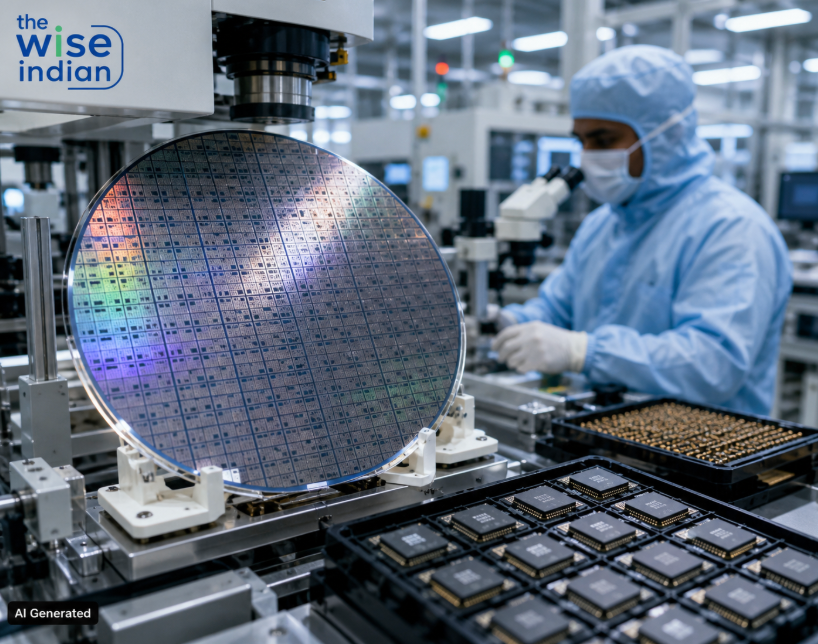
Three semiconductor plants are already operating in Gujarat, but all three handle assembly and testing. India’s first major commercial wafer fab is now expected to begin production in mid-2028, starting with mature technology before moving towards 28nm.
India’s semiconductor industry is finally moving from announcements to actual production. In February 2026, Micron’s Sanand plant began shipping memory products. In March, Kaynes Semicon went commercial. In July, CG Semi, a joint venture between CG Power, Renesas Electronics and Stars Microelectronics, began production. All three facilities are in Gujarat.
But there is an important distinction: these are back-end semiconductor facilities. They assemble, test and package chips. They do not fabricate the silicon wafers on which semiconductor circuits are created.
What These Three Semiconductor Plants Actually Do
A semiconductor goes through two broad stages. First, circuits are fabricated on a silicon wafer. The wafer is then cut into individual chips, which are assembled, packaged and tested. This second stage is known as assembly, testing, marking and packaging, or ATMP. Micron’s Sanand facility handles packaging and testing of DRAM and NAND memory products. Kaynes Semicon and CG Semi are also involved in the back-end of semiconductor manufacturing.
That is real progress. Packaging and testing create manufacturing capacity, jobs and technical expertise. But none of these facilities is a conventional wafer fabrication plant.
India’s Semiconductor Fab: The Date That Moved
Tata Electronics is building India’s first major commercial wafer fabrication facility at Dholera in Gujarat. When the project was launched in March 2024, commercial production was expected by December 2026. That timeline has now moved to mid-2028. The technology plan has also attracted attention. Recent reports say the Dholera fab is expected to begin with 90nm technology before moving towards more advanced nodes, including 28nm. Tata Electronics has said its roadmap has always included a phased rollout using mature technologies before moving towards more advanced nodes. Its partnership with Taiwan’s Powerchip Semiconductor Manufacturing Corporation, or PSMC, provides access to several technology nodes, including 28nm, 40nm, 55nm, 90nm and 110nm.
Why 90nm and 28nm Matter
Smaller semiconductor nodes generally allow manufacturers to build smaller, denser and more power-efficient transistors. That makes advanced nodes important for smartphones, laptops and high-performance computing. But 90nm chips are not obsolete. Mature-node semiconductors remain important for automobiles, industrial equipment, appliances and power-management systems. So the issue is not simply that 90nm is “old”. It is about what India can manufacture and which markets it can serve. For now, 90nm is the immediate node to watch. 28nm is the longer-term benchmark.
The Money Has Gone Up, Not Down
The India Semiconductor Mission was approved in December 2021 with an initial outlay of Rs 76,000 crore. By December 2025, the government said 10 semiconductor projects had been approved across six states, representing around Rs 1.60 lakh crore in committed investment. By August 2026, the number had risen to 12 projects worth approximately Rs 1.64 lakh crore. On July 15, 2026, the Cabinet also approved Semicon 2.0, with an outlay of Rs 1,27,500 crore.The scale of investment is significant. But approved projects are not the same as completed manufacturing capacity.
The Wise Take
India has made genuine progress in semiconductor assembly, testing and packaging. Three facilities are now operating in Gujarat, strengthening an important part of the global chip supply chain. But packaging chips is not the same as fabricating them. India already has fabrication capability at the government-run Semiconductor Laboratory in Mohali. What makes the Dholera project significant is its ambition to create major commercial wafer-fabrication capacity.
The date to watch is mid-2028. The immediate technology node is 90nm. The longer-term benchmark is 28nm. If Dholera reaches commercial production on schedule, India’s semiconductor story will move from packaging chips to making them at commercial scale.
You can also read : More Than Rs 73,000 Crore Is Unclaimed in India. Some of It May Be Your Family’s