
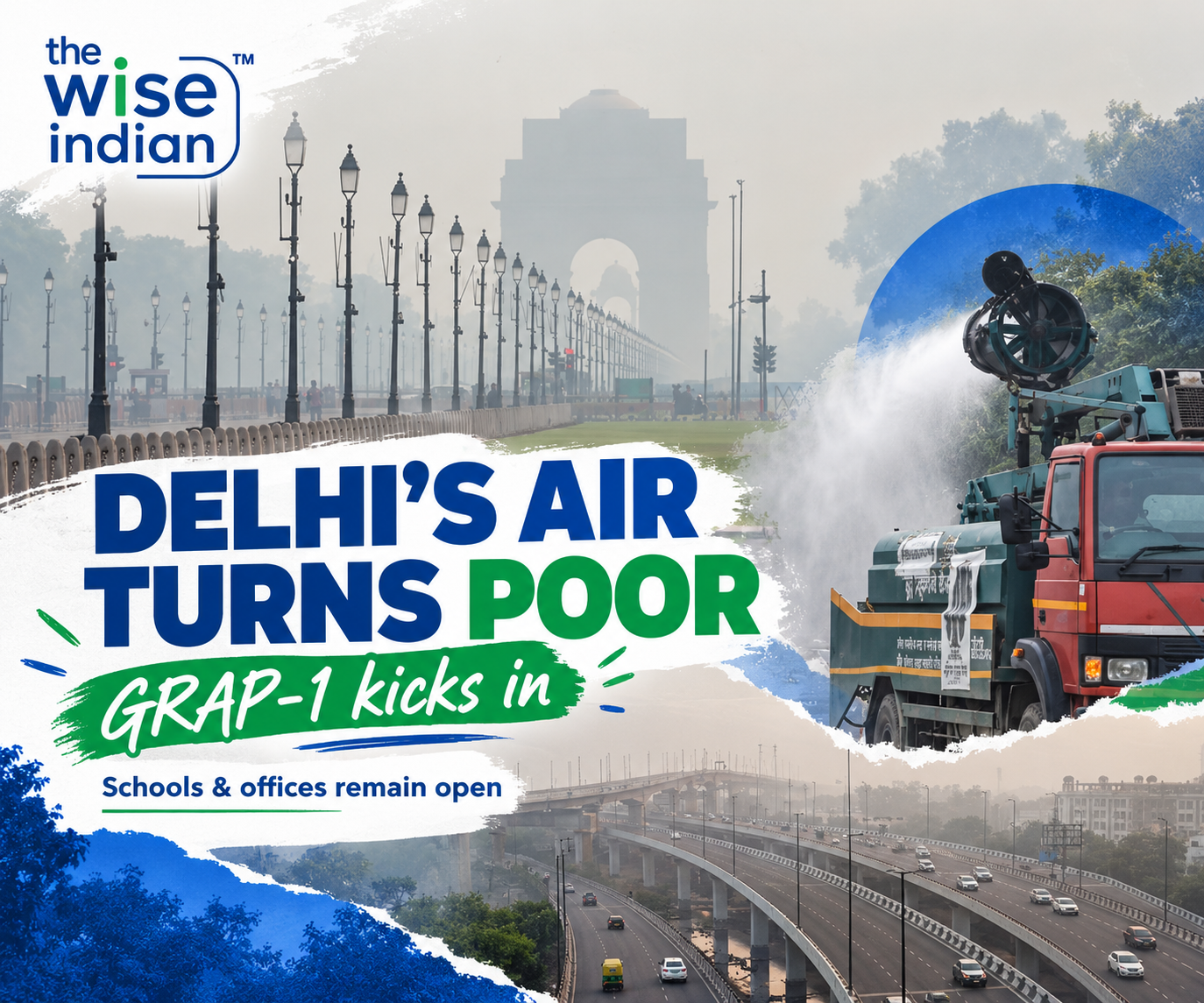
Delhi’s air quality deteriorated to the ‘poor’ category on October 21. As a result, the Commission for Air Quality Management (CAQM) implemented GRAP-1 across the National Capital Region (NCR). This is Stage I of the Graded Response Action Plan (GRAP). The move brings a series of pollution-control measures into force. The order directs authorities to strengthen dust suppression, monitor polluting vehicles and enforce restrictions on waste burning. However, schools and offices will continue to function normally under the current stage.
Delhi’s Air Quality Deteriorates as AQI Reaches 244
Delhi’s Air Quality Index (AQI) recorded a sharp deterioration within a day. According to the CAQM order, which The Indian Express cited, the city’s AQI stood at 179 on October 20. That placed it in the ‘moderate’ category. However, by 2 pm on October 21, it had climbed to 244. Therefore, it entered the ‘poor’ category. The India Meteorological Department (IMD) and the Indian Institute of Tropical Meteorology (IITM) issued a forecast. They said air quality was likely to remain in the poor category over the coming days. The CAQM’s GRAP Sub-Committee then reviewed pollution levels, weather conditions and forecasts. Consequently, it invoked Stage I across the NCR with immediate effect.
Under India’s national AQI classification, readings between 201 and 300 fall in the poor category. The Central Pollution Control Board (CPCB) notes that prolonged exposure to air in this range may cause breathing discomfort. These effects matter to people with respiratory conditions and to residents who spend long hours outdoors. The latest order marks the beginning of the seasonal escalation of pollution-control measures in Delhi-NCR. However, it does not, by itself, mean that the region has entered the more restrictive stages of GRAP.
What GRAP-1 Means and Why It Has Been Invoked
The Graded Response Action Plan is a framework for responding to worsening air pollution in Delhi-NCR through progressively stronger measures. It organises its restrictions into stages that match air-quality conditions. This allows authorities to intensify action as pollution increases. GRAP-1 is the first of these stages. Under the revised schedule, Stage I applies when Delhi’s AQI is between 201 and 300, which counts as poor. In contrast, Stage II corresponds to very poor air quality, with an AQI of 301–400. Stage III applies to severe air quality at 401–450. Finally, Stage IV covers severe-plus conditions above 450.
The activation of Stage I therefore signals immediate preventive action, not a general shutdown of public activity. The measures focus on sources that authorities can address through enforcement and operational changes. These include road dust, construction dust, waste burning and vehicle emissions. The objective is to reduce avoidable pollution and prevent further deterioration. However, the effectiveness of the response will depend on implementation across Delhi and neighbouring NCR areas. Transport, construction and other activities in these areas contribute to the wider pollution challenge.
Construction, Vehicles and Waste Burning Face Tighter Checks
A central component of GRAP-1 is stronger dust management. Authorities must intensify mechanised road sweeping and water sprinkling. They must also control dust from road construction and repair, using anti-smog guns and water sprinklers. Construction activity also faces specific rules. Projects on plots of 500 square metres or more cannot operate if they are unregistered on the relevant government portal. They also cannot operate if they fail the remote dust-monitoring requirements. However, this is a targeted restriction, not a blanket ban on every construction site.
Authorities must also enforce the ban on open burning of biomass and municipal solid waste. The rules also prohibit illegal dumping of waste on open land. In addition, agencies must ensure regular collection and removal of waste from designated locations. Vehicle-related enforcement is another priority. Transport departments and traffic police must enforce pollution-under-control (PUC) rules. They must also act against visibly polluting vehicles. Moreover, they must implement court orders on overage petrol and diesel vehicles.
The measures also restrict specified inter-city and interstate buses from entering Delhi. Likewise, authorities must divert non-destined trucks away from Delhi through the Eastern and Western Peripheral Expressways. Finally, agencies must ease traffic at congested intersections. They must also boost CNG and electric buses, Metro and Regional Rapid Transit System services.
Schools and Offices Remain Open as Residents Are Urged to Stay Alert
Despite the deterioration in air quality, the current GRAP-1 order does not require schools or offices to close. Normal operations can continue while authorities implement the prescribed pollution-control measures. This distinction matters because restrictions become more extensive at higher stages. For example, Stage II includes staggered timings for public offices and municipal bodies. It also brings tighter regulation of diesel generator sets and other interventions. Stage III brings hybrid schooling for children up to specified classes, subject to the applicable directions. Importantly, these are not automatic consequences of the present Stage I activation.
However, open schools and offices do not mean that poor air quality poses no health concerns. The CPCB’s guidance identifies breathing discomfort during prolonged exposure as a possible impact of the poor AQI category. People with asthma or other respiratory conditions should watch local air-quality updates and follow appropriate medical advice. Children and older adults should do the same.
Residents can also help reduce avoidable emissions in simple ways. They can use public transport where practical and avoid unnecessary vehicle idling. They should also keep vehicles properly maintained and comply with PUC requirements. Likewise, residents should avoid open burning of waste. Dust-generating activities should follow the applicable rules.
The Wise Take
The imposition of GRAP-1 is an early intervention that aims to address deteriorating air quality before conditions worsen further. With Delhi’s AQI reaching 244 on October 21, the immediate priority is clear. Authorities must implement the prescribed controls consistently across the capital and the wider NCR. The current stage does not call for general school or office closures. However, it does require action from public agencies, businesses, transport operators and residents. Mechanised road cleaning, construction-dust management, waste collection and enforcement against polluting vehicles can address specific sources of pollution. Their impact, however, depends on sustained compliance rather than the announcement of restrictions alone.
Air pollution is a regional problem, and multiple sources and changing weather conditions influence it. GRAP provides a framework for responding to worsening air quality. However, lasting improvement also requires continued efforts to control emissions from transport, construction, industry and waste management. For now, residents should monitor official AQI updates while authorities carry out the Stage I measures. Whether Delhi-NCR can avoid further deterioration will depend on the coming days’ conditions. It will also depend on how effective pollution-control efforts prove on the ground.
Also read our other article on Bengaluru to Mumbai Vande Bharat Sleeper: What We Know About the Proposed November 1 Launch, Timings, Route, Coaches and Expected Fares
Follow The Wise Indian for regular updates on stories that shape India’s strategic future and global standing. Stay connected with us for sharp analysis, untold perspectives, and a closer look at the shifting legal landscapes, civic rights, and institutional frameworks defining our democratic fabric.