

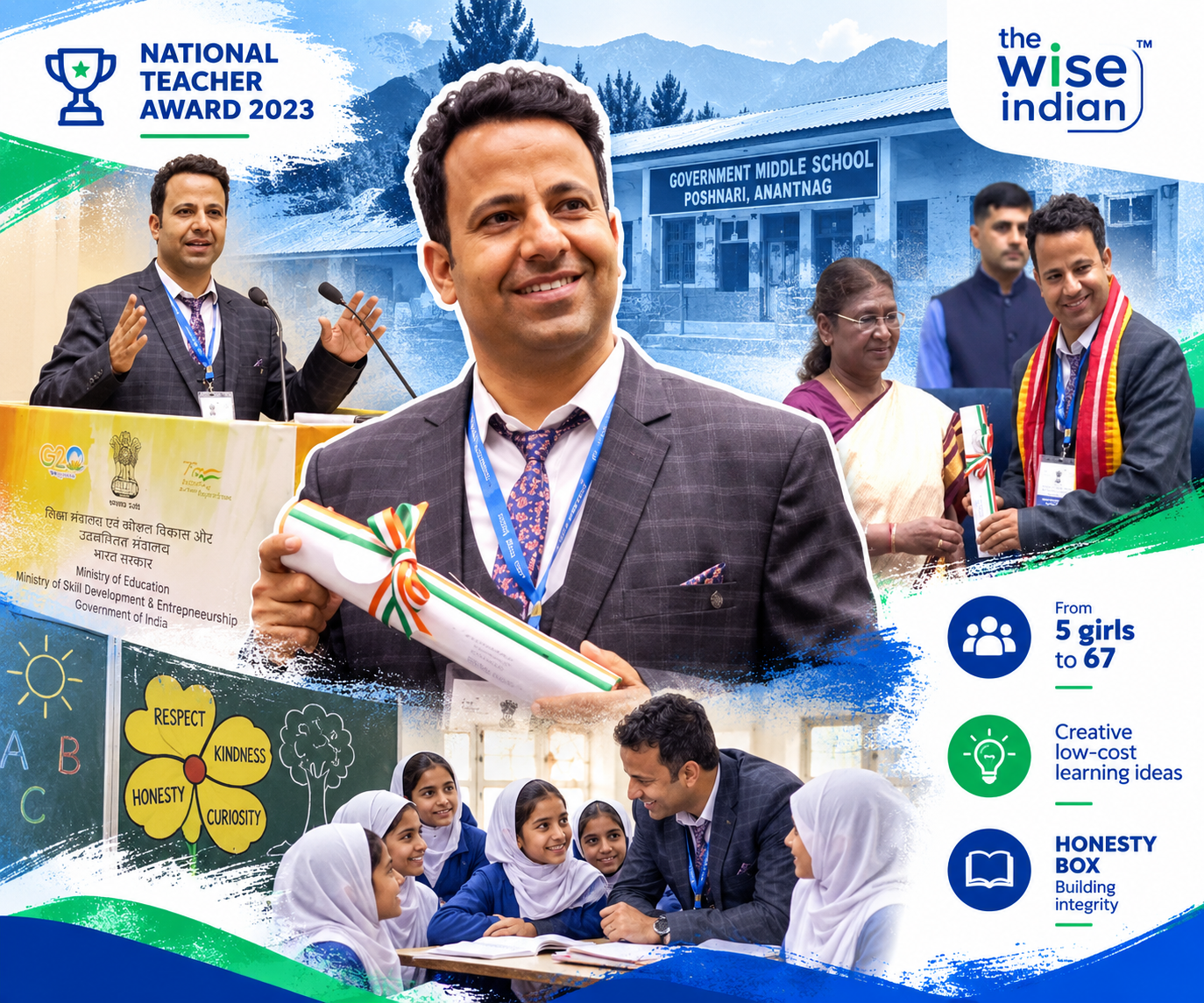
In 2009, a young teacher reached a hilltop school in South Kashmir. Only five girls attended classes there. Today, 67 girls study in the same school. Riyaz Ahmad Sheikh made that change happen, one home visit at a time.
How Riyaz Ahmad Sheikh Won Over Poshnari
Riyaz Ahmad Sheikh joined Government Middle School Poshnari in 2009. The school lies in a remote part of Anantnag district. It stands about 35 kilometres from Anantnag town. Moreover, Poshnari sits in the hilly Shangus region of South Kashmir. Most students come from socially and economically disadvantaged families. Sheikh, a postgraduate in English, lives in Chittergul. Today, the school carries the name PM Shri Government Middle School Poshnari.
At that time, poverty and illiteracy ran deep in the hamlet. Scheduled Tribe families dominate the area. Dropouts were common, and many parents showed little interest in schooling. Besides, parents often put domestic work ahead of their children’s education. As a result, only five girls attended classes.
His mission was clear: change how parents valued schooling. However, Sheikh refused to give up. Instead, he walked from home to home. He talked with parents and listened to their worries. He asked why children, especially girls, stayed away from school. Notably, his tools were dialogue, patience, and home visits. Over time, these small steps built trust between the school and the village. Eventually, families began to see the value of education. Thus, mindsets shifted one family at a time. Now, the school enrols 67 girls.
Sheikh also knew that one teacher cannot do everything. Therefore, he reached out to several government offices. These included the Chief Education Office, Rural Development, Tourism, and Public Health Engineering. He also approached the Deputy Commissioner’s office. Former Deputy Commissioner K.K. Sidha sanctioned a hi-tech projector and a public address system. Later, Deputy Commissioner Dr. Syed Fakhrudin Hamid added smart TVs and pavement tiles. Together, these partnerships show how a school becomes a shared project. Consequently, the school gained stronger resources.
Walls and Floors That Teach
Learning starts the moment a child steps into the school. Every wall and floor carries a lesson. Besides, learning does not stop at the classroom door. Numbers, alphabets, science diagrams, and cultural motifs cover these surfaces. This concept goes by the name Building as a Learning Aid. Hence, children learn while they walk, play, and explore. In effect, the building itself becomes a silent teacher.
Moreover, these ideas do not need big budgets. They rely on imagination and a sound grasp of how children think. Technology supports the approach as well. Sheikh uses ICT-based teaching to make learning fun. Likewise, digital aids such as a projector and smart TVs now support teaching.
The Honesty Box and Other Corners
The school also teaches values through daily practice. The Honesty Box stands out. When a student finds something that belongs to someone else, the student drops it into the box. In this way, children practise integrity every day. Thus, character grows through action, not lectures.
Furthermore, the campus offers several learning corners. An open library lets every student read freely. Its goal is to make reading a delight rather than a duty. Meanwhile, a science corner lets learners explore ideas through practical work. It turns passive listeners into active investigators. In the mathematics corner, children handle three-dimensional models and charts. Similarly, the Heritage Corner celebrates local crafts and traditions. It roots students in their own identity. The Hygiene Corner holds soap, toothpaste, hair oil, and lotion. Therefore, children learn self-care alongside their lessons.
Overall, these spaces make learning tangible and enjoyable. Together, they give children skills, values, and self-respect.
A National Honour for a Village School
Riyaz Ahmad Sheikh’s work soon drew national attention. On Teachers’ Day, 5 September 2023, President Droupadi Murmu presented him the National Teachers’ Award. The ceremony took place at Vigyan Bhawan in New Delhi. The award carries a certificate of merit, a cash prize of Rs 50,000, and a silver medal. Moreover, the awardees interacted with Prime Minister Narendra Modi. He praised their dedication to shaping young minds.
In 2023, the Ministry of Education selected 75 teachers for the award. Of these, 50 came from school education. That year, the award also expanded to include higher education and skill development teachers. Sheikh was 38 years old at the time. When the selection news arrived, teachers and students celebrated. The Ministry describes its selection process as rigorous and transparent.
Notably, Sheikh was the only teacher from Jammu and Kashmir to receive the award that year. He has developed over 400 teaching-learning materials and several science projects. Moreover, he helps students learn through observation and immersive experiences. Besides, fifteen students from his school completed a three-year snow ski course at Gulmarg. As Sheikh told Rising Kashmir, the initiative included girls and empowered them beyond academics.
The Wise Take
Riyaz Ahmad Sheikh shows that change starts with listening. He walked into homes before he asked families for trust. Moreover, he proves that great schools need creativity more than costly tools. First, he listened. Second, he built partnerships. Third, he made the building itself teach. Finally, he taught honesty through practice.
Nevertheless, challenges remain. Reports from late 2025 say the school still needs more classrooms, staff, and modern learning tools. Therefore, support from officials and citizens will matter. Because the ideas are simple, other schools can try them too. Today’s 67 girls are proof that trust can beat doubt. In short, one patient teacher can open doors for an entire village. Above all, his story proves that one teacher’s belief can change many futures.
Also read our other article on India Just Finished Its First Year of Two Board Exams. What Parents Learned
Follow The Wise Indian for more stories about the teachers and changemakers quietly reshaping a better India. We, The Wise Indian, bring you the stories that deserve to be told.