

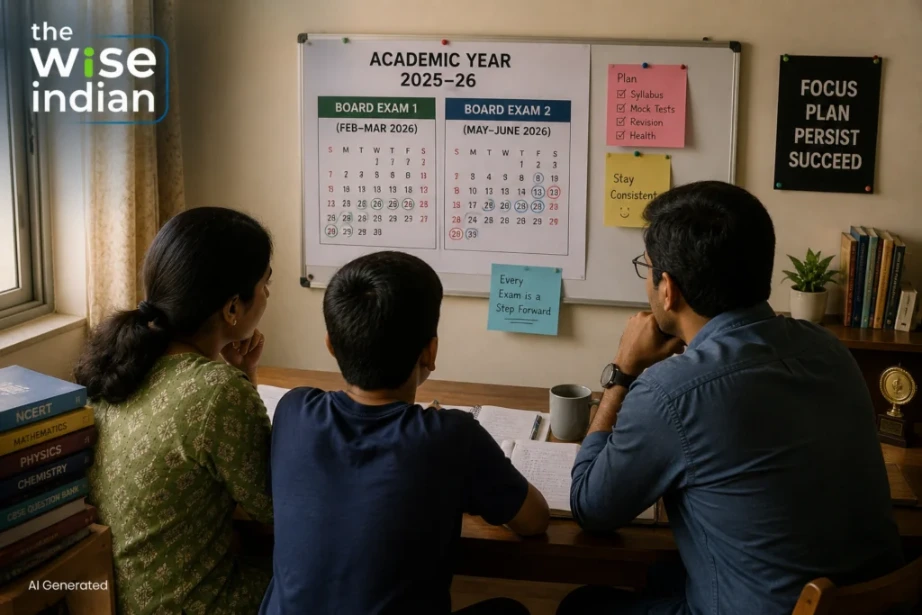
CBSE Class 10 ran twice in 2026 for the first time, with the better score counting. The early evidence suggests the change works best when families treat the second attempt as optional.
For decades, a single set of Class 10 examinations in February and March carried a weight out of all proportion to what it measured. One fever, one bad week, one difficult morning could shape a teenager’s academic record for years.
In 2026, that changed. Following the National Education Policy 2020, the Central Board of Secondary Education conducted Class 10 board examinations in two phases for the first time, and the first full cycle has now been completed.
How the Two-Phase System Worked
The first phase was held from 17 February to 11 March 2026 and was compulsory for all eligible students. Its results were declared on 15 April 2026.
The second phase, held from mid-May, was optional. It was open to students who wanted to improve their performance in up to three subjects among science, mathematics, social science and languages, as well as to those in the compartment category. Students who did not appear in three or more subjects in the first phase were not permitted to take the second, and were instead required to reappear in the following main examination cycle.
The Rule That Changes the Stakes
The critical design choice is that the better of the two attempts is retained. A student’s score cannot fall as a result of sitting the second examination, and CBSE issues a revised marksheet reflecting the higher mark in each subject.
This is materially different from the old compartment system, where a second attempt largely functioned as a rescue mechanism rather than an improvement opportunity.
What the First-Cycle Numbers Showed
The overall pass percentage in the first phase was 93.70 per cent, marginally above the previous year. Girls recorded a pass rate of 94.99 per cent against 92.69 per cent for boys.
More than six lakh students appeared in the second phase, either to improve their scores or to clear compartments, a substantial number but well short of the full cohort.
What This Means at Home
The reform reduces the cost of a single bad day, which is genuinely valuable. It also introduces a risk that families should name honestly, which is turning an optional attempt into a compulsory one at home.
A child who has scored well and is content has no obligation to sit again. Two examination cycles in one academic year is a real demand on a fifteen-year-old, and the policy’s benefit is the availability of the second chance, not the obligation to use it. Schools and teachers have also had to absorb a heavier assessment load across a single academic year, which is a practical consideration that tends to get lost in discussion of student flexibility.
The Wise Take
Every examination reform in India eventually meets the same test, which is not administrative but domestic. A flexible system stops being flexible the moment a family treats every available attempt as a duty. The design here is thoughtful, because a score that cannot go down removes the gamble entirely. But the decision about whether to sit again belongs with the student who has to prepare for it, and it should turn on whether a specific subject genuinely fell short, not on the possibility of a slightly better aggregate. Used that way, this is a rare reform that lowers pressure. Used the other way, it simply doubles it.