

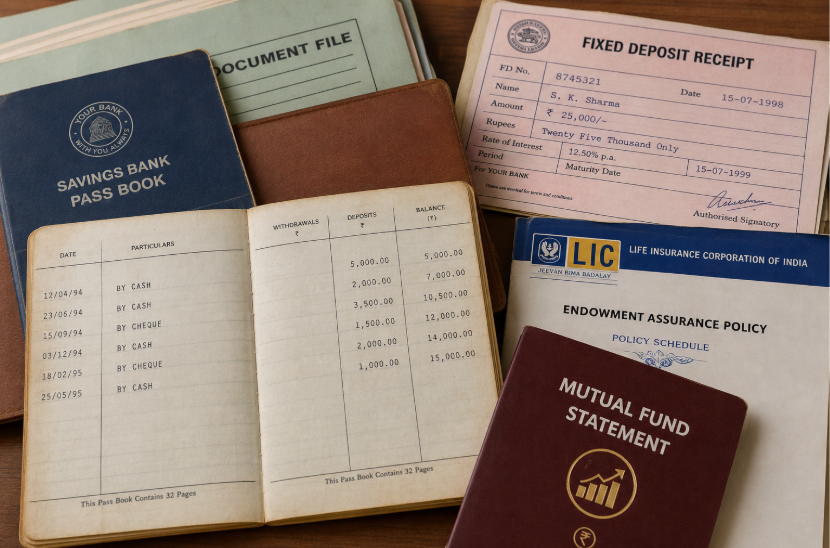
More than Rs 73,000 crore is sitting in unclaimed bank deposits, insurance proceeds and mutual funds in India. Three government-backed portals can help you search for forgotten money — and a recent nationwide campaign returned Rs 5,777 crore to rightful claimants.
A savings account opened decades ago and forgotten. A fixed deposit that matured while a family moved cities. An insurance policy nobody at home remembers. A mutual fund investment whose paperwork disappeared over the years.
For many Indian families, these are not unusual stories.
The money does not simply vanish. It can become unclaimed, waiting for the account holder, nominee or legal heir to trace it.
And some of it could belong to your family.
How Much Unclaimed Money Is in India?
The latest government figures show just how large the problem has become.
As of 31 January 2026, public sector banks had transferred Rs 60,518 crore in unclaimed deposits to the Reserve Bank of India’s Depositor Education and Awareness (DEA) Fund.
At the end of February 2026, insurers had Rs 8,973.89 crore in unclaimed insurance amounts. Mutual funds had another Rs 3,749.34 crore in unclaimed amounts under SEBI regulations.
Together, these three categories add up to approximately Rs 73,241 crore.
It is important to note that these figures cover different categories and reporting dates. The Rs 60,518 crore figure is specifically the amount transferred by public sector banks to the RBI’s DEA Fund.
When Does a Bank Deposit Become Unclaimed?
A bank deposit can eventually be transferred to the DEA Fund when the account has not been operated for 10 years or more.
This can happen with old savings accounts, fixed deposits and other eligible deposits when customers or their families stop tracking them.
The government says banks are required to transfer such balances to the DEA Fund after the prescribed period. The money remains associated with the depositor’s claim rather than simply disappearing.
That is why old family records matter.
A passbook from a previous city, an old fixed-deposit receipt or even the name of a bank remembered by a parent could be enough to prompt a search.
Where Can You Search for Unclaimed Money?
You do not necessarily need to hire an agent to find forgotten financial assets.
There are government-backed platforms for different types of assets.
1. UDGAM for Unclaimed Bank Deposits
The Reserve Bank of India created UDGAM — Unclaimed Deposits-Gateway to Access inforMation.
The portal allows registered users to search for unclaimed deposits across multiple participating banks from one place.
By 1 March 2026, UDGAM had 18.86 lakh registered users.
However, finding an account on UDGAM is not the same as receiving the money. Once a possible deposit is identified, the claimant has to approach the concerned bank and complete its claim process.
2. Bima Bharosa for Insurance
For forgotten insurance policies and unclaimed insurance proceeds, the IRDAI’s Bima Bharosa portal can help people trace relevant information.
This can be particularly useful when a policyholder has undergone a relocation, misplaced documents or left behind financial records following their demise.
3. MITRA for Mutual Funds
For unclaimed mutual fund amounts, investors can use MITRA, a platform developed under SEBI’s regulatory framework.
The aim is to make it easier for investors and their families to identify forgotten mutual fund folios and begin the process of claiming the money.
Rs 5,777 Crore Has Already Been Returned
There is evidence that these efforts are helping families recover forgotten money.
Between October and December 2025, the Department of Financial Services conducted the nationwide “Your Money, Your Right” campaign in coordination with RBI, SEBI and IRDAI.
Special camps were organised in 748 districts.
By 28 February 2026, unclaimed financial assets worth Rs 5,777 crore, linked to 22.95 lakh claims, had been restituted to rightful owners.
That works out to an average of roughly Rs 25,173 per claim.
The average does not mean every family received that amount. Some claims would have been much smaller, while others could have involved significantly larger sums.
Still, it shows that forgotten financial assets can be recovered.
India Also Changed Its Bank Nomination Rules
There is another important reason for families to review their bank accounts.
From 1 November 2025, provisions of the Banking Laws (Amendment) Act, 2025 allowed depositors to nominate up to four people for eligible bank deposits.
For deposit accounts, customers can choose between simultaneous and successive nominations.
With simultaneous nomination, up to four nominees can be given specified percentages of the deposit. The percentages must add up to 100%.
With successive nomination, nominees are placed in an order. The next nominee becomes effective after the earlier nominee’s demise, subject to the law.
For bank lockers and articles kept in safe custody, only successive nominations are permitted.
The change gives families more flexibility when planning how financial assets should be transferred.
What Should You Do Now?
You do not need to spend an entire weekend searching through every old document.
Start with three simple steps.
First, search for yourself. Check UDGAM, Bima Bharosa and MITRA where applicable.
Second, check your parents’ records. Look for old savings accounts, fixed deposits, insurance policies and mutual fund investments.
Third, update your nominations. Review the nominee details on your current bank accounts and make sure they still reflect your wishes.
Also keep important financial documents in a place that your family can locate if something happens to you.
The Wise Take
Most unclaimed money was not deliberately hidden. It was often left behind after a demise, relocation, forgotten account, matured deposit, misplaced document or years of financial records being scattered across different cities and institutions. That is why checking for unclaimed money should become part of a family’s financial housekeeping. The practical step is simple: search the government portals for your own name and your parents’ names.
You may find nothing. But you may also find an old account, policy or investment that your family had completely forgotten. And considering that Rs 5,777 crore was returned through 22.95 lakh claims during the recent campaign, spending an evening checking could be worthwhile.