
Walk into a museum and look at the names beside the paintings.
You will find masters whose names have survived for centuries. You will find movements built around their work, books written about them and paintings that have become cultural landmarks.
But there is another story hiding in the same history.
It is the story of women forgotten by art history.
For centuries, women created paintings, sculptures, photographs, textiles and other forms of art. Yet many struggled to receive the same recognition as their male contemporaries. Some were excluded from institutions, some were dismissed as “decorative” artists, and in some cases their work was later attributed to husbands, fathers or male colleagues.
Now, museums and researchers are beginning to look again.
Why were so many women artists forgotten?
The answer is more complicated than simply saying that women were not given opportunities.
For much of history, women faced restrictions on education, professional training and access to the institutions that shaped artistic careers. Art academies, exhibitions, patrons and critics played an enormous role in deciding who would become part of the official record.
When women were denied access to those systems, their absence from art history became almost inevitable. That does not mean they were not producing important work. t means fewer people were in a position to preserve, promote and study it.
The problem was so deeply embedded that art historian Linda Nochlin famously questioned it in her landmark 1971 essay, Why Have There Been No Great Women Artists? Her argument shifted attention away from supposed differences in talent and towards the social and institutional barriers that shaped artistic recognition.
The Renaissance had women masters too
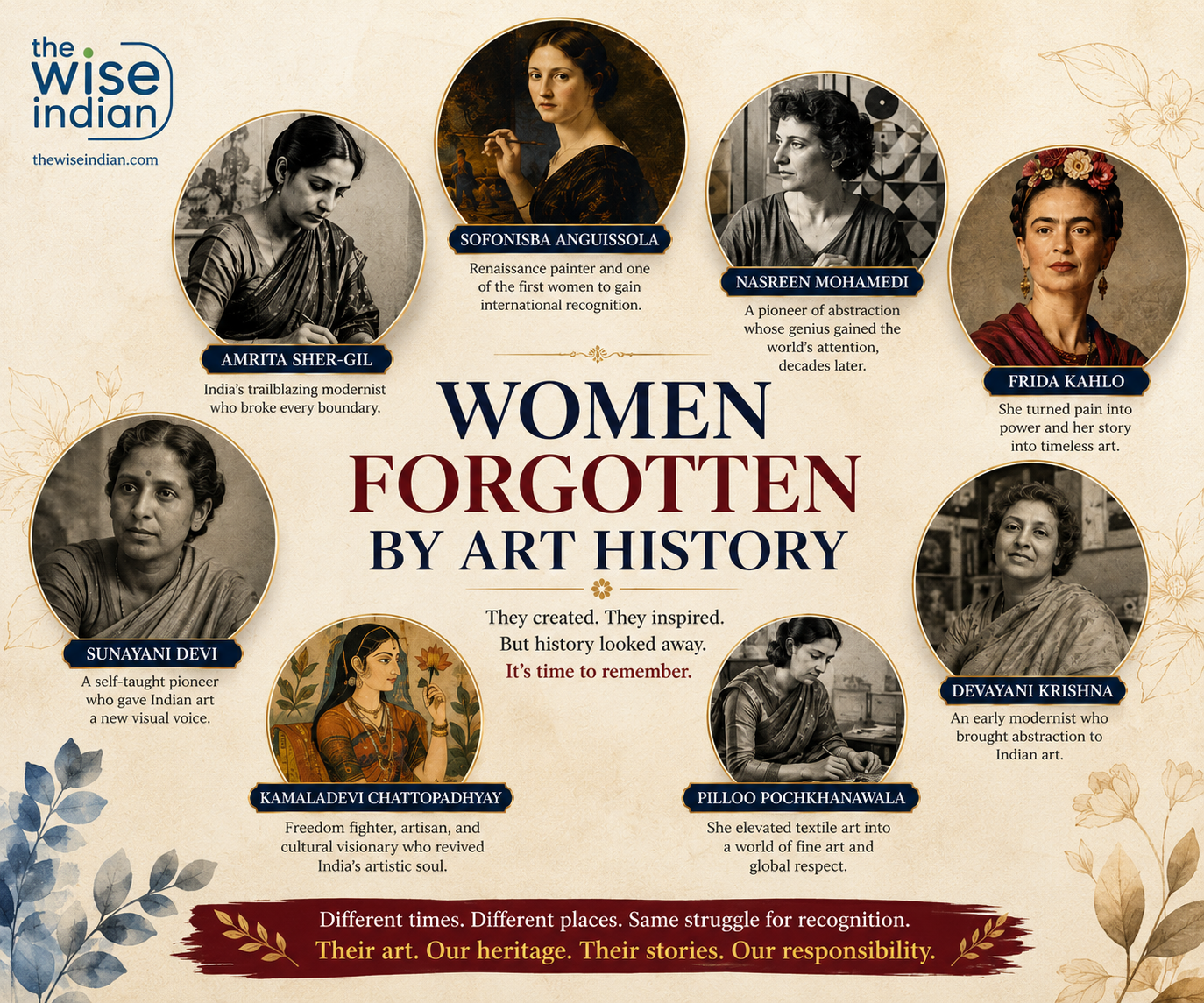
One of the clearest examples is Sofonisba Anguissola, a Renaissance painter who gained recognition during her lifetime and was praised by Michelangelo.
Another is Artemisia Gentileschi, one of the most important women painters of the Baroque period. She received major commissions and became the first woman admitted to Florence’s Accademia delle Arti del Disegno. Yet her place in mainstream art history remained far less prominent than that of many male artists of her era.
Their stories challenge a familiar assumption.
Women did not suddenly become capable artists in the modern era. They were there all along.
India has its own forgotten stories
India’s art history also contains women whose contributions deserve greater attention.
Sunayani Devi, often described as one of India’s earliest modern women artists, began painting around the age of 30 while managing domestic responsibilities. She was largely self-taught and developed a distinctive visual language influenced by Indian traditions.
Her story is significant because it reveals how talent can exist outside formal institutions.
Other Indian women artists, including Devayani Krishna, pushed into abstraction and modernism at a time when the Indian art world was largely shaped by male artists. Her contribution to Indian modernist abstraction has received renewed attention in recent years.
These artists are not footnotes. They are part of the story.
When “decorative” becomes a way of dismissing art
Perhaps one of the most revealing problems is the distinction between “fine art” and forms of creativity traditionally associated with women.
Textiles, embroidery, weaving and craft have often been connected to domestic work. But the boundary between craft and fine art is not as simple as it appears.
Women have used these forms to preserve cultural memory, communicate identity and respond to social change. Modern artists have also transformed textiles and other traditionally marginalised mediums into major forms of contemporary artistic expression.
The question, therefore, is not simply whether something was beautiful. It is who was allowed to define what counted as serious art.
The forgotten are being found again
The good news is that the story is changing. Museums, galleries, researchers and cultural organisations are increasingly revisiting women artists whose work was overlooked or misattributed.
That process is already changing the way audiences understand art history. Recent international exhibitions and research have brought renewed attention to women from the Renaissance through modernism, while organisations dedicated to women artists are documenting artists who were previously absent from mainstream narratives. But rediscovery is only the first step.
The goal should not be to create a separate corner called “women artists.”
It should be to place their work where it belongs: inside the main story of art history.
What happens when history leaves people out?
This question goes beyond museums. Who gets remembered is often determined by who gets recorded, published, taught and celebrated. The same pattern can appear in science, literature, politics, business and sport. When someone’s contribution disappears from the record, future generations may assume that person never existed—or never mattered.
That is why recovering forgotten women artists is not merely about correcting an old injustice. It is about correcting our understanding of history itself. Because history becomes incomplete when half of its creators are treated as an afterthought.
The Wise Take
The most important lesson from the women forgotten by art history is not that women were missing. They were there. We simply did not always look closely enough. For generations, their work sat in homes, studios, archives, galleries and collections. Some names faded. Some works were misattributed. Others were dismissed because they did not fit the definition of what “great art” was supposed to look like. Today, we have the opportunity to look again. And perhaps that is what a wiser understanding of history requires.
Not rewriting the past. Re-seeing it. Because sometimes the people history forgot are not the people who contributed the least. They are the people we failed to remember.