
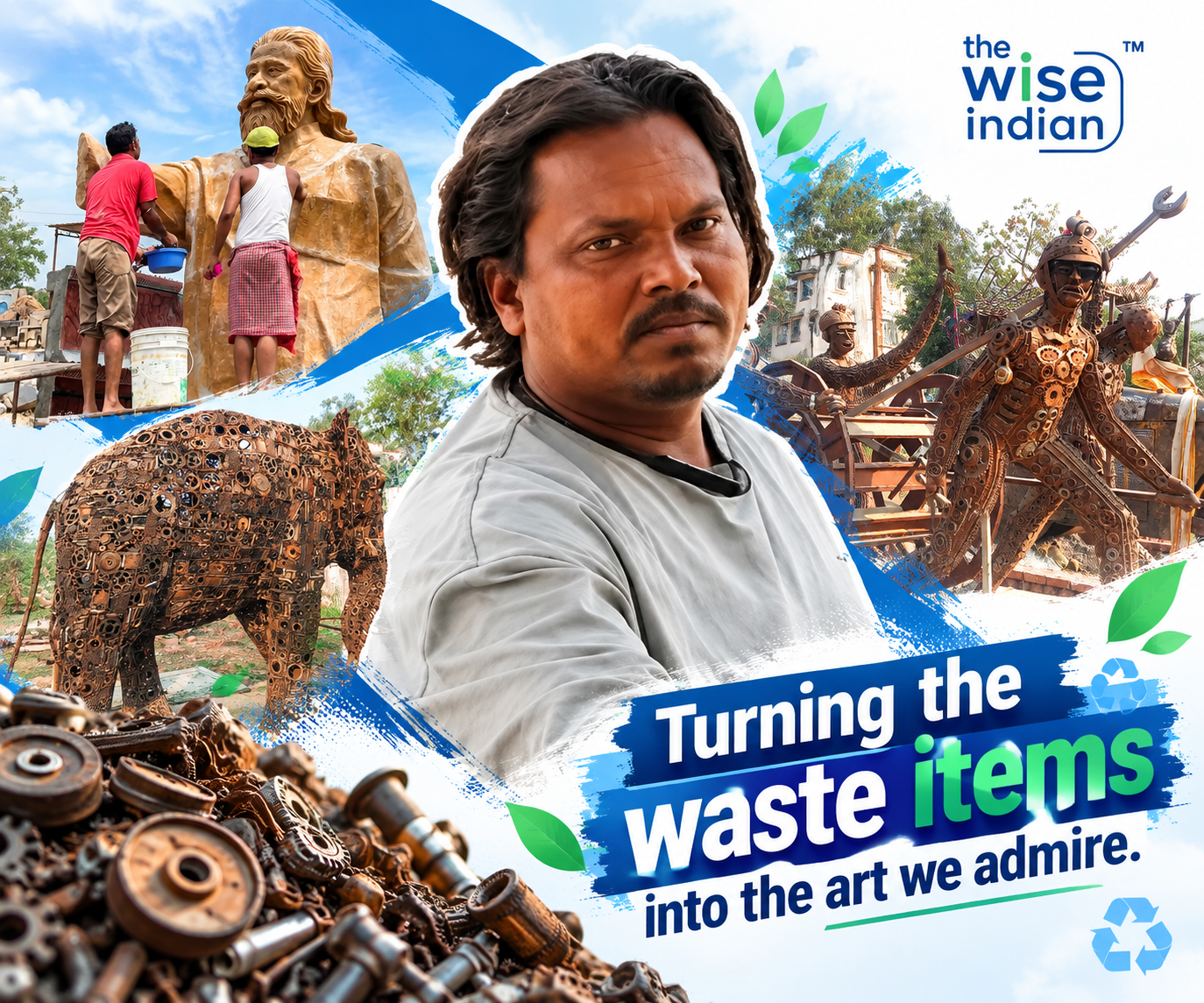
Most people see a broken fan or a rusted tin and think of the dustbin. Amrit Prakash Sah sees a sculpture waiting to happen. This Sahibganj artist from Jharkhand turns discarded metal into public art. Now his work is shaping an entire park built from scrap.
How Amrit Prakash Sah Sees Scrap
Amrit Prakash Sah lives and works in Sahibganj, Jharkhand. According to The Better India, his journey began with simple curiosity. He wondered why people throw objects away once they stop being useful. Instead of seeing endings, he saw possibilities in worn tins, plastic, wood and factory leftovers. As a result, scrap became his everyday working material.
However, scrap is hard to work with. Pieces can be awkward and fragile. Moreover, unrelated parts rarely fit together on their own. Therefore, each sculpture needs careful planning, shaping and patience. Also, a public artwork must look striking and stay structurally sound. Local reports also call him a well-known terracotta artist. In other words, his craft is not limited to metal. That range lets him move between clay, iron and mixed waste.
A Guru-Shishya Sculpture for Patna
In 2025, Prabhat Khabar reported on a large eight-foot sculpture he made for Patna. He designed it for the front corridor of the new CBSE Regional Office building at Digha. It took two months of hard work. The piece carries a thoughtful message. The guru appears as a tree, while the shishya appears as its shade. Therefore, the sculpture shows how a teacher offers knowledge, shelter and guidance. Furthermore, the report says education officials noticed his talent and asked him to create it. Importantly, this commission shows that his art can speak about social values as well. It is not only about waste. It is also about learning and respect.
Inside Sahibganj’s Waste to Wonder Park
His largest canvas so far is the Waste to Wonder Park in Sahibganj. ETV Bharat reported in February 2026 that the district administration started it. The park follows the three Rs: reduce, reuse and recycle. Moreover, the report called it the first park of its kind in Jharkhand. The administration chose Amrit to lead the artwork. According to The Better India, which cited Hindustan, the project would cover about 22,000 square feet. Planners expected more than 1,000 tonnes of waste to go into it.
The list includes vehicle parts, fans, iron sheets, nuts and bolts, and old bicycles. In addition, it names old motorcycles, stoves, gas cylinders, broken tiles and plastic bottles. The municipal council was expected to supply about 200 tonnes. Meanwhile, some material would come from the Ganga. Importantly, the scale matters. More than 1,000 tonnes is a huge amount of waste. Giving that material a second life means it need not end in a dump. Furthermore, people will see its potential with their own eyes.
ETV Bharat described the progress in detail. Giant dinosaurs, peacocks, elephants and eagles were taking shape from scrap. Furthermore, tribal costumes, palm trees, Sarhul festival scenes and a grand gateway were also taking shape. The boundary walls would show Jharkhand’s rich culture. The whole project costs about 3.25 crore rupees, according to the report. By then, work had run for more than six months. The report expected completion within two to three months. Meanwhile, Amrit said visitors and students would leave with a fresh message about protecting nature.
Why the Park Matters for Recycling
The park aims to teach as well as impress. ETV Bharat says a special gallery will share Sahibganj’s culture, food, language and history. It will also cover the Rajmahal hills, fossils, the dinosaur era and volcanoes. Visitors will learn through writing, pictures and sound. In addition, children can see and touch the artworks. Deputy Commissioner Hemant Sati also shared his hopes. He said children would learn from real experience instead of mobile screens.
Furthermore, he expects the park to encourage jute bags instead of polythene. He also hopes it will inspire people to reuse household waste. Because of this, the park works like a classroom as much as a tourist spot. The idea is spreading across India. The Better India notes the Ministry of Housing and Urban Affairs includes such parks in Swachh Survekshan. It also counts waste-to-art sculptures. Therefore, projects like this one fit a wider national push for cleaner cities.
One moment captures his mission. The Better India says a child once looked at his installation and asked how waste could look so beautiful. For Amrit Prakash Sah, that question showed his work was changing how people see discarded things.
The Wise Take
Amrit Prakash Sah shows that creativity can answer a civic problem. His sculptures turn waste into something people stop to admire. As a result, they invite people to rethink what they throw away. Moreover, his story is a reminder that big change begins with small habits. A jute bag, a reused container or a repaired item can keep waste out of the bin. Likewise, a park built from scrap can start a conversation across a district.
However, readers should note one detail. Reports from early 2026 showed the park was still under construction. Therefore, check official updates before planning a visit. Until then, take his lesson home: look twice before you discard anything.
Also read our other article on Varsha Sivakumar Returned to Bhavani to Support 30 to 35 Weavers and Carry the GI-Tagged Jamakkalam Craft Forward
Follow The Wise Indian for exclusive stories celebrating everyday heroes who are quietly shaping the culture, sustainability, and future of a better India.