

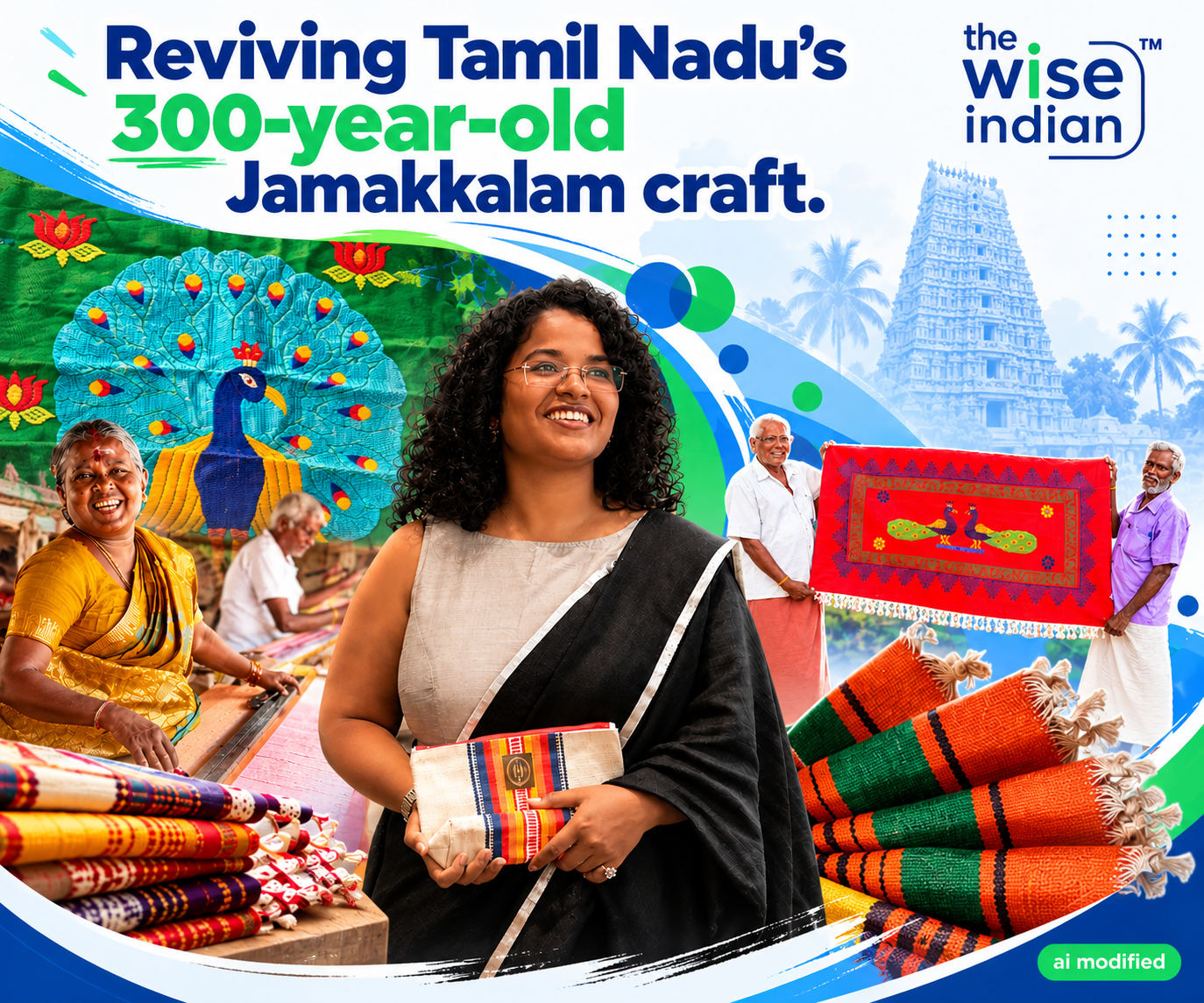
Varsha Sivakumar is a 26-year-old entrepreneur from Bhavani in Tamil Nadu. She returned to the looms she grew up around. Her venture, House of Jamakkalam, now works with 30 to 35 weavers. Here is how she is carrying an old craft forward.
Varsha Sivakumar and the Craft of Bhavani Jamakkalam
Varsha Sivakumar grew up among the pit looms of Bhavani. Bhavani and nearby Kumarapalayam sit along the Cauvery’s plains in Tamil Nadu. Weavers here have made Jamakkalam for almost three centuries. It is a thick, striped cotton weave. The Jangamar community first wove it. Local weavers needed something of their own to compete with British mill textiles. The craft earned a Geographical Indication tag in 2005-06. A GI tag protects a product linked to a particular place. Jamakkalam went on to find a place in nearly every Tamil household. Jamakkalam is woven on pit looms. The weaver sits in a pit dug into the ground. Hands move the shuttle while the legs work two pedals. It is slow, physical work.
Why a Nearly 300-Year-Old Craft Is Running Out of Buyers
By Varsha’s own account, weaving touched nearly every household in town in the early 2000s. Families worked their looms together. One generation taught the next. That hum has since thinned. Government cooperative orders, once the backbone of the trade, dropped sharply. Looms fell idle, and weavers looked elsewhere for income. Weavers say cooperative stockrooms are piling up with unsold pieces.
Industry estimates suggest the number of active weavers has fallen sharply. It dropped from roughly 20,000 two decades ago to around 3,000 today. Many families now steer their children towards better-paying work or better education. She met 200 to 300 weavers who depended almost entirely on cooperative orders. They earned between Rs 2,000 and Rs 15,000 a month. Some went without work for months at a stretch.
How a Classroom Moment Brought Her Back to the Looms
In 2017, she was studying at the National Institute of Fashion Technology. During orientation, a guest lecturer presented a project on Jamakkalam weaving. The lecturer had no ties to Bhavani or Kumarapalayam. The moment unsettled her. She had grown up around this craft, yet had never looked at it closely. A stranger saw more in it than she had. That thought stayed with her long after the class.
Varsha Sivakumar began returning to Bhavani and Kumarapalayam as a student. She sat for hours with artisans and documented what they showed her. Almost none of the craft had ever been properly recorded. Her decision to stay was unusual. Weaving has been losing its youngest hands for years. She is one of the youngest of her generation still choosing this craft.
How House of Jamakkalam Supports Its Weavers
House of Jamakkalam, or HOJ, was built in 2026. The craft should be continued from within, not rescued from outside. Varsha Sivakumar resists the word “revival”. HOJ works with around 30 to 35 weavers, depending on the scale of orders. It pays weavers upfront in cash. On complex orders, it adds a premium of 30 to 35 per cent. If a piece comes out flawed, HOJ still buys it at full price. The biggest shift is financial. Standard yarn in the cluster costs roughly Rs 60 to 70 a kilogram.
HOJ sources and dyes finer yarn that costs Rs 206 to Rs 550 a kilogram. It absorbs that extra cost itself instead of passing it on to weavers. The finer yarn allows sharper detail and truer colour. Weavers elsewhere in the cluster typically earn Rs 200 to Rs 350 a day when work is available. HOJ’s premiums are designed to sit above that floor. Design starts from the cluster’s own archive, not a blank page. The team tweaks colours and proportions only slightly. The Smiling Pouch borrows from the Pallu Mutham stripe arrangement. Its name translates to pearl-like teeth. The stripes already looked like a woven grin.
HOJ also takes fully customised orders. These cost from around Rs 10,000 to over Rs 30,000. Even the smallest custom piece takes two weavers four full days. Mariyamma returned to Bhavani after her husband passed away. She now earns between Rs 2,000 and Rs 6,000 a month. She says the work gives her comfort and independence. Agilandam, who is 56, says her income helps pay for her husband’s medicines. Mariyamma also says orders have been reducing and more support is needed.
The Wise Take
Varsha Sivakumar’s story is not about saving a craft from outside. It is about continuing it, loom by loom, with the same hands. She returned home when many young people were leaving. She listened, documented, designed gently and paid fairly. The numbers remain humble. HOJ supports 30 to 35 weavers in a cluster that once had thousands. Real change starts small, and it can start at home. Every weaver paid fairly is a loom that keeps running.
When we buy handloom, we buy time, skill and a family’s income. A single Jamakkalam piece carries nearly three centuries of stripes. Choose handmade when you can, and ask who made it. Crafts survive when someone chooses to keep them alive.
Also read our other article on Hemant Sachdev Fell Into an Everest Crevasse, Then Built a Mountain Rescue Service for the Indian Army
Follow The Wise Indian for more stories about the everyday heroes quietly shaping a better India



