

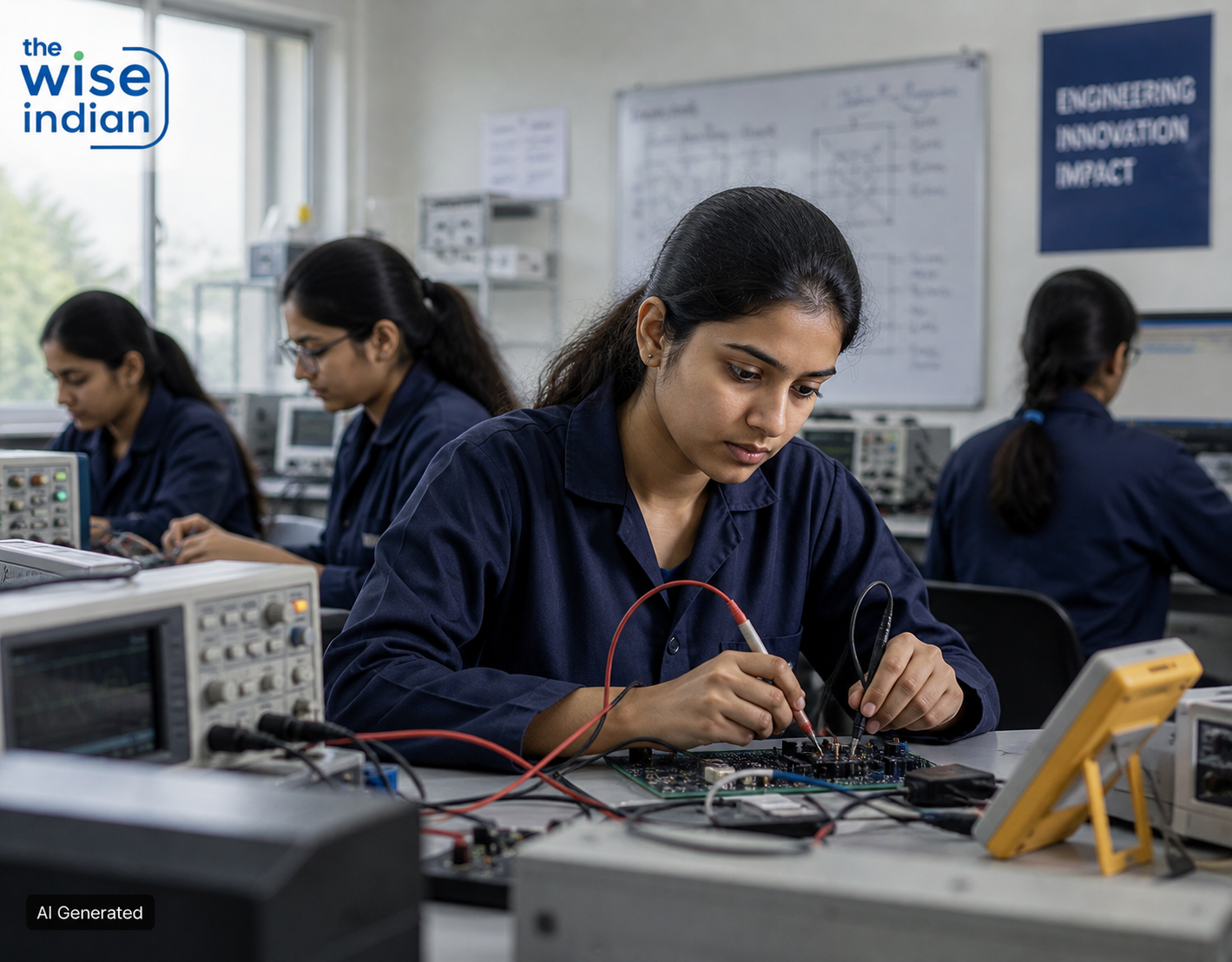
The new AISHE reports put the female share of STEM enrolment at 44 percent, though science carries that figure, not engineering.
India released two years of higher education data in July, covering 2022-23 and 2023-24. The headline finding was that women now make up close to half of all enrolment. A second figure, on women in STEM, travelled alongside it. Yet the two numbers do not mean the same thing. The share of women in engineering explains why.
What the New AISHE Reports Show
The Ministry of Education runs the All India Survey on Higher Education, the official record for the sector. Its 2023-24 edition drew data from 59,553 institutions.
Total enrolment reached about 4.46 crore, and women accounted for 49.7 percent of it. Female enrolment has risen by roughly 42 percent since 2014-15, from 1.57 crore to 2.24 crore. The female gross enrolment ratio now runs higher than the male figure.
The ministry also put the female share of STEM enrolment at 44 percent in 2023-24, up from 38.4 percent in 2014-15.
Why STEM Looks Better Than Women in Engineering
STEM covers science, technology, engineering and mathematics. Women are already a majority in the first of those. AISHE put women at 52.1 percent of science enrolment in 2021-22, higher still at postgraduate level.
Engineering runs the other way. AICTE data shows the female share of engineering enrolment falling from 33.7 percent in 2012 to 30.2 percent in 2020. The absolute number fell too, from 3.03 lakh to 2.01 lakh.
So a single STEM percentage averages two opposite trends into one reassuring number.
The Numbers That Have Not Moved, and the One That Did
An analysis of AISHE data from 2013-14 to 2021-22 found female undergraduate enrolment up 46 percent, and postgraduate enrolment up 55.5 percent. Over the same period, female undergraduate enrolment in engineering fell 1.35 percent, while postgraduate engineering enrolment fell 43 percent.
Where somebody targeted the problem, though, the number moved. Female undergraduate enrolment at the IITs rose from 8 percent in 2016 to 20 percent in 2021, after they created supernumerary seats for women.
What the Survey Does Not Cover
AISHE counts enrolment. It does not follow students after they graduate. So it cannot show whether women in engineering enter that work, or stay in it.
The Wise Take
A 44 percent share sounds like a field that has almost balanced. Read alongside the discipline data, it describes something narrower. Women have entered higher education in very large numbers, and in science they are the majority. Engineering, though, has sat near a third for more than a decade. The IIT figures suggest the number responds when somebody sets out to change it. Reporting STEM as a single block hides which part of it is working. So the more useful question for the next survey is not how many women are in STEM, but how many are in each part of it.