

A new report prices the gap at Rs 1.2 to 2 lakh crore a year. That figure is modelled. The land numbers underneath it are not, and they are worse.
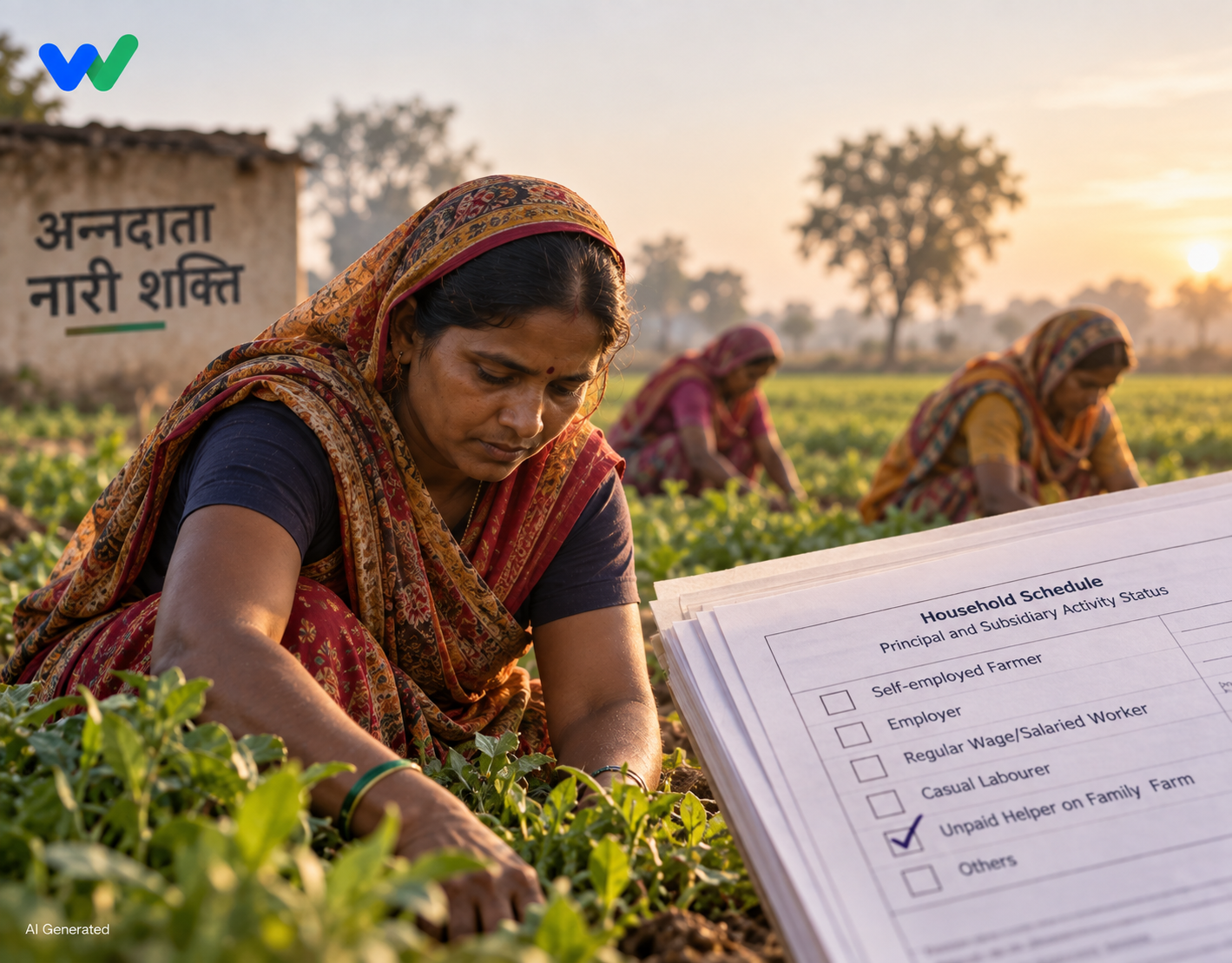
There is a box on a form, and what gets ticked in it decides whether a woman can borrow money. In Indian agricultural records, 50.5 percent of women working the land are filed as unpaid helpers on a family farm. For men the figure is 21.7 percent. Women farmers India feeds itself with are, by a coin flip, not classified as farmers at all. A report published in August 2026 by the agritech firm Arya.ag puts a price on that, between Rs 1.2 lakh crore and Rs 2 lakh crore of lost output a year. Handle that number with care. The ones underneath it need none.
About That Rs 2 Lakh Crore
Most coverage rounded the range to a flat Rs 2 lakh crore, which is the higher end and the tidier headline.
The report, Her Harvest 2026, gives Rs 1.2 lakh crore to Rs 2 lakh crore. It gets there by taking an existing Food and Agriculture Organization estimate, that unequal access to resources cuts farm output by 2.5 to 4 percent, and applying it to Indian production.
So nobody counted missing grain. Somebody applied a global ratio to a national figure, and the range simply reflects the range in the ratio.
That is a legitimate order-of-magnitude argument and a poor precise one. Quote it as roughly, or do not quote it.
What Women Farmers India Actually Hold
Now the part that comes out of agricultural statistics rather than a model.
Women operate 11.72 percent of India’s farmed area. They hold 13.96 percent of operational holdings, an operational holding being a unit of land somebody farms, whether or not they own it.
Picture eight fields in a row. Women farmers India runs on hold the paperwork for one of them.
And notice the two figures do not match. More holdings than area means the parcels women do hold are smaller than average. They are not just fewer. They are slighter.
Why the Box on the Form Decides Everything
Being filed as a helper is not a clerical annoyance. It is a locked door, several of them.
Formal credit wants land title or recognised farmer status. So does agricultural extension. So does selling into government procurement. So do input subsidies and most schemes designed around the cultivator.
A woman who sows, weeds and harvests but appears in the record as a helper cannot borrow against the land she works, cannot sell in her own name, and is invisible to the programme built to reach her.
That is the mechanism behind another finding in the report: farms run by women can be up to 24 percent less productive than comparable farms run by men. The report attributes that to resources, not to skill, and decades of similar work in other countries point the same way. Give anybody worse seed, less credit and no extension advice and their yields will drop.
What the Work Pays
Wages finish the job that classification starts.
Women in Indian food and farming earn roughly 18 percent less than men overall. In farm labour the gap widens to between 20 and 30 percent, for the same work, on the same day, in the same field.
And an unpaid helper, by definition, earns nothing that anybody records. Her labour shows up in the household’s output and in nobody’s income.
The Wise Take
Land title is the root of this, and it is the hardest thing in rural India to shift. Inheritance custom, not law, decides who holds a patta in most of the country, and every attempt to record joint ownership has run into that wall.
But the classification problem is smaller than the title problem, and it can move much faster. In practice a farmer is whoever the land record and the scheme database say is a farmer. Several states have started recording women cultivators separately from landowners, which lets a woman reach extension services and procurement without first winning an argument about ownership inside her own family.
That is the reform worth watching, and unlike most gender policy it is countable. Ask any state agriculture department two numbers. How many women are registered as cultivators in its farmer database. How many women does the census record working in agriculture in that state.
The difference between those two figures is how many women farmers India has decided not to see. No FAO ratio required. A woman in Bandipora built a 500-sheep farm off a subsidised starter unit, which is what happens on the rare occasion a scheme arrives in a woman’s own name.