

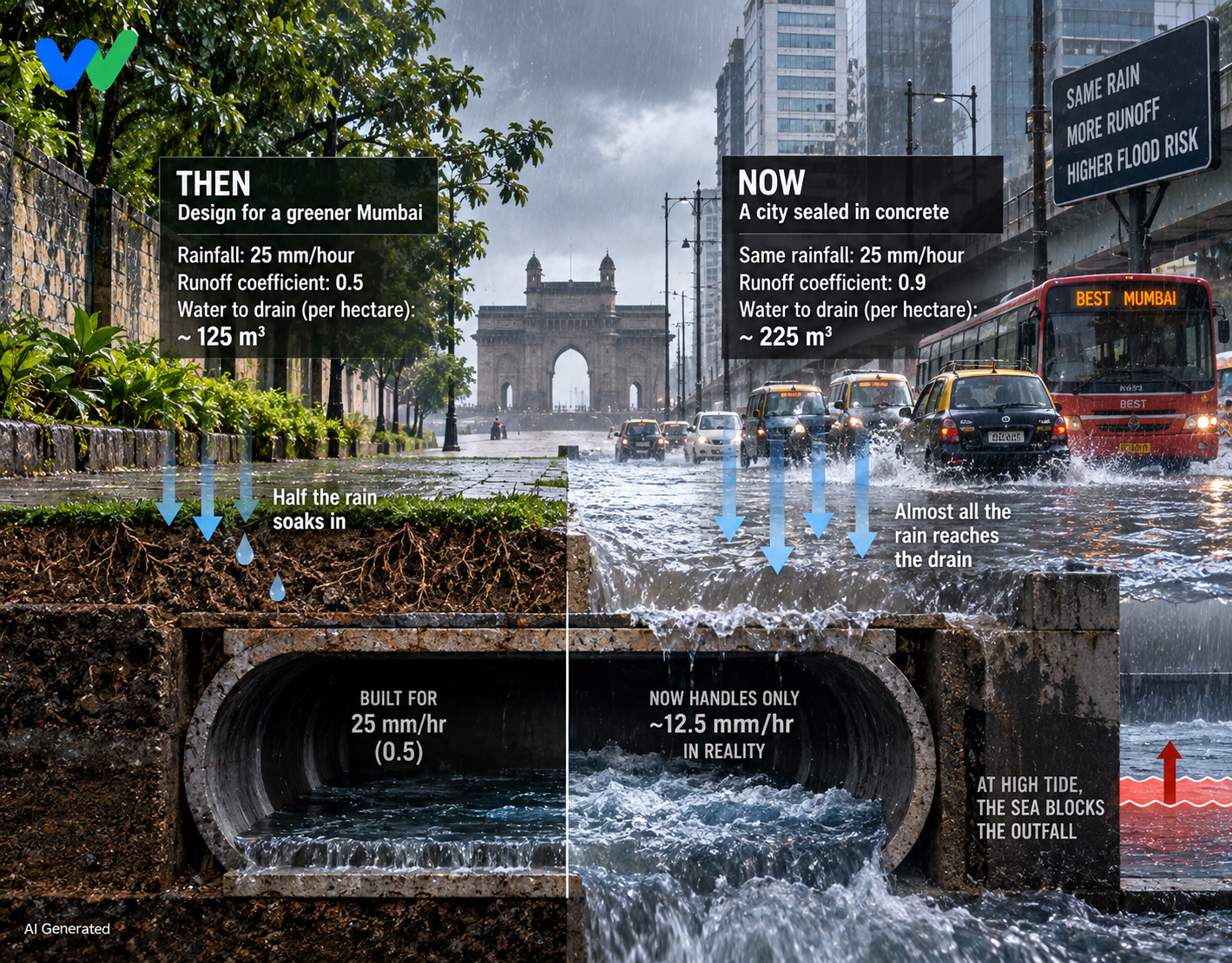
Two numbers in a municipal file decide whether your street floods. One of them was set for a city that still had soil.
Drains do not handle rain. They handle a number. Urban flooding India starts with two numbers. Mumbai’s old design standard is on file with the city’s own drains department. It is 25 mm of rain an hour, with a runoff coefficient of 0.5.
What the Runoff Coefficient Assumes
The coefficient is the share of rain that reaches the drain instead of soaking away. Set it at 0.5 and you assume half the rain soaks away into soil, gardens, lanes and open plots.
Take one hectare of city. Put 25 mm of rain on it in an hour. That is 250 cubic metres of water. At a coefficient of 0.5, about 125 cubic metres reaches the drain. The pipe carries that much.
Engineers call this the rational method. Flow equals the coefficient, times the rain, times the area. Change any one of the three and the pipe either copes or it does not.
Then the Ground Was Sealed, and Urban Flooding India Got Worse
Concrete and paving push the coefficient to 0.9 or more. Almost nothing soaks in. On the same hectare, the same rain now sends about 225 cubic metres into the drain.
The rainfall has not changed. The pipe has not changed. The water arriving has nearly doubled.
Put it another way. Seal the ground, and a drain built for 25 mm at 0.5 now copes with about 12.5 mm of real rain. That is an ordinary monsoon shower.
The Sea Has a Say Too
Mumbai’s drains discharge by gravity. At high tide the outfall sits underwater. The water has nowhere to go, whatever the pipe can carry.
A CAG report on the system found floodgates on only three of the 45 outfalls it examined. That leaves 42 with no tidal control at all.
The BRIMSTOWAD plan of 1993 asked for a new standard: 50 mm an hour, at a coefficient of 1.0. The work is still not done.
The Wise Take
None of this maths is unique to Mumbai. Every city in India builds its drains to a stated rain figure and a stated coefficient. Both numbers are on record. A resident can ask for them.
So the reason one street floods every year is rarely a mystery. It is rarely graft, and rarely freak rain. Somebody fixed one number when the ground could still soak up water. Every building, paved compound and concreted footpath since has quietly falsified the other.
Redesign is expensive. Knowing the number costs nothing, and urban flooding India is mostly an argument about numbers nobody has read. Rain gauges and volunteers have already changed the conversation in Wayanad, and it changes what the conversation is about here too.