
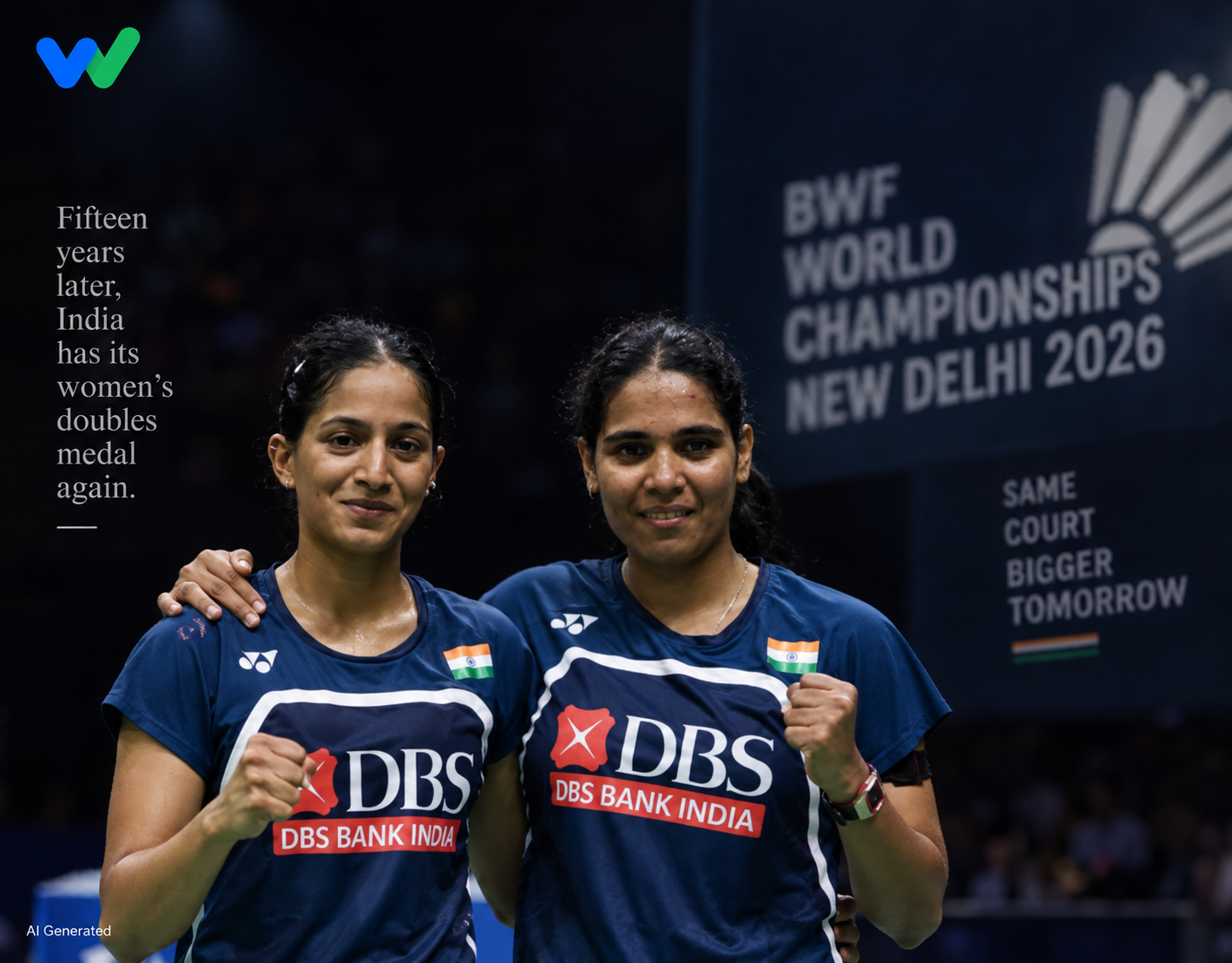
The medal was secured in the quarter-final, a day before they played the semi. Fifteen years is the number that should bother Indian badminton.
India won a women’s doubles medal at the Badminton World Championships in 2011. Then it won nothing in that event for fifteen years. Three Olympic cycles went past. A generation of players came up, played, and retired without ever putting an Indian pair on that podium. On 22 August, in New Delhi, Treesa Jolly and Gayatri Gopichand Pullela ended it. Treesa and Gayatri went in unseeded. They beat the fourth seeds to do it. And they had the bronze in hand before they played their semi-final, which takes some explaining.
The Medal Was Won a Day Early
Badminton does not play off for third place at the World Championships. Both losing semi-finalists get bronze.
So the match that mattered was the quarter-final, against Jia Yi Fan and Zhang Shu Xian of China, the fourth seeds. Treesa and Gayatri won it. The medal was theirs from that moment, whatever came next.
What happened next was Liu Sheng Shu and Tan Ning. World number one. Defending champions.
The Indians took the first game 21-18. Then they lost 13-21 and 8-21, over an hour of badminton. Read that scoreline the right way round. An unseeded pair took a game off the best in the world, in front of a home crowd, in a World Championships semi-final.
Fifteen Years Is the Real Story Here
Jwala Gutta and Ashwini Ponnappa won bronze in London in 2011. For most of that period they were the only Indian women’s doubles pair anyone outside the sport could name.
After they stopped playing together, India did not have a settled women’s doubles pairing for years. Combinations formed, lost a few tournaments, and got broken up.
Meanwhile India kept winning World Championship medals in women’s singles, in men’s singles, in men’s doubles. Only this event stayed empty. That is not an accident of talent. India has never been short of good women doubles players.
What Treesa and Gayatri Did Differently
They stayed together.
The pairing dates to 2022, when they reached the quarter-finals in Tokyo. Four seasons is unremarkable in Chinese or Japanese doubles. In Indian doubles it is close to a record.
Doubles is not two singles players sharing a court. The value sits in the partnership itself, in who covers which diagonal without being told, and it accumulates over hundreds of matches. Split a pair after a bad six months and the clock goes back to zero.
There is also a mechanical payoff. A World Championships bronze carries ranking points, and ranking points decide which draws you can enter next. A good fortnight buys access to the tier where the only way to improve is to keep losing to the top ten until you stop losing.
The Part About Playing at Home
India does not host a World Championships often, and the benefit is hard to put in a budget line.
Indian players usually arrive at these events off a long flight and into an unfamiliar hall. This time they did not. No time zones, no acclimatising, nothing new about the venue.
The other benefit takes a decade to show up. Every junior in that arena watched an Indian pair beat the fourth seeds in person, rather than on a stream at two in the morning. Nobody can measure what that does. It is still the main reason to host one.
The Wise Take
There is a ritual after results like this. The medal gets celebrated, Treesa and Gayatri get felicitated, and everyone moves on until the next one.
Try a different question. Why did it take fifteen years?
Not for lack of players. India’s problem in women’s doubles has been churn. Pairings assembled and disassembled around selection cycles and short-term form, in a discipline where the only thing that produces results is time served together. Treesa and Gayatri are not an exception to the Indian system. They are what happens when a pair survives it for four years.
So the thing to watch is boring and decisive. Are they still playing together in 2028. Is there a second Indian women’s doubles pair inside the top twenty by then. Is the federation funding a full international calendar for both, because doubles rankings run on volume and volume costs money.
India rebuilt its sports funding around questions like this. The bronze is a good week. Whether it becomes anything more is a scheduling decision, taken in an office, by people who were not in the hall.