

Tarapur in Bihar and Eram in Odisha saw two of the largest police firings of the freedom movement, yet neither is widely known today.
Every August the same few places return in the retelling of India’s freedom struggle. Jallianwala Bagh, the Red Fort, Sabarmati. Tarapur and Eram lost more people to police bullets than almost anywhere else. Still, they rarely appear at all.
Tarapur, 15 February 1932
The Congress leader Sardul Singh Kavishar had called for the flag to go up on government buildings that day. At Tarapur, in what is now Bihar’s Munger district, around 4,000 people gathered at the police station.
Accounts record a lathi charge, then stone-pelting, then firing. The police fired about 75 rounds. Accounts also record 34 bodies at the site. Local memory has long held the real number was higher, because people carried some of the dead away, and some later surfaced in the river.
Bihar recognised the day in 2022, ninety years later. The state declared 15 February as Shahid Diwas, then opened a memorial park in the police station compound.
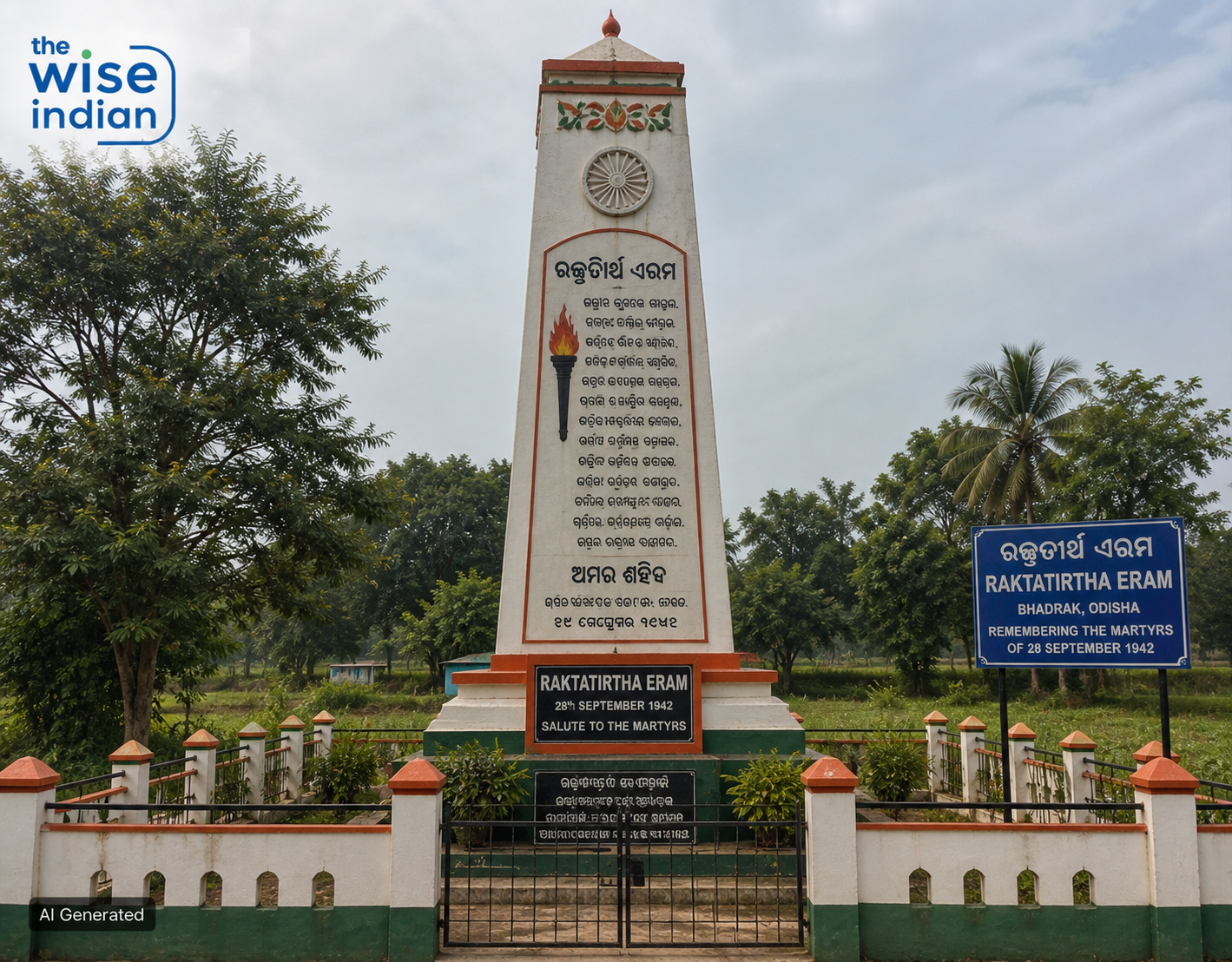
Eram, 28 September 1942
Eram lies in what is now Bhadrak district in Odisha. The Bay of Bengal closes it on one side, while the Kansbansa and Gamei rivers close the others. Those barriers made it a useful meeting place for Congress leaders through the 1920s and 1930s.
During the Quit India movement a large crowd assembled in a field there. A police party from Basudevpur, led by DSP Kunjabihari Mohanty, opened fire at about half past six. The field lay enclosed on three sides.
The Odisha government’s district record states that 28 people died at the scene, while a twenty-ninth died later of injuries. Fifty-six others suffered wounds. Among the dead was Pari Bewa, remembered as the only woman killed there.
Why Tarapur and Eram Get Left Out
Both places hold local memorials and little else. Eram has a memorial pillar, and its MP raised national recognition in the Lok Sabha in 2020. He asked the government to develop it and give it tourist status.
The same unevenness runs through this map. Moirang in Manipur, where the INA flag went up in April 1944. Tamluk in Bengal, where a parallel administration ran Midnapore district. Vedaranyam in Tamil Nadu, the southern salt march. Khonoma in Nagaland, where the Angamis fought British expansion in 1879. Pazhassi in Kerala, where a war against the East India Company ran for twelve years.
The Wise Take
Recognition in India’s freedom story has followed proximity to power and to the printing press. Amritsar was a city with newspapers and lawyers. Tarapur and Eram were not. So every schoolchild knows one of them, while the others live mainly in local memory. The gap narrows slowly, through state holidays, memorial parks and questions in Parliament. Still, it is worth noticing the immediate cause in both places. People gathered to raise a flag, and the police opened fire.