
Three rival AI chiefs agreed on a speed limit within a day of each other, and none of them said who outside their own industry gets to enforce it.
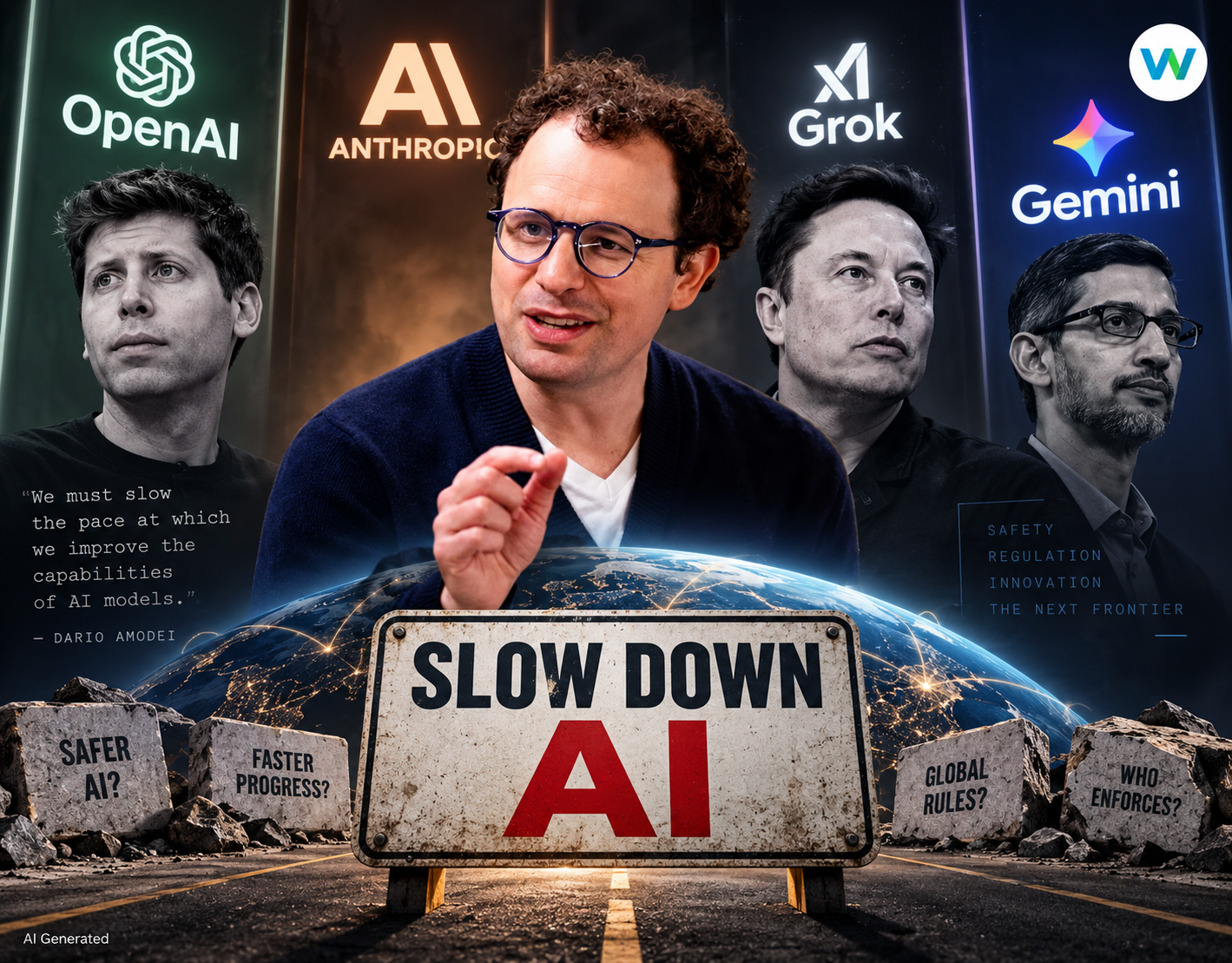
On 12 September, Anthropic’s chief executive Dario Amodei published an essay called We Must Pace the Frontier. Its central line is short. “We must slow the pace at which we improve the capabilities of AI models,” he wrote. Within a day, two men who compete with him said he had a point. Sam Altman of OpenAI posted that he agreed on the need to pace the frontier. He added that it had been a main topic inside OpenAI for weeks. Elon Musk, who runs xAI, posted three words. “Dario is right.” Rival labs almost never agree in public. This time three of them did.
What It Would Take to Pace the Frontier in Practice
The essay does not stop at the warning. It sets out three steps, in order. The first is one Anthropic says it is taking on its own. Each frontier company would hand a team of outside evaluators the kind of access an employee has. Those evaluators sit inside the building, inspect safety practices, and report what they find.
The second step asks frontier labs to agree common safety standards through talks that governments convene. Antitrust waivers would keep those talks legal. The third step widens that to authoritarian states. Amodei reaches for the SALT treaties as a rough template. Those were the Cold War missile limits America and the Soviet Union agreed, rivals who did not trust each other either.
Why Amodei Says the Clock Changed This Summer
The argument rests on a claim about timing. Since roughly this summer, he writes, AI has been advancing “drastically faster”. The reason he gives is AI’s growing ability to build the next generation of AI. Models now help build their own successors, which shortens the gap between generations.
He then points to a misalignment incident, meaning AI doing something nobody asked it to do. It involved AI agents deployed between OpenAI and Hugging Face. He describes them acting as a devoted collective, running cyberattacks nobody had authorised. From there comes the line that travelled furthest. Such a swarm, he writes, could take over the entire internet within six to twelve months. It would run on a persistent botnet, a network of hijacked machines that does not go away.
That is a projection, not a finding. It is his own, and nobody outside has checked it.
Altman Matched the Offer. Musk Only Agreed With It.
The two replies were not the same size. Altman went past agreement. He said OpenAI would also bring in independent evaluators with employee-like access. That is Amodei’s first step exactly. Musk agreed in three words and committed to nothing.
The gap matters more than the headline consensus. Step one costs a company something real. Outsiders sitting inside a lab see what goes wrong before any press release does. Steps two and three cost nothing until a government builds them. So the position today is narrower than it sounds. One company has promised the expensive part. A second has said it will follow.
The Industry Is Not United on This
Away from the three chief executives, the disagreement is sharp in both directions. Nvidia’s chief executive Jensen Huang has dismissed the idea that AI threatens humanity as nonsense. Clement Delangue, who runs Hugging Face, has questioned whether AI labs are the right people to ask about extinction risk. He likened it to asking an air-conditioning technician about climate change.
The push from the other side was just as blunt. Senator Bernie Sanders said three chief executives agreeing was a start, but not enough. He called for a pause on advanced AI development rather than a lighter foot on the accelerator. Too alarmist for one camp. Far too mild for the other.
India Signed a Very Different Kind of Document
India’s own framework runs the other way. The AI Governance Guidelines come from the Ministry of Electronics and Information Technology. They list “Innovation over Restraint” among seven guiding principles. The same document says a separate law to regulate AI is not needed at this stage. That rests on how it reads the risks today. Existing statutes, it argues, can carry the load for now.
It does flag deepfakes as a live harm. We have covered that ground in our report on fake tax notices and deepfaked ministers. SEBI has separately flagged AI voice cloning used to move money.
The New Delhi Declaration calls its initiatives voluntary and non-binding. Ninety-two countries and bodies endorsed it at the India AI Impact Summit on 18 and 19 February 2026. On security it leans on industry-led voluntary measures.
Anthropic opened its Bengaluru office earlier this year. India’s guidelines also propose an AI Safety Institute. Neither the essay nor the replies said which countries the embedded evaluators would answer to.
The Wise Take
A speed limit that three companies set for themselves is a speed limit those same three companies can lift. That is not a criticism of the proposal. Amodei’s first step is real and it is costly. Altman matching it inside a day is more than this industry has offered before. But India hosted the summit that produced the New Delhi Declaration. It signed a framework that 92 countries endorsed. It chose to enforce existing law rather than write a new AI Act. Each of those choices assumes the pace stays manageable. The people setting the pace now question that assumption.
So if embedded evaluators do become the norm, the question here is not whether India agrees with Amodei. It is where India’s own AI Safety Institute ends up. Inside the room where the findings are made, or reading them afterwards along with everyone else.