
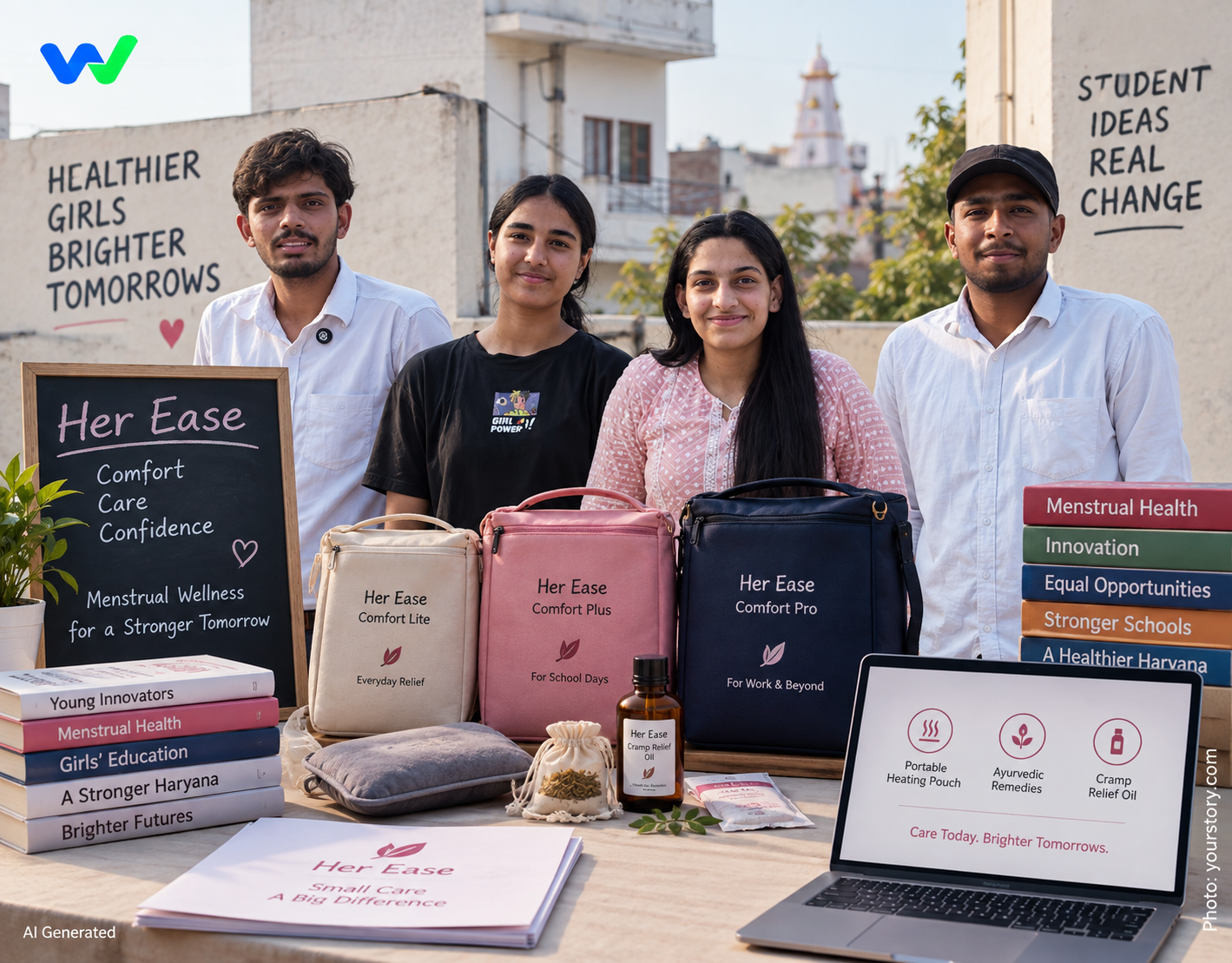
They won Rs 1 lakh from a state scheme and have sold fifteen units. Both halves of that sentence matter.
Pritam Suthar had to explain himself. He is one of four students at Aarohi Model Senior Secondary School, a government school in Hisar, and he joined a team building a product for period pain. “Initially, people asked me why I was joining a menstrual solutions team,” he said. “But later, people understood that we were solving a real-life challenge.” The team is called Innovative Minds. The product is called Her Ease. It won them Rs 1 lakh in seed funding from a state scheme built to get menstrual health Haryana students thinking commercially. So far they have sold fifteen of them.
What They Made
Her Ease is a product line rather than one object, which is unusual for a school project.
It is a bag holding a portable heating pouch, Ayurvedic herbal remedies and a cramp relief oil. Three versions. Comfort Pro is an office bag, Comfort Plus is for school, Comfort Lite is the basic option. They sit between Rs 549 and Rs 899. The team plans to sell through Amazon.
The four are Pallavi Kaswan, Pritam Suthar, Anand Bansal and Neha Loura.
Why Menstrual Health Haryana Schools Talk About It Now
The project began somewhere else and turned. Pallavi Kaswan explained the pivot plainly.
“But we turned this to women’s health when we realised that it needed greater attention because menstrual cramps can be uncomfortable and cause girls to miss school.”
That is the observation the whole thing rests on. It is an attendance problem before it is a comfort problem. Girls miss school. Girls who attend cannot concentrate. Indian government schools have documented this for years, and it is why menstrual health Haryana programmes keep reaching for curriculum and supply schemes.
Their answer was physical, not educational. Heat helps cramps. A pouch a girl can carry treats the symptom where it happens, in the classroom. Most cramp management anywhere comes down to heat, rest and pain relief. So this is not naive. It is direct, which is different.
The Scheme That Found Them
This did not come out of nowhere, and the machinery behind it is the transferable part.
The Kushal Business Challenge is a Haryana government entrepreneurship programme for school students. Samagra Shiksha runs it, with the Udhyam Learning Foundation as technical partner. The team won at block, district and state level. They also placed second at a programme at Hisar ITI. The Rs 1 lakh came with that run.
So a student in a government school had a competition to enter, mentors to work with, and a route to real money, without knowing anybody first.
That is rarer than it sounds. Most Indian student innovation funding finds its way to private schools, because private schools have staff with the time to chase it.
Fifteen Is the Number Nobody Would Have Printed
Fifteen units sold and twenty pre-orders, as of May 2026.
At roughly Rs 700 a unit that is about Rs 10,500 of revenue against Rs 1 lakh of seed funding. It is a small number and it deserves to be said out loud, because it is the number that separates a prize from a business.
This is not a criticism of four teenagers sitting board examinations at the same time. It is what an early-stage physical product looks like with no manufacturing help, no distribution and no buyer. Menstrual health Haryana funds ideas. It does not yet buy them.
Indian coverage of student innovation is full of prize ceremonies and almost empty of follow-ups. That is how a country convinces itself it has an innovation pipeline when what it really has is an awards circuit.
The Wise Take
Two things are true here and the story needs both.
The scheme worked. It found four students in a government school in Hisar, gave them structure and mentors, and put a lakh behind them. Most states run nothing like it. Pallavi’s ambition is not modest either: “Next year, we want to expand our market to pan-India, and then take it to the international market.”
But the pipeline stops at the cheque. Seed money without manufacturing support, distribution or an institutional buyer produces exactly this: a decent product, a real prize, fifteen sales.
And there is an obvious buyer inside the same government that funded them. Haryana runs schools. Those schools hold girls with period pain and an attendance problem the state already measures. A government that can find and fund a product can also pilot it in fifty of its own schools and publish what happened.
Nobody does that follow-up, which is the actual gap. Government school enrolment is falling even as teacher numbers rise, and states are hunting for anything that makes their schools work better. One is sitting in Hisar with twenty pre-orders and no customers.