

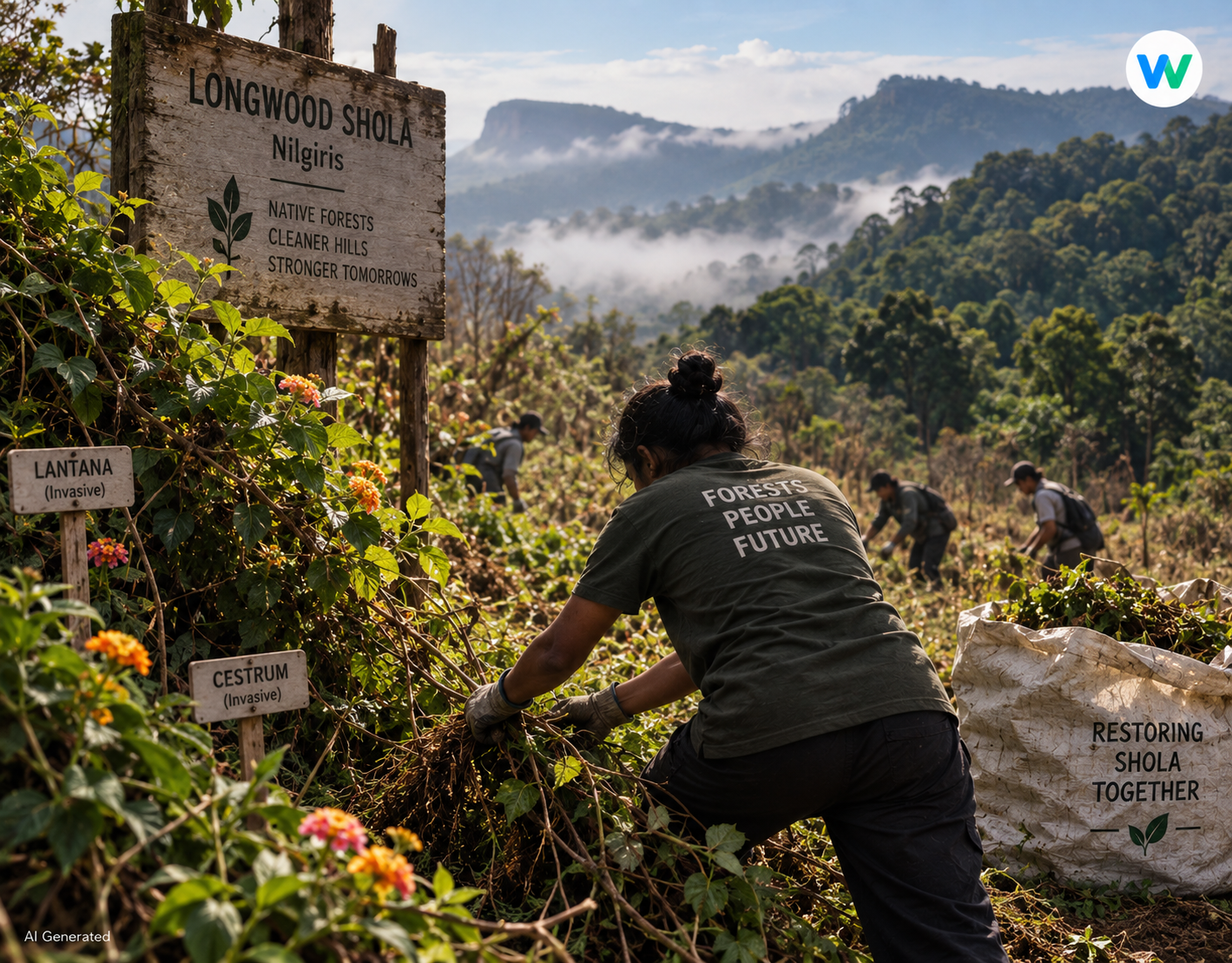
The forest runs to 116 hectares. A survey put native tree cover at about 90 of its 250 acres, and the citizens’ committee that did the clearing has since stopped.
The Longwood Shola sits above Kotagiri in the Nilgiris. It covers 116 hectares, or about 250 acres. For roughly 27 years a citizens’ group worked with the Tamil Nadu Forest Department. They patrolled the forest and pulled out the plants taking it over. Few community efforts in south India are this well documented. This one is also unfinished.
What Removing Weeds From the Longwood Shola Actually Involves
The invaders are specific plants. Cestrum aurantiacum is a weed from South America. It spreads by root, by shoot and by seed. It grows many times faster than the native shola trees. Lantana camara came to India as a garden ornamental in the early 1800s. The forest department itself planted eucalyptus and wattle last century, for firewood and pulp.
None of these can be sprayed away at scale. Group members describe students pulling acacia saplings out by hand. About a hundred each, in one session. They came back year after year, because the weeds came back too.
The Acreage That Was Not Recovered
A 2022 survey put native tree species on roughly 90 of the forest’s 250 acres. Exotic plants had taken the rest. So about two thirds of the reserve still sat under weeds.
The same year, the Longwood Shola received Queen’s Commonwealth Canopy accreditation.
Those two facts belong in the same paragraph. The recognition arrived while weeds still held two thirds of the forest. The committee has since stopped its work. Its members have put that down to a difference of approach with the Forest Department.
What the Research Says About Pulling Weeds
Researchers at the National Centre for Biological Sciences found that you must uproot lantana, not cut it. Cut it above the ground and the root stock throws up aggressive new growth.
The same work found that native grasses recover only partly even after weeding. They recommend one order: uproot, then weed, then sow native grass seed.
In March 2026 the Madras High Court set up a supervised programme to remove Prosopis juliflora across Tamil Nadu. Two retired judges head the committee.
The Wise Take
India counts its conservation in saplings planted and hectares notified. The Longwood Shola suggests a harder measure. How much of the patch still holds native trees? And what does that figure look like five years later?
That number exists here only because a newspaper went and asked. Nobody publishes it as routine. An accreditation, a court order and a volunteer roster are all inputs. The output is acreage. Planting saplings is the easy half of this problem everywhere. The Nilgiris has no public series showing whether native cover is rising or falling, and one would tell everybody, the Forest Department included, whether the removal is winning.