
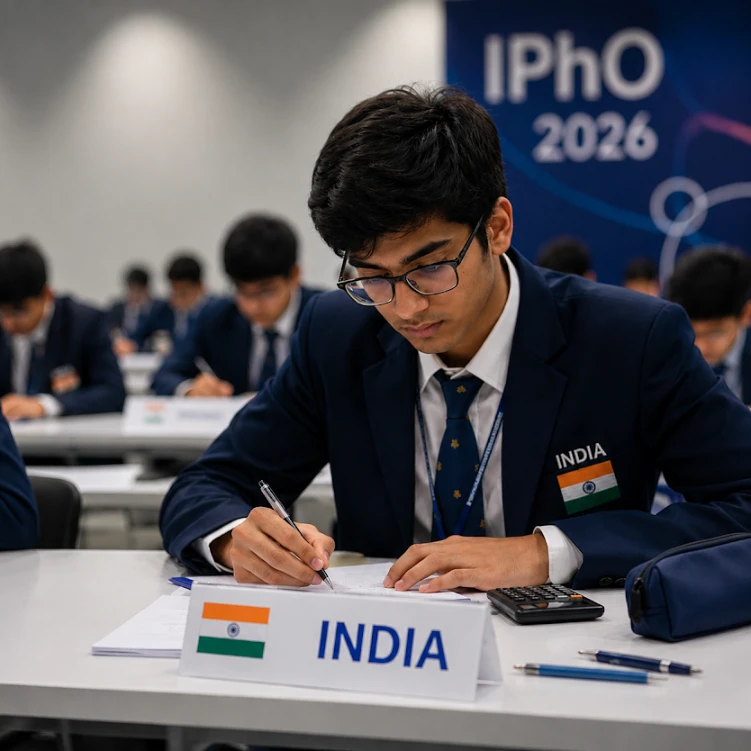
All five Indian students who travelled to Colombia returned with gold medals, placing the country level with China, Russia and three others at the top of the table.
India’s team at the 56th International Physics Olympiad has returned from Bucaramanga, Colombia, with a gold medal for every member. The last time all five Indian participants won gold was at the 49th edition in 2018.
The five students are Kanishk Jain from Pune, Riddhesh Anant Bendale from Indore, Rishit Garg from New Delhi, Shresth Suraiya from Mumbai and Svarit Joshi from Ahmedabad.
Where India Finished in the Tally
The result placed India in joint first position in the country tally, shared with China, Kazakhstan, Russia, South Korea and Taiwan. The competition drew 381 students from 87 countries, making it one of the larger editions of the contest.
Prime Minister Narendra Modi congratulated the five students in a social media post. Minister of State for External Affairs Pabitra Margherita and Department of Atomic Energy Secretary Dr Ajit Kumar Mohanty also issued messages of congratulation to the team.
A Step Up From Last Year’s Result
The 2026 outcome improves on India’s showing at the 55th edition in Paris in 2025, where the team won three golds and two silvers and finished fifth in the tally alongside Taiwan, Japan and Russia.
Two members of this year’s team, Kanishk Jain and Riddhesh Anant Bendale, were also gold medallists in Paris. At the 54th edition in Isfahan in 2024, the Indian contingent won two golds and three silvers.
How the Indian Team Is Selected
Indian participation at the International Physics Olympiad is coordinated by the Homi Bhabha Centre for Science Education, a Tata Institute of Fundamental Research centre in Mumbai.
Selection runs through a multi-stage national olympiad examination followed by a residential orientation and selection camp. The final contest combines a theoretical paper with an experimental component, testing laboratory technique alongside problem solving. Students reach it from schools across the country rather than from any single institution or coaching stream.
The Wise Take
Olympiad results are easy to read as a scoreboard and harder to read as evidence. Five golds show that a small, well-supported cohort at the top of India’s science pipeline can compete with any country in the world. They say less about the average Indian classroom, where laboratory access and specialist physics teaching remain uneven. What is worth noting is that the pathway behind this result is publicly funded and entered by examination rather than fee, at a time when most national conversation about science education runs through coaching costs and entrance ranks.