

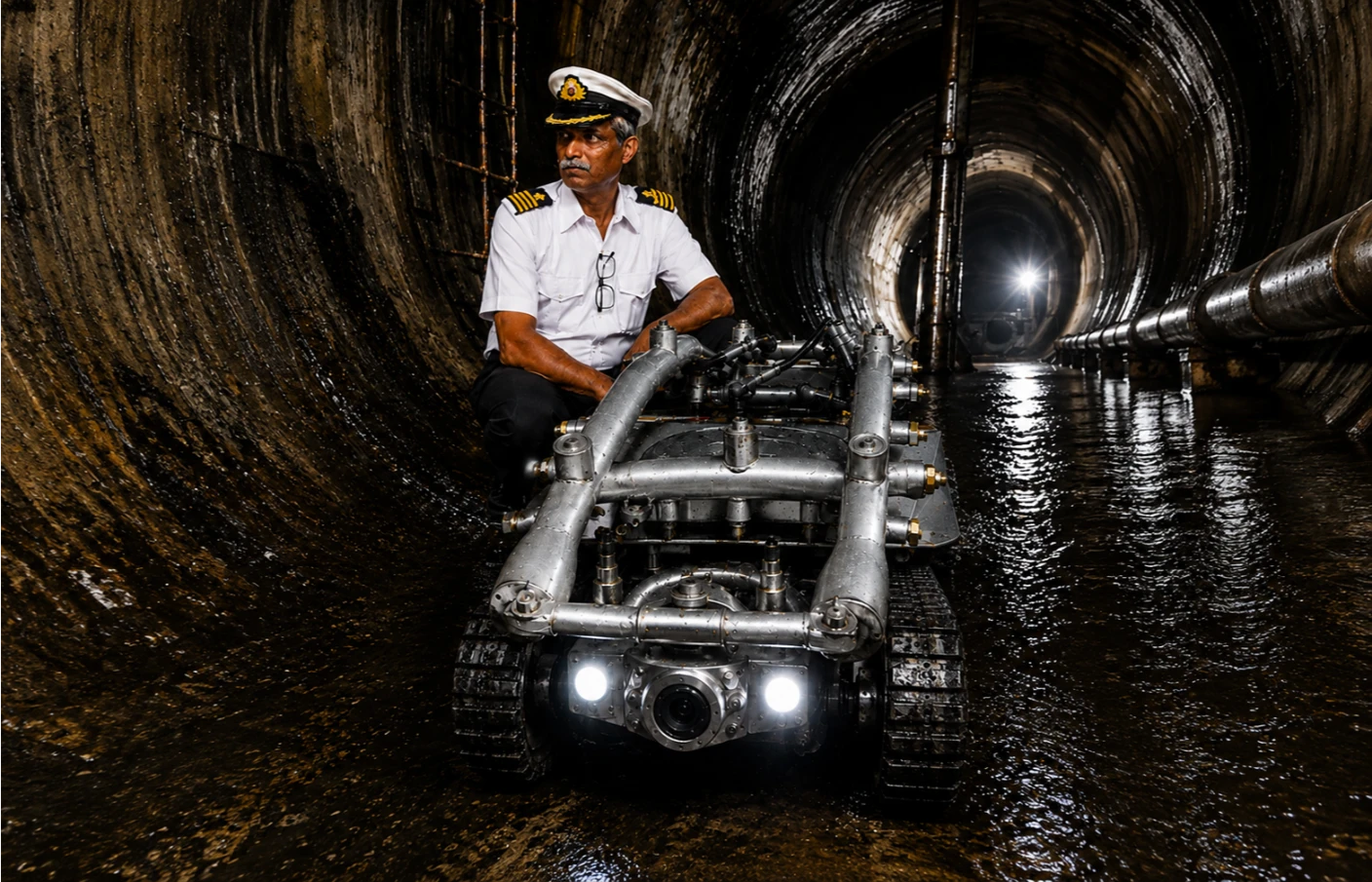
Captain DC Sekhar cleaned more than 150 petroleum tanks in the Merchant Navy before founding a company designed to make that job unnecessary.
Twenty metres below the deck of an oil tanker, there is no daylight. There are oxygen-deficient pockets, hydrocarbon gases and hydrogen sulphide, held inside a sealed steel structure.
Captain DC Sekhar entered and cleaned more than 150 such tanks with his crew over nearly two decades in the Merchant Navy. He has said that no safety protocol ever made him underestimate the risk.
An Idea Held for Almost Three Decades
Sekhar has said he first conceived a robotic solution in 1995, while serving as a ship’s officer overseeing tank operations. It stayed an idea for close to thirty years.
The company that resulted, Beta Tank Robotics, is based in Bengaluru and was incubated at IIT Guwahati’s technology incubation centre with backing from Oil India Limited’s startup programme.
Why Existing Robots Fell Short
Robots for crude oil tanks are a difficult engineering problem. They are hydraulically powered and controlled to avoid any sparking risk, and specialised machines of this class can cost around half a million dollars each.
Most existing designs pull sludge out by suction from a pump sitting outside the tank, which limits them to roughly one bar of pressure and struggles with thick residue over long pipe runs.
BetaTANK places the pump on the robot itself and operates at a discharge pressure of about ten bar. The machine is also built low enough to move beneath the heating coils inside storage tanks. An operator works from a control panel outside, watching through a camera.
Certification and What Comes Next
The company holds a patent on the robot and has secured IECEx Zone 0 certification, the highest international safety classification for equipment operating in hydrocarbon environments.
A second product uses foldable arms to clean the underground storage tanks at retail fuel stations. The company reports enquiries from the steel and pharmaceutical sectors as well.
Industry estimates cited by the company place the value of this niche robotics segment between six and thirteen billion dollars over the coming decade. BetaTANK exhibited at Indian Energy Week and was named its best startup.
The Wise Take
Confined-space entry remains one of the most lethal categories of industrial work in India, and much of it persists because removing the human is expensive while the human is cheap. What makes this case instructive is that the person who built the alternative had done the job himself, which is why the design targets the specific failure of existing robots rather than the general idea of automation. Faster tank turnaround is a commercial argument. Nobody going twenty metres below deck is the point.