

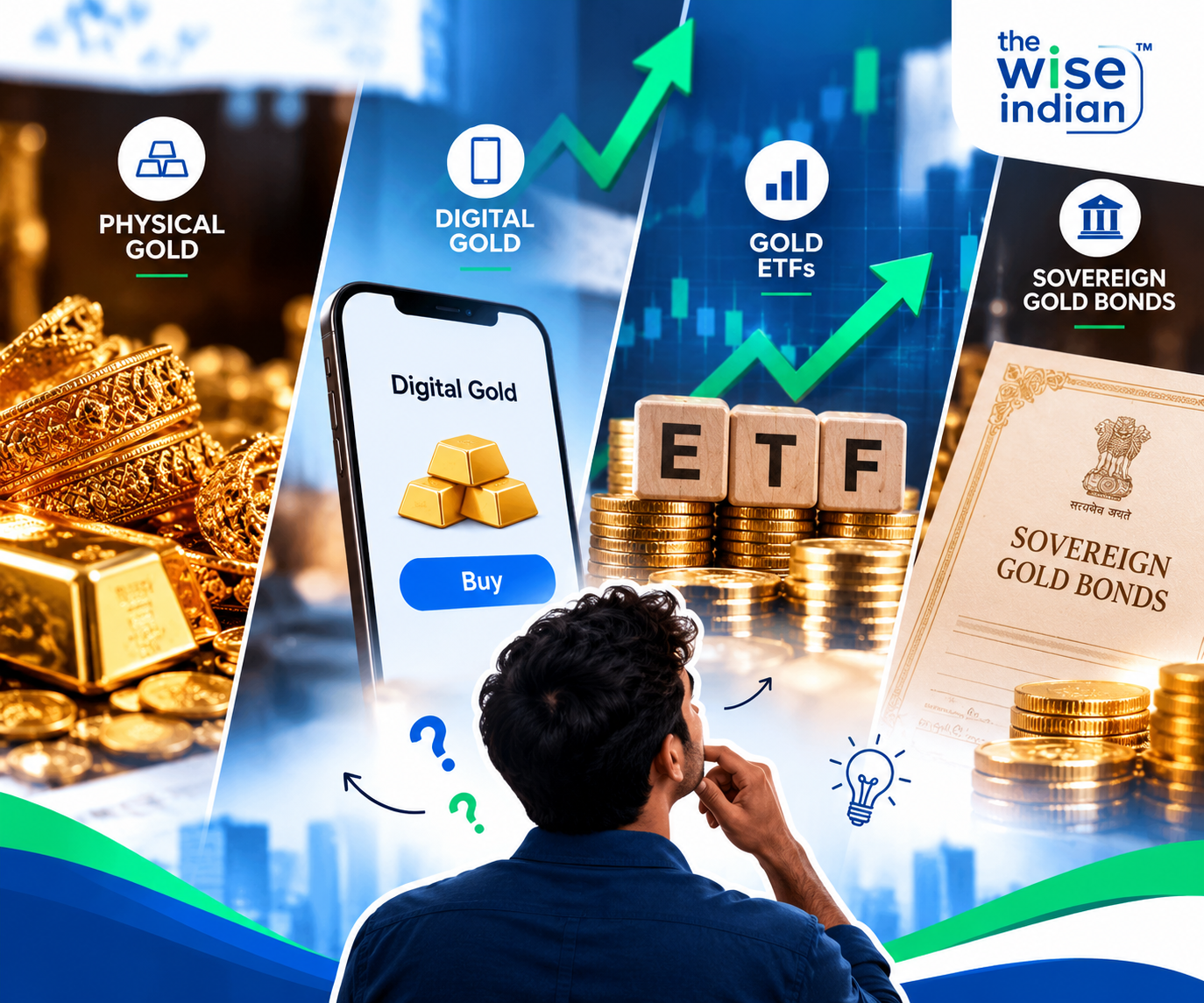
Dhanteras arrives on 6 November, and every family asks the same question. Should we buy gold from the jeweller, an app, the stock market, or somewhere else? The right answer depends on your goal, not just tradition. Let us compare the main gold investment options in plain words.
Gold Investment Options Start at the Jeweller’s Counter
Physical gold is the oldest of all gold investment options. You can see it, touch it, and wear it. Many families also buy a small coin on Dhanteras for good luck. That emotional comfort is real. However, it comes with costs that many buyers forget. First, check the hallmark. Look for the BIS logo, the purity mark, and a six-digit HUID code. Then open the BIS Care app and use the “Verify HUID” option. It takes a minute and protects you from false purity claims. Since 31 March 2023, a jeweller cannot sell hallmarked gold jewellery without that HUID code.
Next, read the bill carefully. Jewellery carries making charges, and those charges reduce your returns when you sell. Also, you must keep the gold safe at home or in a locker. Therefore, buy jewellery to wear, and treat the investment angle as a bonus. Tax matters too. If you sell after 24 months, the gain faces a flat 12.5 per cent long-term tax. Before that, the gain joins your income and follows your slab rate.
Digital Gold: Easy to Buy, Hard to Trust
Digital gold feels wonderfully simple. Apps let you buy gold for as little as ₹10 or ₹100, so even students can start. Moreover, you skip the storage worry completely. However, the real catch sits in the rules. On 8 November 2025, SEBI warned that digital gold is neither a security nor a commodity derivative. As a result, the protections that cover regulated products do not apply here. If the platform fails, you carry the counterparty and operational risk yourself.
Because of this, treat digital gold as a small convenience. Do not make it your main Dhanteras purchase. Besides, ask yourself one honest question before every purchase. Who is responsible if this app disappears? Today, a dispute with the platform has no SEBI-backed route for relief. Therefore, a small amount is the sensible limit.
Gold ETFs: The Quiet Winner for Many Buyers
A gold ETF trades on the stock exchange, and each unit tracks the price of gold. You need only a demat account and a few taps. In fact, among all gold investment options, ETFs balance safety and convenience quite well. SEBI lists gold ETFs among its regulated gold products. So you get stronger safeguards than digital gold offers. Besides, you pay no making charges and need no locker.
Buying is also simple. Open a demat account, search for a gold ETF, and place an order like any share. Start small, and add more over time. Because ETFs trade on the exchange, you can sell on any market day. Tax rules help too. If you sell after 12 months, the gain faces a flat 12.5 per cent tax without indexation. For example, a ₹25,000 gain on a ₹1 lakh investment attracts about ₹3,125 in tax, plus cess. Selling within 12 months, however, adds the gain to your income at slab rates.
Patience can save real money. In one published example, a ₹30,000 gain faced ₹3,750 tax after a year. In contrast, a 30 per cent slab would have taken ₹9,000. Still, remember one small catch. The ETF price may differ slightly from the market gold rate.
Sovereign Gold Bonds: A Great Deal You Can No Longer Buy Fresh
Sovereign Gold Bonds, or SGBs, once looked like the smartest of all gold investment options. The government backed them, and they paid 2.5 per cent yearly interest on top of gold’s price gains. The interest is taxable, though. The bonds run for eight years, but you can exit early after the fifth year. Here is the twist. The government has stopped issuing new SGBs. So you cannot buy a fresh tranche this Dhanteras. You can still look for older bonds on the stock exchange. However, if you sell early there, you may accept a discount.
The returns explain why people loved them. A bond issued at ₹4,890 per unit reached an early redemption price of ₹13,929 in January 2026. That is a 185 per cent gain. Similarly, an investor who put ₹48,900 into 10 units received ₹1,39,290. However, note the critical 2026 tax twist: the maturity gain is tax-free only for original primary subscribers. If you buy an older bond from the stock exchange today, your final profit at redemption will attract a flat 12.5 per cent long-term capital gains tax The RBI sets the early exit price using the average gold price of the last three business days. Moreover, every tranche has its own exit dates. So check the date for your bond before you plan anything.
The Wise Take
So, which of these gold investment options suits you? It depends on your purpose. Choose physical gold if you want jewellery or a family tradition. Choose gold ETFs if you want a simple, regulated investment. Treat digital gold with caution. If you already own SGBs, check the early redemption dates before you sell. Think of it like a festival meal. Jewellery is the sweet you enjoy today. An ETF is the steady meal that feeds you for years.
Finally, match the gold to your goal. Verify every hallmark, check every rule, and never rush because of a festival offer. Rates and tax rules change, so confirm the latest details before you buy. This article shares general information, not financial advice. Happy Dhanteras, and may your savings shine brighter than your jewellery!
Also read our other article on What Is a SIP, and How Can You Start Investing in Mutual Funds With Just ₹500 a Month Today?
Follow The Wise Indian for clear, unbiased, and actionable guides that make personal finance simple.