

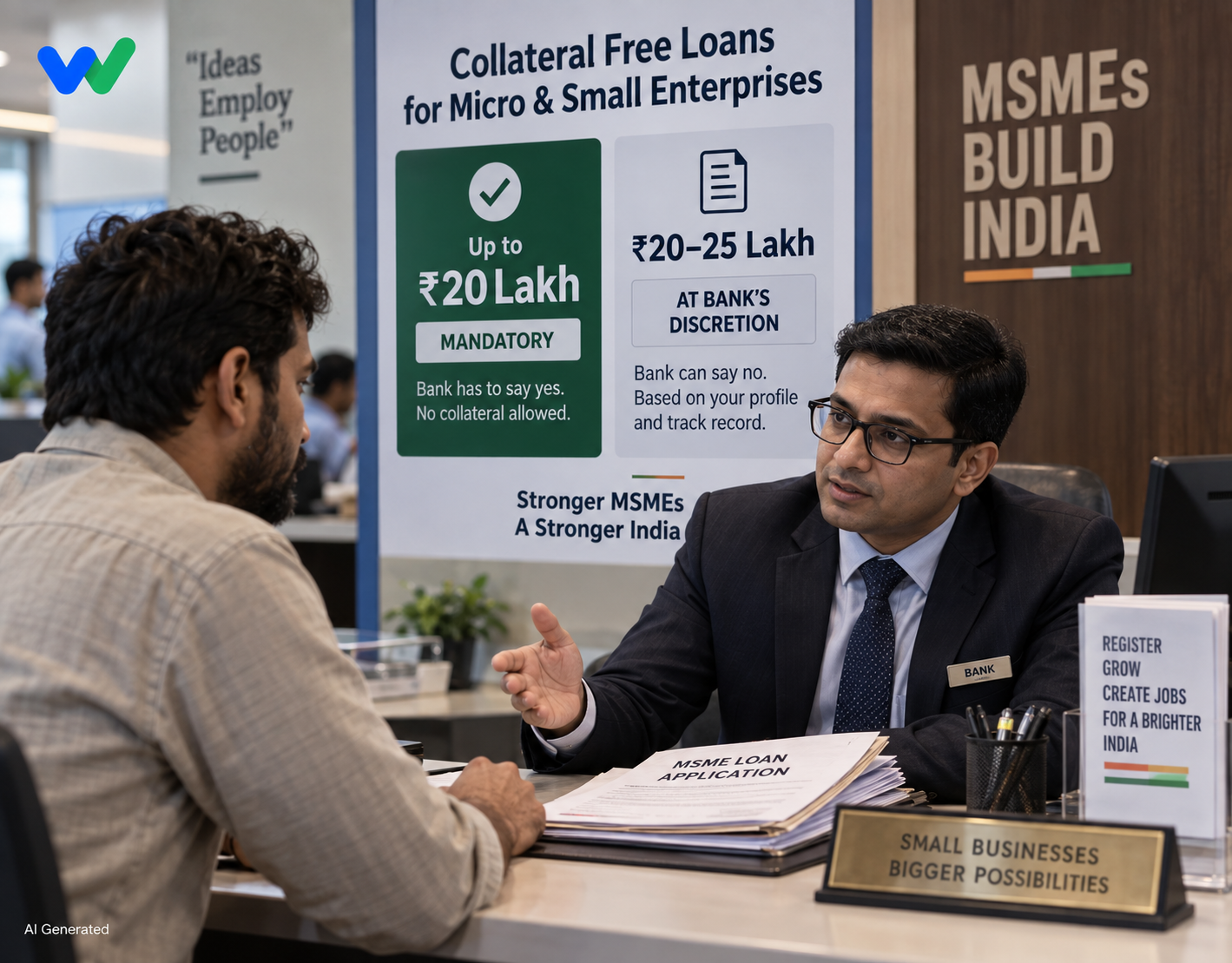
Every report covered the bigger number. The smaller one is the only figure a small business owner can actually insist on.
Walk into a branch, run a registered small business, and ask for a collateral free loan of eighteen lakh rupees. The manager cannot lawfully ask you to pledge property. Walk in and ask for twenty three lakh and he can decline, and there is nothing in the rulebook standing behind you. That gap is the entire story of a Reserve Bank amendment from earlier this year, and almost every report about it led with the number on the wrong side of the line.
What the Reserve Bank Actually Wrote
The instrument is the Lending to Micro, Small and Medium Enterprises Sector (Amendment) Directions, 2026. Reference RBI/2025-26/206, dated 9 February 2026, applying to loans a bank sanctions or renews from 1 April 2026.
Under it, banks must lend micro and small enterprises up to Rs 20 lakh without security. Must. That is a floor, and a manager who ignores it is breaking a rule you can name.
Above that, up to Rs 25 lakh, the language changes completely. A bank may extend a collateral free loan, at its own discretion, under its own internal policy, to a borrower it judges to have a strong track record and sound finances.
May. Not must.
The amendment also deletes paragraph 6.5 of the earlier Directions, which is the plumbing that makes the new limits operate.
Why the Collateral Free Loan Gap Matters
This distinction decides whether you are making a claim or asking a favour.
Below Rs 20 lakh you are citing a regulation. A refusal is a compliance issue and you can escalate it as one.
Between Rs 20 lakh and Rs 25 lakh you are appealing to a credit policy you have never seen, written inside a bank, applied by people who do not have to explain themselves. There is no circular to wave.
Both of those got reported as the same announcement. The collateral free loan headline everybody ran was Rs 25 lakh, which is the half nobody can enforce.
Who This Actually Applies To
Only micro and small enterprises. Medium enterprises are a separate category and this ceiling does not cover them.
Two things set your classification: what you have invested in plant and machinery, and your annual turnover, against thresholds in the MSME Development Act.
There is a trap in that. Grow past the small enterprise limit and the protection disappears. It is one of the quieter reasons Indian firms hesitate to formalise their own growth, and nobody in the system seems to find that odd.
In practice, registration on the Udyam portal is what makes you an MSE on paper. Without it the bank has no basis to treat you as one, and these rules do not reach you at all.
The Guarantee Sitting Underneath
Do not assume the bank is carrying this risk.
Banks can take cover under the credit guarantee scheme for micro and small enterprises, run through CGTMSE. A trust guarantees a large share of the loan if you default, and the bank pays a fee for that cover.
So a collateral free loan is frequently not an unsecured loan from where the bank sits. It is a loan secured by a guarantee rather than by your house. The risk moved. It did not vanish.
The fee can reach you in the pricing, which is worth knowing before you celebrate. Collateral free does not mean cheap.
The Wise Take
Indian credit policy mostly lives in the space between what a regulator permits and what a bank does, and this amendment is a tidy demonstration.
The Reserve Bank moved one number from optional to mandatory. It added a second that stayed optional. The press reported the optional one, because Rs 25 lakh is a better headline than Rs 20 lakh, and because nobody reads the Directions.
The practical advice is small and worth having. Ask for Rs 20 lakh and name the circular if you are refused. Ask for Rs 25 lakh knowing you are asking, not claiming.
The larger question is whether any of this reached a single new borrower. The Reserve Bank already collects the lending data. How many collateral free loans between ten and twenty five lakh did each bank sanction in the year from April 2026, and how many went to people borrowing for the first time. Publish that bank by bank and the ceiling starts to matter. Leave it unpublished and raising the limit again in 2028 will produce another round of headlines and the same quiet refusals at the counter. India’s MSME law has already changed around this, and the counter has not noticed yet.