

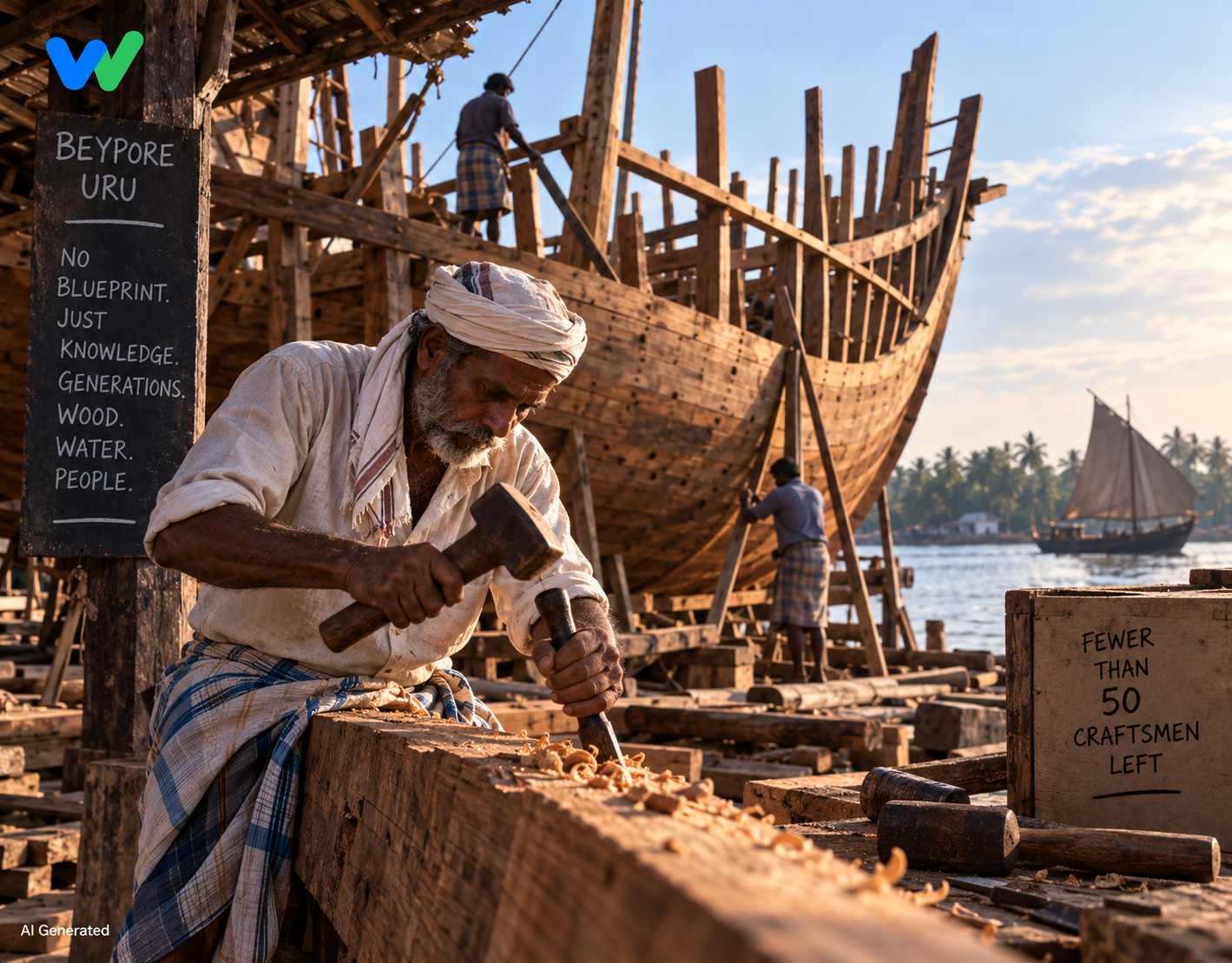
The method survives. The customer, the timber and the vessel itself do not, and the application filed to protect the craft is still pending.
A Beypore uru takes between one and four years to build. The yards sit on the Chaliyar river in Kozhikode district, Kerala. There is no blueprint. The curve of the hull, the waterline and the joinery all sit in the memory of the master craftsman, the odayi, who instructs his team day by day. That has not changed in centuries. Almost everything around it has.
The Customer Changed First
Beypore built cargo dhows for traders across the Arabian Sea for close to two thousand years. That trade ended. By the 1970s boatbuilding at Beypore had stopped. It shifted to Mangaluru and Kannur, and failed there too.
It restarted in 2011, when commissions began arriving from Qatar. Since then at least one uru has left Beypore for Qatar in most years. Two were sent in December 2024, built under the master craftsman Edathodi Sathyan for a Qatari businessman. A vessel under construction now is 105 feet long. A Qatari family commissioned it, at an estimated cost of about Rs 4 crore including the engine.
What a Beypore Uru Is Now
The vessels heading to the Gulf are not cargo ships any more. Yards fit them out as luxury craft, with engines, air conditioning and electronic navigation. The blueprint-free method builds them. The finished boat is something the original trade would not recognise.
The timber changed as well. Malabar teak from the Nilambur forests was the traditional material. The yards now work largely with imported teak.
The Numbers That Decide Whether It Lasts
A traditional build used a team of forty to fifty men. The family running one of the yards has described fifteen permanent skilled craftsmen on the current vessel.
Counts of active uru craftsmen have sat below fifty for well over a decade. Reports since 2022 describe most of them as being in their fifties, sixties and seventies.
The Kozhikode District Tourism Promotion Council first sought a geographical indication tag for the Beypore uru in December 2022. The application carries the number 1025. Nobody has granted it yet.
The Wise Take
A craft can be alive and shrinking at the same time. Beypore is doing well by one measure. A Rs 4 crore order is real money, and a launch still draws a crowd.
It is doing badly by the measure that decides survival. That measure is how many people under forty can lay a keel without drawings. One order a year does not train a generation.
A GI tag, whenever it arrives, protects a name against imitation. It does not fund an apprentice. One family kept a dying card-making craft alive by finding a market for it, which is the harder and more useful trick. Kerala has the yards, the register and the master craftsmen it would need in order to count both. Nobody has published the count.