
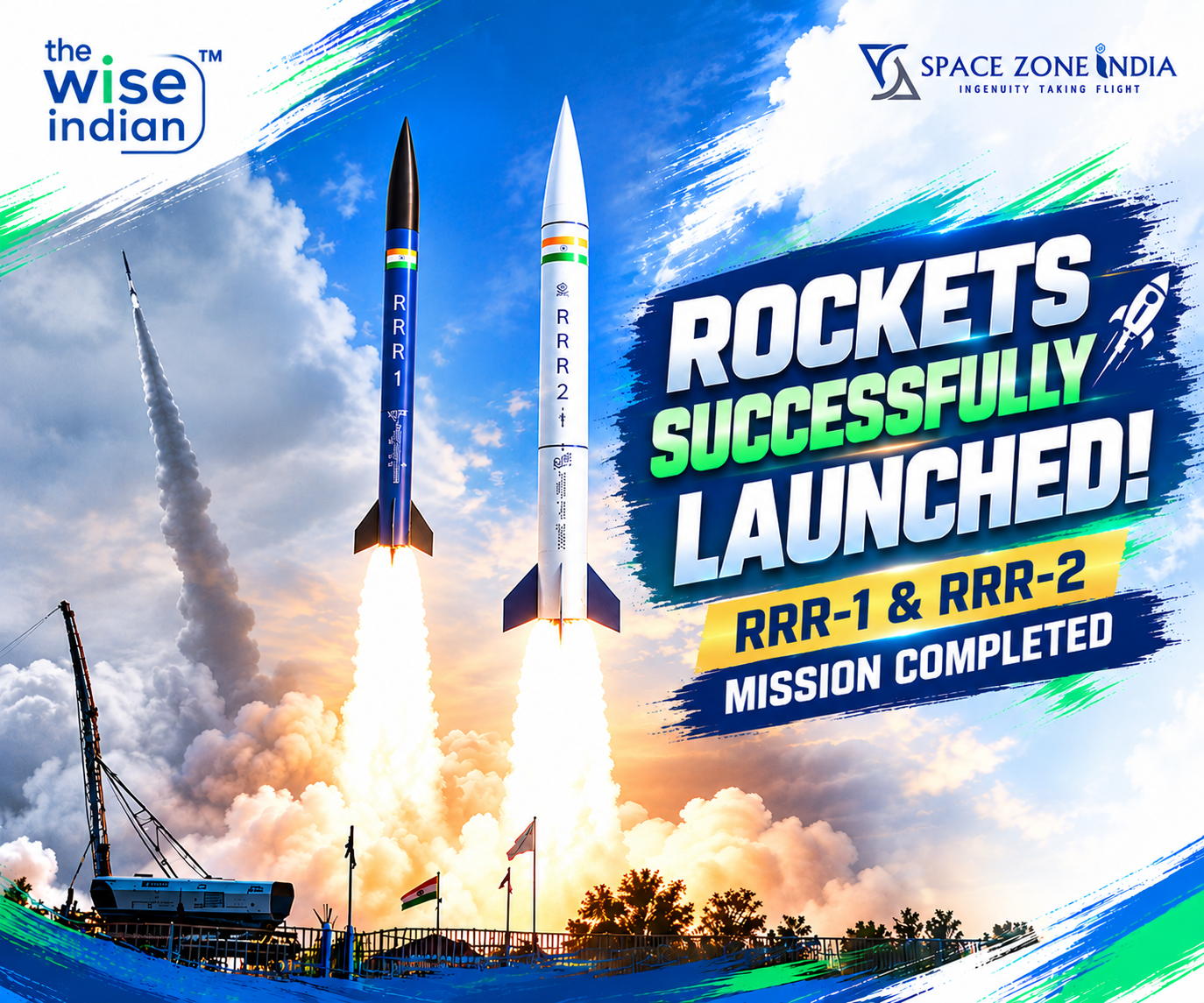
India has tested two homegrown rockets, RHUMI 1 and RHUMI 2, near Chennai. Both run on hybrid rocket engines that a private Indian startup developed. The twin launch took place on October 10, 2026. Notably, it aimed to test engine restart and inspire young students.
Twin Rockets Lift Off Near Chennai
First, Space Zone India launched both rockets simultaneously at 7 am on October 10. The site was Tiruvidanthai, along the East Coast Road near Chennai. Organisers named the effort Mission RHUMI Twin 2026. Martin Group and the US-based Global Help International Foundation also joined Space Zone India as organisers. Each rocket measures 3.1 metres in length and 164 mm in diameter. Moreover, each one weighs 35 kg. Both rockets rely on an indigenous restart mechanism.
The hybrid rocket engines inside them can fire, pause and fire again. As a result, the mission put restart technology through a real flight test. Furthermore, the team expects the data to support future research and development in the space sector. Space Zone India is a Chennai-based aerospace company. Earlier, it worked with Martin Group on the 2024 RHUMI-1 flight too. Thus, this twin launch builds on an existing partnership. Martin Group reportedly spent more than Rs 1.5 crore from its corporate social responsibility funds. Therefore, the project had solid financial backing for its student programme.
How Hybrid Rocket Engines Work
First, hybrid rocket engines pair a solid fuel with a separately supplied oxidiser. This design sits between solid and liquid propulsion. For example, Space Zone India’s 2024 rocket used a solid fuel with a liquid oxidiser. Next, consider the layout. In a typical hybrid motor, the solid fuel sits inside the casing as a cylinder. The oxidiser then flows over it. As the two meet, combustion begins and thrust follows. Solid motors usually burn until their fuel runs out. In contrast, a hybrid design can allow controlled shutdown.
Operators simply interrupt the oxidiser flow. Therefore, the engine can stop and later restart. Moreover, many engineers value hybrids because fuel and oxidiser stay separate until ignition. Besides, compared with liquid engines, hybrids need plumbing for only one fluid. The design can also cut operating costs, according to the team behind RHUMI-1. Furthermore, the team flies its rockets from a mobile launch platform. This setup allows flexible launch locations. Therefore, test flights may need less fixed infrastructure.
Why the Restart Test Matters
Space Zone India reports a successful demonstration of an in-flight rocket engine restart mechanism. The company’s statement calls its vehicle RRR-1, short for RHUMI Restart Rocket. Meanwhile, news coverage names the two rockets RHUMI 1 and RHUMI 2. Further clarification on the naming would help. The engine ran for 14 seconds in total. A three-second unpowered interval separated the burns. Additionally, the company’s caption describes a nine-second burn, a three-second shutdown and a five-second reignition. In plain terms, the engine fired, paused briefly and fired again. That sequence, if confirmed, shows the hardware can relight mid-flight.
Restart ability matters because rockets often need more than one burn. For instance, an upper stage may need to fire again to reach its target orbit. Therefore, hybrid rocket engines with reliable reignition could become more useful. Likewise, reignition also opens the door to flights with several burns. Such flights can place payloads into precise paths. Notably, the company says hybrid propulsion offers greater control over rocket operations. Shutdown and reignition sit at the heart of that control.
However, these figures come from the company itself. Independent confirmation would add weight. In addition, the company is studying how to adapt restart-capable systems to larger vehicles. It also plans to start investor discussions after the flight.
Students at the Heart of the Mission
The mission also targeted education. Students trained in satellite technology, rocket science, payload systems, avionics, sensors, telemetry, communication and atmospheric studies. Therefore, the mission aims to bring school and college learners into practical space research. In turn, that could widen participation in India’s growing space sector. Such programmes also help nurture future engineers. Importantly, this is not the team’s first flight. In August 2024, Space Zone India launched RHUMI-1 from a mobile platform at Tiruvidanthai. That rocket carried 50 pico satellites and three cube satellites. It reached about 35 km before returning to Earth.
Mayilswamy Annadurai, a former director of the ISRO Space Centre, led that expedition. He said the rocket used liquid and solid propellants to lift efficiency and trim costs. Moreover, the 2024 rocket used an electrically triggered parachute system without pyrotechnics. Its body used a carbon fibre airframe. In addition, its data aimed to support research on climate, air quality and radiation. Reports also describe it as India’s first reusable hybrid rocket. Likewise, reuse can reduce discarded rocket parts.
The Wise Take
Twin launches like this show private Indian teams pushing propulsion technology forward. The restart result looks promising. Yet the key numbers still come from a company statement. Therefore, independent data would strengthen the claim. Readers should treat the 14-second figures as company-reported until others confirm them.
Still, the student training and CSR backing add lasting value. For students, the launch turns textbook ideas into visible results. For the startup, the next challenge is scale. Larger vehicles bring tougher engineering demands. Overall, hybrid rocket engines deserve attention as a flexible propulsion option. Watch for larger vehicle plans and independent flight data in coming months.
Also read our other article on Two Villages Lost Dozens of People to Police Firing for Raising a Flag. Both Waited Decades for Recognition
Follow The Wise Indian for more inspiring stories