
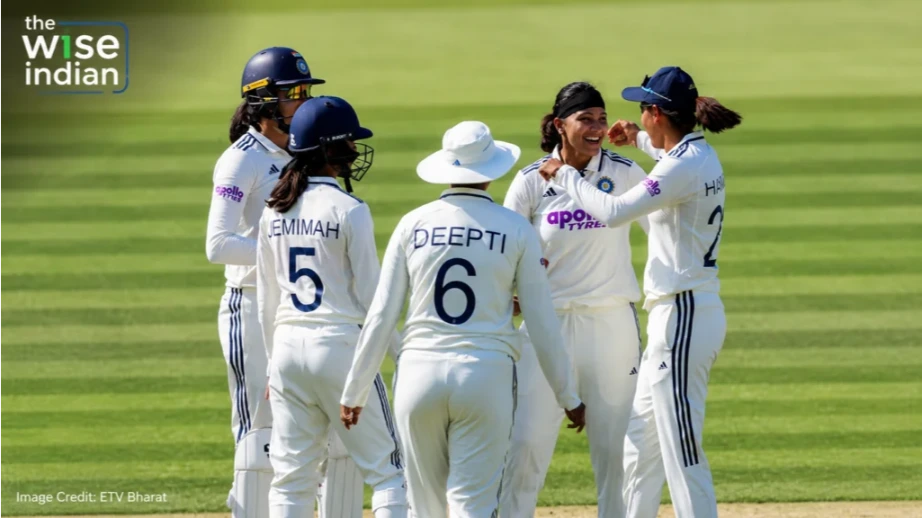
India’s victory over England in the one-off Test in July 2026 was not just a large margin. It was a young side proving it can win the longest format away from home.
Indian women’s cricket has spent much of the last decade being described in terms of promise. Promising talent, promising depth, promising results in white-ball formats. Test cricket, played rarely and won away from home even more rarely, sat outside that story.
On 13 July 2026, that changed at Lord’s. India defeated England by 270 runs in the one-off Test, a margin that left little room for interpretation.
A Win With Very Little Ambiguity
A 270-run victory is not a match decided by a single session or a fortunate declaration. It reflects sustained control across both innings and both disciplines.
The Board of Control for Cricket in India described the result as a landmark achievement and a defining moment for a young side, noting that winning a Test at Lord’s carries particular weight for any cricketer. Both innings contributed to the margin, which is unusual for a touring side in England and suggests the bowling attack held up across changing conditions rather than in a single favourable spell.
Why the Venue Matters
Lord’s occupies an outsized place in cricket’s imagination, and results there travel further than the scorecard alone would justify.
For a team that plays Test cricket infrequently, an away victory at that ground answers a question that shorter formats cannot. It demonstrates the patience, fitness and tactical discipline the five-day game demands. India have historically played very few Test matches in a calendar year, which means opportunities to build a record in the format arrive rarely and carry disproportionate weight when they do.
A Squad in Transition
The result came from a side blending experienced players with a newer generation, several of whom have entered the setup over the past two seasons.
Discussion around leadership has been part of that transition, with Smriti Mandhana indicating in mid-July 2026 a willingness to take on greater captaincy responsibility for India. Building continuity in a squad that plays across three formats with limited red-ball cricket is a selection challenge without an obvious solution, and it is one the team has been navigating publicly.
A Crowded Calendar Ahead
The win sits within a dense schedule. India’s fixtures through the second half of 2026 include the Women’s Twenty20 Asia Cup in Dubai, the cricket competition at the Asian Games, and a home series against Zimbabwe.
Managing workload across formats is now a genuine selection problem for Indian women’s cricket, which is itself a sign of how far the structure has come. Rotation, recovery and the balance between franchise and international commitments are now live questions in the women’s game in India, in much the same way they became live in the men’s game a decade ago.
The Wise Take
The temptation with a result like this is to call it a turning point and move on, which usually means nothing much changes. What makes this one worth marking is the format. Test cricket rewards depth that cannot be assembled quickly, and it exposes teams that have been carried by two or three individuals. A 270-run win away from home says the base is broader than it was. The harder work now is structural, not emotional. More Test matches scheduled, more first-class cricket beneath them, and a domestic system that produces players ready for five days. The win earns that argument a hearing.