
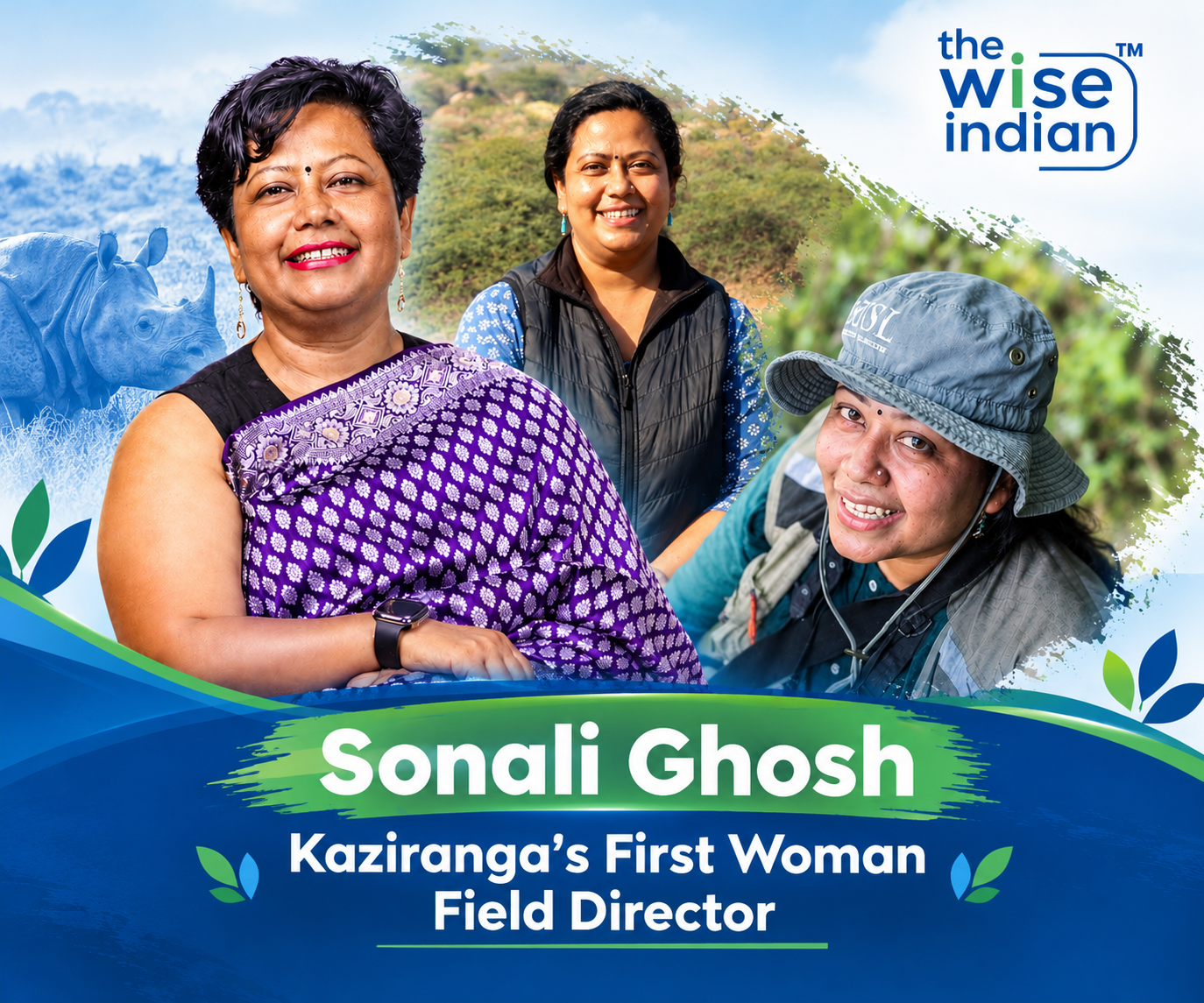
On 1 September 2023, Sonali Ghosh walked into history. She became the first woman field director of Kaziranga National Park in Assam. The park was 118 years old and had never had a woman lead it. Since then, she has led flood rescues, anti-poaching drives and community outreach.
Sonali Ghosh: From an Army Family to the Forest Service
Sonali Ghosh was born in 1975 into a middle-class family. Her father served in the Indian Army. As a result, the family moved often across the country. Those moves exposed her to forests, rivers and wild landscapes. Moreover, the time she spent outdoors shaped her bond with nature. She calls herself a late bloomer. However, her fascination with life sciences kept growing. Later, she won a seat at the Wildlife Institute of India in Dehradun. There, her hidden passion became a lifelong purpose. Then she joined the Indian Forest Service.
She joined the Indian Forest Service in 2000 and began her career at Kaziranga. Later, she served as Assistant Conservator of Forests there. She also served in the Assam State Zoo Division. At Chakrashila Wildlife Sanctuary, she worked to save the endangered golden langur. In Kokrajhar, she oversaw the first successful release of hand-raised, orphaned clouded leopard cubs back into the wild. She also played a vital role in reviving Manas as a UNESCO World Heritage Site.
Breaking a 118-Year Barrier
The Assam government issued the order on 25 August 2023. It followed the retirement of Field Director Jatindra Sharma on 31 August. Before the posting, she served as Chief Conservator of Forests in Guwahati. Ghosh took charge on 1 September. Thus, a woman finally headed the famous rhino park. Her path was not easy. Early in her career, she was the only woman in the field. Basic facilities such as toilets and clean drinking water were missing at field posts. Moreover, she faced scepticism and a constant need to prove herself. She also says some people still believe women cannot give work equal time. Her advice to others is simple. Develop a thick skin, like a rhino.
Once in charge, she set two clear priorities. First, protect the wildlife. Second, look after the frontline staff who serve in some of the toughest conditions. She has patrolled alongside these guards, so she understands their risks. Therefore, her leadership blends enforcement with empathy. In 2024, Prime Minister Narendra Modi toured Kaziranga with her and met the Van Durga women guards.
Leading Flood Rescues in Record Waters
Kaziranga sits on the Brahmaputra floodplain, so water shapes its life. Floods hit almost every monsoon. In 2024, Sonali Ghosh led the response as the water crossed an all-time high of 87.47 metres at Nimatighat. The earlier record stood at 87.37 metres, set in 1991. The park has 233 forest camps, and dozens went under water. Because many camps lie deep inside the park, monsoon often cuts staff off from roads. Therefore, she made staff welfare a priority alongside animal safety.
Rescue work began at once. Park officials rescued 157 wild animals, including two rhino calves and two elephant calves. Forest veterinarians treated them, and most were later released. Still, the flood took a heavy toll. By 21 July, officials had recorded 215 animal deaths, including 13 rhinos. Most of the dead were hog deer. Ghosh also worked to protect animals from highway traffic. Barricades and human chains of frontline workers guarded the stretches where animals cross toward the Karbi hills. Moreover, forest cadets manned those roads round the clock in batches. As a result, only two animals died in vehicle hits during the floods. In addition, the park keeps about 150 man-made highlands where animals shelter during floods.
Strengthening the Fight Against Poachers
Kaziranga shelters the world’s largest population of one-horned rhinos. Its last census before her arrival counted over 2,600 of them. The park also hosts elephants, tigers, swamp deer and over 500 bird species. UNESCO listed the park as a World Heritage Site in 1985. However, valuable horns attract organised poaching networks. Therefore, protection remains the park’s first priority. Ghosh strengthened the anti-poaching system.
She improved patrol coordination and kept frontline staff deployed consistently. Moreover, she backed intelligence-led responses to poaching threats. In addition, she promoted community-led conservation. Local families therefore build livelihoods that reduce their dependence on the forest. Assam reported zero rhino poaching in 2025. The state’s forest minister credited forest teams and local communities for the progress. State figures also put Assam’s rhinos at 3,260, roughly 80 per cent of the global population. Meanwhile, tourism hit a record, with over 5.48 lakh visitors since April 2025.
Global recognition followed. On 10 October 2025, Sonali Ghosh became the first Indian to win the WCPA-Kenton Miller Award. The IUCN World Commission on Protected Areas honoured her at the World Conservation Congress in Abu Dhabi. The award recognises innovation in national park and protected-area sustainability. In addition, it cited her community-driven, science-informed model in Kaziranga and Manas. That same year, the Sanctuary Nature Foundation also gave her a Wildlife Service Award.
The Wise Take
Sonali Ghosh’s journey offers four lessons. First, barriers fall when someone steps forward and does the work well. Second, strong leaders care for people as much as for animals. Third, conservation succeeds when communities share the mission. Fourth, field experience builds the strongest leaders. She continues to lead Kaziranga, according to reports from 2026. She also mentors young women who are entering the forest service. Therefore, girls who dream of wearing the green uniform now see a leader to follow. Her story proves that courage, empathy and persistence can protect a wild world.
Also read our other article on How Wildlife Vet Meghana Pemmaiah Went Down a 25-Foot Well in a Cage to Save a Leopard
Follow The Wise Indian for more inspiring stories.