
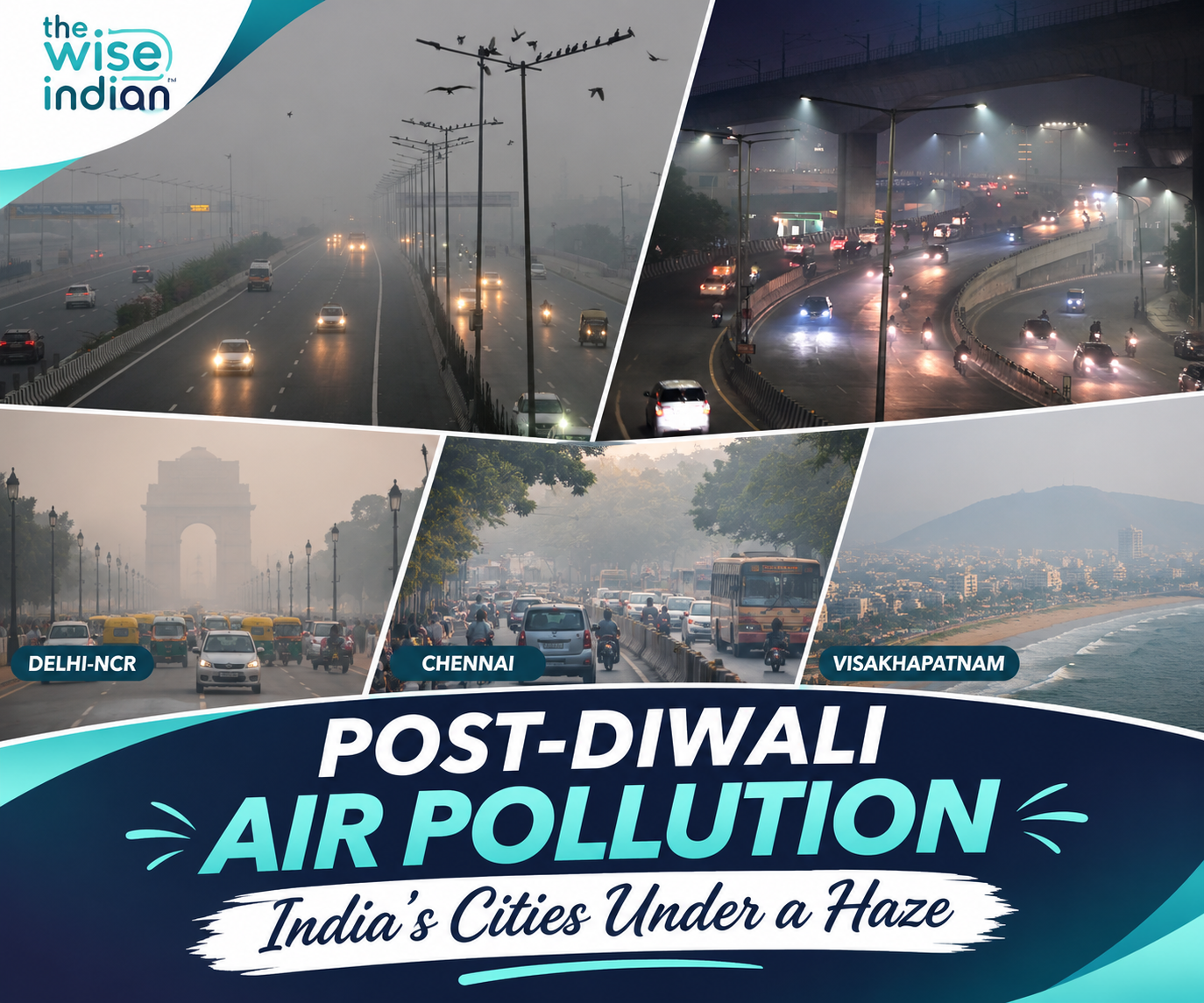
India’s post-Diwali air pollution has renewed public-health concerns after firecracker celebrations on November 8, 2026. Reports published the following day described deteriorating air quality in several regions. Delhi faced thick smog and severe readings at multiple monitoring stations. Meanwhile, Andhra Pradesh recorded worsening conditions across all 17 cities in its monitoring bulletin.
Chennai also reported elevated pollution and smoke-related disruption at its airport. Severity differed between locations, but the reports point to a shared challenge. Festival emissions can intensify pollution from traffic, construction, industry and unfavourable weather. Therefore, the post-Diwali air pollution story is broader than fireworks alone. It raises questions about monitoring, enforcement and long-term clean-air measures.
Delhi-NCR Faces Severe Air Quality After Diwali
Delhi was among the worst-affected regions after Diwali. The Indian Express reported a capital-wide Air Quality Index (AQI) of 406 early on November 9. This placed Delhi in the severe category. Central Pollution Control Board (CPCB) station data showed Jahangirpuri at 433. Chandni Chowk recorded 418, while Mundka reached 417. Anand Vihar recorded 335, which falls in the very poor category. Meanwhile, thick smog reduced visibility across several neighbourhoods.
Stage III of the Graded Response Action Plan (GRAP) was already in force across Delhi-NCR. Reuters reported a city AQI of 370 at 9 am, in the very poor category. However, several neighbourhood readings exceeded 400. Moreover, firecracker smoke added to pollution from vehicles, construction dust and crop-residue burning. In addition, low winds and cooler conditions limited pollutant dispersal. The episode shows why festival restrictions alone cannot solve the city’s air pollution problem.
Andhra Pradesh Reports Deterioration Across 17 Cities
The problem extended beyond the capital. A Press Trust of India report published November 9 described deterioration across all 17 monitored Andhra Pradesh cities. The state pollution control board placed Visakhapatnam at an AQI of 264. That was up from 229 a day earlier. Rajamahendravaram recorded the sharpest rise, climbing from 104 to 220. As a result, the city moved from moderate to poor air quality. The remaining 15 cities were in the moderate category, with readings between 101 and 200. Tirupati recorded 191, Nellore 175 and Srikakulam 170.
Eluru registered 118. In particular, PM2.5 was the predominant pollutant in Visakhapatnam and Rajamahendravaram. By contrast, PM10 was more prominent in Amaravati, Eluru and Kakinada. Amaravati, Vijayawada, Guntur and Anantapur also moved down from satisfactory air quality. However, the figures do not mean all 17 cities entered poor or severe categories. Instead, they show broad deterioration. Therefore, post-Diwali air pollution coverage must include smaller cities, not only major metros.
Chennai Sees Pollution Spike and Airport Disruption
Tamil Nadu also experienced the effects of the celebrations. DT Next reported a private-monitor peak AQI above 1,200 in Chennai. The reading came around 10 pm on November 8. This figure needs qualification. It came from private platforms and cannot be compared directly with the CPCB’s official Indian AQI scale. Tamil Nadu Pollution Control Board readings on November 9 showed Manali at 277. Arumbakkam recorded 264, Kodungaiyur 220 and Velachery 202. All four stations fell in the poor category.
At the same time, smoke affected airport operations. DT Next and Moneycontrol reported disruption to 26 flights. Eleven arriving flights faced delays, while 15 departures left late. An IndiGo flight from Raipur carried 156 passengers. It could not land in Chennai and returned to Bengaluru. For this reason, airport officials monitored runway visibility as smoke accumulated near the airfield. Consequently, post-Diwali air pollution disrupted transport as well as affecting health. Official station readings also provide a sounder basis for comparison than private-platform peaks.
Why Festival Smoke Becomes a Wider Pollution Problem
Firecrackers release particulate matter and gaseous pollutants. These include fine particles known as PM2.5 and coarser particles called PM10. PM2.5 is concerning because it can travel deep into the lungs. Additionally, exposure may irritate the eyes and throat. It can also worsen asthma and aggravate respiratory or cardiovascular conditions. In particular, children, older adults and people with heart or lung disease can be especially vulnerable. However, attributing every post-festival reading to fireworks alone oversimplifies the problem.
Seasonal pollution also involves vehicle exhaust, industrial activity, construction dust and crop-residue burning. More importantly, weather matters. Weak winds, cooler temperatures and stagnant air prevent pollutants from dispersing. As a result, festival emissions add to pollution already present. For example, coastal cities may experience different wind patterns from landlocked northern cities. Traffic and industrial sources also vary locally. The post-Diwali air pollution spike is additional pressure on existing pollution. It does not prove every Indian city experienced identical contamination. Thus, reliable monitoring and attention to local sources remain essential.
The Wise Take
The latest reports point to a serious and geographically varied challenge. Delhi’s severe readings, Andhra Pradesh’s deterioration and Chennai’s airport disruption show how festival emissions affect regions differently. They also highlight the need to distinguish official CPCB or state-board readings from private estimates. Those platforms may use different scales and methods. Therefore, public agencies should publish timely neighbourhood-level data and explain what readings mean. Enforcing permitted firecracker timings and pollution-control restrictions can help. However, short-term measures cannot replace year-round action.
Furthermore, cleaner public transport, construction dust control, industrial emission enforcement and better crop-residue management all matter. Residents can reduce exposure during high-pollution periods. They can limit strenuous outdoor activity and follow local health advisories. Ultimately, cleaner air requires coordination between central and state agencies, local bodies, industries and communities. Air quality must remain a public-health priority throughout the year, not only when festive smoke becomes visible.
Also read our other article on Dhanteras 2026: Gold and Silver Sales Surge Nationwide as Festive Buying Reaches Record Levels During Peak Muhurat
Follow The Wise Indian for regular updates on stories that shape India’s strategic future and global standing. Stay connected with us for sharp analysis, untold perspectives, and a closer look at the shifting legal landscapes, civic rights, and institutional frameworks defining our democratic fabric.