
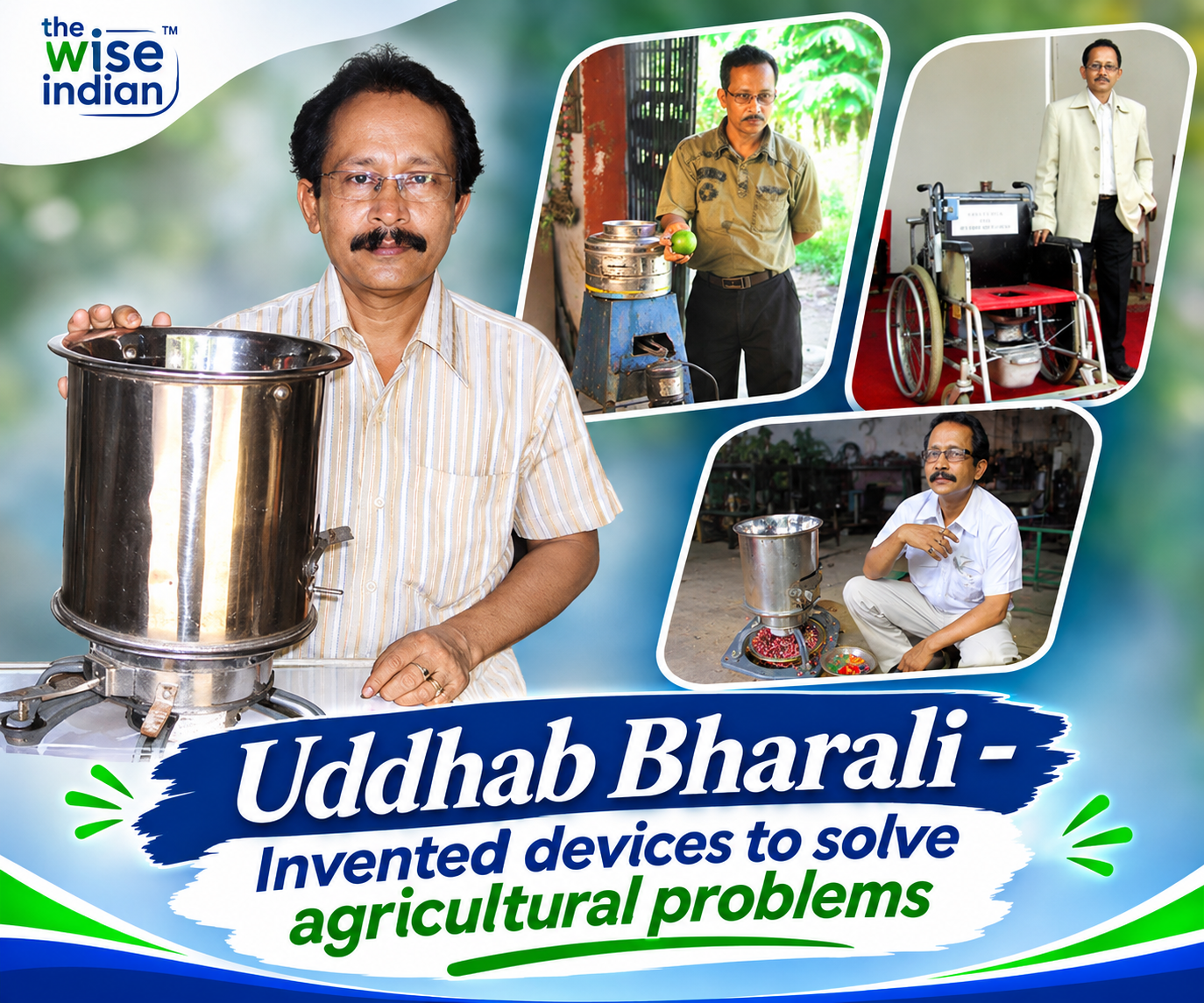
Innovation does not always begin inside expensive laboratories or advanced research institutions. Sometimes, it starts with observing everyday difficulties and developing practical solutions. Uddhab Bharali, a grassroots inventor from North Lakhimpur in Assam, has built his reputation through this approach. With more than 150 inventions reported reported by 2019, he has developed affordable machines for agriculture, food processing and disability assistance.
His work demonstrates how engineering can address practical challenges faced by ordinary people. Rather than focusing only on complex technology, Bharali creates mechanisms that make daily activities easier, reduce manual labour and improve accessibility. His journey also highlights the importance of creativity, determination and socially responsible innovation.
A Difficult Beginning That Inspired Innovation
Born on April 7, 1962, in North Lakhimpur, Assam, Uddhab Bharali developed an early interest in mathematics and practical problem-solving. He pursued mechanical engineering at Jorhat Engineering College. However, financial difficulties and family responsibilities interrupted his education. The Assam agitation also affected his studies. Following his father’s death in 1988, Bharali returned home to manage his family’s debt-ridden workshop. This unexpected responsibility changed the direction of his life.
Instead of abandoning his interest in engineering, he began applying his knowledge to practical business problems. One of his earliest challenges involved manufacturing polythene covers for tea estates. Purchasing an industrial machine required considerable investment, so he decided to develop an affordable alternative. He designed a machine that could perform the required task at a significantly lower cost. This experience encouraged him to continue developing machinery based on real-world requirements. It also established the foundation for his career as a grassroots innovator.
Affordable Machines for Farmers and Small Industries
A major part of Uddhab Bharali’s work focuses on agricultural processing and small-scale industries. Farmers often depend on labour-intensive methods because commercial machinery can be expensive or unsuitable for their needs. Bharali approaches these challenges by designing equipment that simplifies repetitive tasks and improves productivity. His pomegranate deseeding machine is among his best-known inventions. It separates the seeds from the fruit without damaging them and can process approximately 50–55 kilograms per hour. The machine also attracted international attention, with exports reported to Turkey and the United States.
His other inventions include garlic peeling machines, arecanut peelers, cassava processing equipment, bamboo-splitting machines and paddy threshers. He has also developed equipment for processing products such as safed musli and jatropha. These mechanisms address specific difficulties experienced by farmers, agricultural workers and small manufacturers. The National Innovation Foundation documented several of his early inventions in its publication, Assam Innovates. Its account highlights how his designs emerged from practical observations rather than purely theoretical engineering exercises. His work shows that affordable machinery can help smaller producers improve their operations without investing in large industrial systems.
Assistive Technology That Promotes Independence
Beyond agricultural machinery, Bharali has devoted significant attention to people with disabilities. He believes engineering should help individuals overcome practical difficulties and perform everyday activities with greater independence. His assistive inventions include specially designed feeding and cleaning devices for people who have lost their arms. These mechanisms are customised to individual requirements and have been distributed free of cost to people who cannot afford them. In 2015, The Telegraph reported on these devices and highlighted their potential to help amputees manage essential personal activities.
Another important development was his specially designed bed for people with disabilities and patients who remain bedridden. Reported in 2019 as his 155th invention, the bed included mechanisms that helped users change positions and manage personal hygiene. It also incorporated provisions for cleaning and other daily needs. Bharali subsequently worked on a moving lifter designed to help wheelchair users transfer between a wheelchair, bed and toilet. Such equipment addresses challenges that conventional products may overlook. His approach places accessibility at the centre of engineering design. By developing practical devices for underserved communities, he demonstrates that technology can support dignity, comfort and independence.
National Recognition and International Achievements
Bharali’s inventions have attracted recognition from scientific organisations, educational institutions and government bodies. In 2007, he received the SRISTI Samman for his contributions to grassroots innovation. Two years later, he received the President’s National Grassroots Innovation Award, recognising his practical engineering work. His designs also received international attention through NASA Tech Briefs’ Create the Future Design Contest. He earned recognition in the 2012 and 2013 editions for different inventions, including his pomegranate deseeder and a specially designed chair for people with intellectual disabilities. In 2014, Assam Agricultural University awarded him an honorary Doctor of Science degree.
This recognition acknowledged his contributions to practical technological development despite his incomplete formal engineering education. His work also received attention from organisations supporting rural technology and innovation. One of his most significant achievements came in 2019, when the Government of India awarded him the Padma Shri in the Science and Engineering category for grassroots innovation. The honour brought wider national attention to his work. It also highlighted the importance of inventors who develop solutions outside conventional research institutions. His achievements demonstrate how practical engineering can gain recognition through its contribution to society.
Engineering With a Human Purpose
For Bharali, innovation extends beyond designing machines or receiving awards. His work reflects a broader commitment to making useful technology accessible to people who need it. His workshop and machine design activities in North Lakhimpur provide a setting for developing equipment based on specific community requirements. Reports have also highlighted his support for underprivileged families and people with disabilities. He has spoken about dedicating time to developing assistive devices and providing certain inventions without charge.
This approach distinguishes socially focused innovation from technology developed exclusively for commercial markets. His agricultural machines address the needs of small producers, while his assistive equipment responds to everyday accessibility challenges. Both areas share a common principle: technology should solve problems that people actually experience. His journey also challenges the assumption that meaningful inventions require expensive infrastructure or prestigious institutional backgrounds. Careful observation, experimentation and an understanding of local needs can produce useful engineering solutions.
The Wise Take
Uddhab Bharali’s journey from managing a financially struggling workshop to becoming a Padma Shri recipient illustrates the possibilities of grassroots innovation. His inventions connect engineering with agriculture, accessibility and everyday life. More importantly, his work reminds us that technological progress should not be measured only by complexity or commercial success. Its real value lies in making life easier, safer and more independent for the people it serves.
Also read our other article on Clean Air Should Not Be a Luxury: How AIIMS Advice Exposes India’s Unequal Access to Pollution Protection
Follow The Wise Indian for more stories about the people and ideas quietly reshaping India.