
Air pollution is often discussed through AQI readings, hospital warnings and seasonal smog. Yet behind those numbers are people who cannot simply escape polluted surroundings. In November 2025, AIIMS New Delhi shared practical advice for reducing exposure, including indoor exercise and checking local air quality. Yet not every household can follow this advice. Findings published in 2026 make unequal access to clean air harder to ignore.
AIIMS Advice and the Unequal Cost of Air Pollution Protection
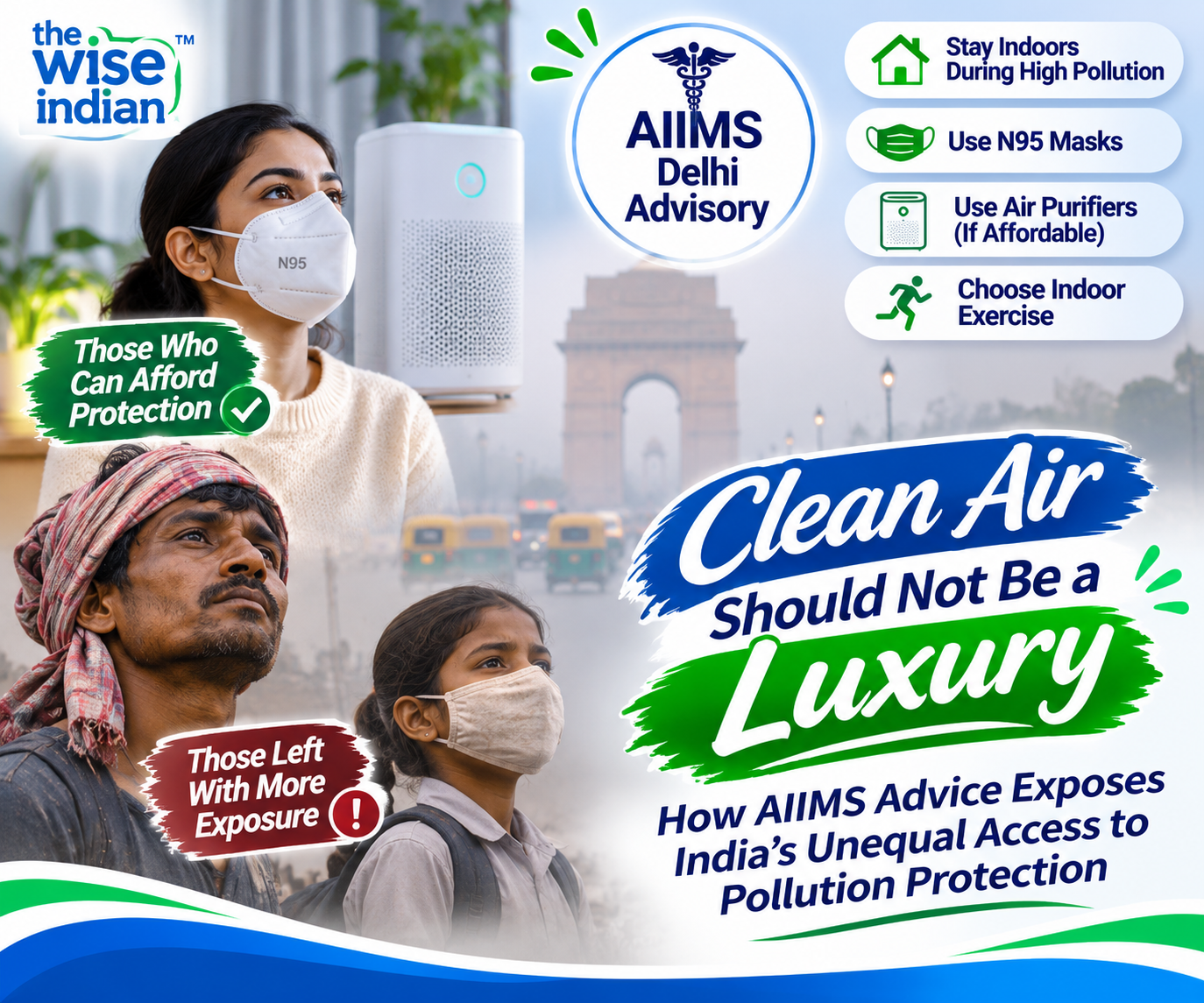
In November 2025, AIIMS New Delhi shared an advisory featuring Dr Harshal Ramesh Salve from its Centre for Community Medicine. It advised people to monitor the Air Quality Index (AQI), avoid strenuous outdoor exercise and choose indoor activities. It also recommended properly fitted N95 masks when necessary. It also suggested avoiding congested roads, using air purifiers where affordable and observing a weekly petroleum-free day. These steps guide individual decisions, but cannot remove air pollution at its source. Someone working from home may change routines. Street vendors and construction workers may have no choice but to remain outdoors.
The affordability question is visible in the price of household filtration. Business Standard reported in November 2025 that a basic air purifier could cost around ₹12,000–₹15,000. This was a reported range, not a fixed price for every model. Filters also need replacement, adding recurring costs. For families balancing essential expenses, this can be difficult. Smaller homes may also lack a separate room for effective filtration. Access to clean air indoors can therefore depend partly on income.
2026 Research Brings Workers Into Focus
The issue of air pollution is not limited to Delhi-NCR. On October 28, 2026, Chennai-based organisation Citizen consumer and civic Action Group (CAG) published Resilience under Smog. It examines exposure, health sensitivity, socio-economic vulnerability and coping capacity among outdoor workers in Chennai. The report identifies semi-formal workers as particularly vulnerable and describes structural challenges faced by informal workers. It calls for worker-centred health protection, social support and inclusive urban planning. The report widens the air pollution debate. Outdoor workers cannot always stay home during poor AQI conditions without losing income.
A research highlight published by Nature India on June 1, 2026, points to another dimension. It describes an IIT Delhi-led study combining nationwide health survey information with estimates of fine-particle exposure. Researchers found that long-term PM2.5 exposure placed a disproportionate disease burden on poorer, less educated and socially disadvantaged groups. Rural residence and limited healthcare access were also associated with greater vulnerability. Income alone does not determine health. However, exposure can deepen disadvantages when people lack resources for treatment or better housing.
What India’s 2026 Air Pollution Numbers Reveal
Government figures published by the Press Information Bureau in September 2026 offer one measure of national progress. Under the National Clean Air Programme, 108 cities recorded lower annual PM10 concentrations in financial year 2025–26 than in 2017–18. Of these, 72 recorded reductions above 20%, while 26 recorded reductions above 40%. The government also reported that, as of March 2026, India’s air-quality monitoring network included 1,646 stations across 603 cities. The SAMEER application provided near-real-time AQI information for more than 292 cities. This indicates wider monitoring and lower measured particulate levels in many cities. However, a reduction from a baseline does not automatically mean standards are being met.
An independent assessment published by the Centre for Research on Energy and Clean Air in January 2026 adds context. Among 100 National Clean Air Programme cities with sufficient PM10 data, 23 recorded increases and 77 recorded reductions. Yet 68 of those 77 cities still exceeded the national PM10 standard. The assessments use different methods and are not directly interchangeable. Together, they show that progress can coexist with pollution above standards. In June 2026, the Commission for Air Quality Management reviewed Delhi-NCR enforcement. Its review covered vehicle emissions, construction dust, waste and industrial standards. Lasting improvements require control of multiple sources.
From Private Protection to Shared Responsibility
The Central Pollution Control Board’s SAMEER app helps people check hourly AQI updates and register pollution complaints. Indoor exercise, less congested routes and a well-fitted N95 respirator can reduce some exposure. Yet staying inside does not guarantee clean air. Outdoor particles enter homes, while cooking smoke, tobacco, incense and mosquito coils add pollutants. India’s October 2025 advisory recommends wet mopping and reducing indoor smoke. The World Health Organization reviewed real-world studies of portable air filters. They lowered indoor PM2.5 by around 40–82%, although evidence and maintenance limitations remain. Filtration helps, but cannot guarantee clean air outdoors.
Protection should become less dependent on private spending. Schools, libraries, healthcare centres and community halls could offer cleaner indoor spaces. This would require suitable filtration and funded maintenance. Employers could provide protective equipment, cleaner rest areas and work arrangements that reduce exposure. These are proposals, not services available everywhere. Authorities also need public transport, dust and waste controls, and enforcement of industrial and vehicle standards. National monitoring shows both progress and continuing gaps, while 2026 worker research highlights unequal exposure. Individuals cannot control emissions around their homes and workplaces.
The Wise Take
AIIMS offered practical steps to reduce exposure, while 2026 research has added evidence about who bears a heavier burden. A purifier may help at home, but cannot clean a street or protect a worker throughout a shift. AQI information alone cannot create safer workplaces or affordable healthcare. Policy must combine air pollution control at its source with protection for those facing the greatest exposure. Cleaner transport, enforcement and accessible health guidance all matter. Clean air should not depend on a family’s ability to buy an appliance; it is a public-health necessity.
Also read our other article on A Childhood Washed Away by Her Mother’s Schizophrenia: How Neha Kirpal Turned Pain Into Care for Thousands of Families
Follow The Wise Indian for more stories about the people and ideas quietly reshaping India.