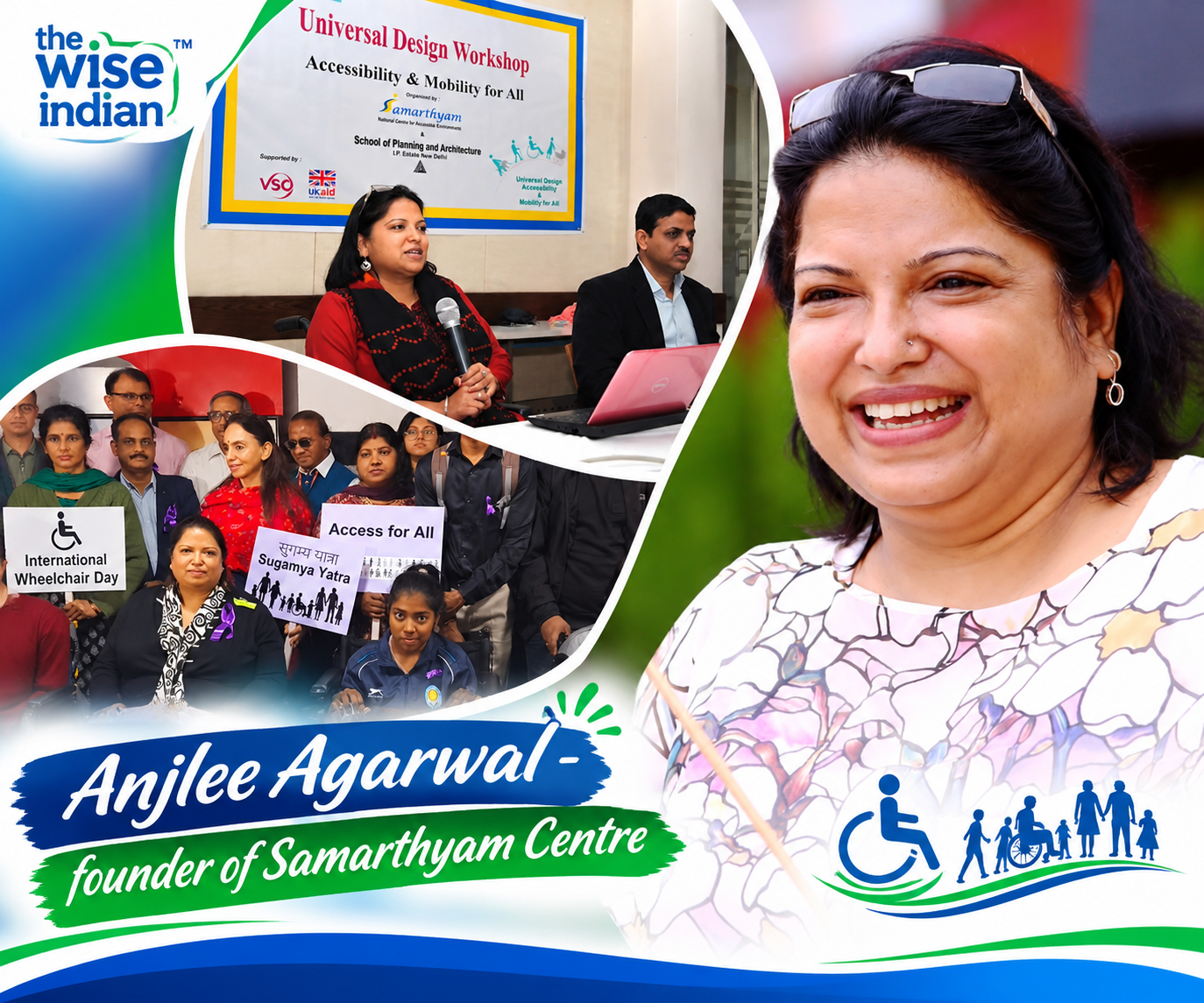
A staircase can keep a child out of a classroom. An uneven footpath can turn a short journey into a difficult task. For people with disabilities, these barriers shape everyday life, yet thoughtful design can prevent many of them. In Delhi, Anjlee Agarwal has spent more than three decades challenging the idea that accessibility is optional. Through Samarthyam, the organisation she co-founded, she works to make schools, transport systems and public spaces more inclusive. Her journey shows how lived experience and persistent advocacy can change shared environments.
Anjlee Agarwal Turned Lived Experience Into a Mission
Anjlee Agarwal understands inaccessible spaces through her own life as well as her professional work. She has lived with limb-girdle muscular dystrophy since she was 18 and uses a wheelchair. Everyday activities can become complicated when buildings lack lifts, pavements remain uneven or public transport ignores different access needs. However, she turned these experiences into a wider mission. She questioned why people with disabilities had to depend on others to enter buildings or use public facilities. Instead, she argued, spaces should allow people to move independently and with dignity.
In 1991, she joined two other persons with disabilities to establish Samarthyam. The organisation promotes accessible environments and disability inclusion. It was formally registered in 2001. Over time, its work expanded from awareness and advocacy into accessibility audits, research, training and policy engagement. It gained special consultative status with the United Nations Economic and Social Council in 2015. For Anjlee Agarwal, the principle remains clear: accessibility is a right, not a favour that institutions may choose to provide.
Anjlee Agarwal: Making Schools Accessible for Every Child
Education creates opportunity. However, a school cannot offer equal access if a child cannot enter its building. The same applies when children cannot reach classrooms or use toilets independently. Anjlee has therefore made inclusive education an important part of Samarthyam’s work. Since 2012, the organisation has partnered with UNICEF across five states. Its work includes school and Anganwadi accessibility audits, training and capacity-building initiatives. These efforts recognise that inclusion must extend beyond classroom admission. Children also need safe routes, usable facilities and opportunities to participate in school activities.
In 2023, Samarthyam collaborated with the World Health Organization to conduct special accessibility audits in 33 government schools in Delhi. The assessments examined barriers affecting children with disabilities and identified changes that could make school environments more inclusive. The organisation has also developed resources on accessible schools and supported education for children with severe and multiple disabilities. These practical steps matter because a ramp alone cannot make a school inclusive. Entrances, corridors, classrooms, toilets, playgrounds and emergency arrangements must work together.
Rethinking Streets, Transport and Public Spaces
Anjlee’s work reaches far beyond school gates. For a wheelchair user, a broken footpath or missing kerb ramp can make a nearby shop unreachable. Similarly, inaccessible buses, railway stations and public buildings can restrict someone’s ability to study, work or participate in community life. Samarthyam has worked with planners, engineers and public authorities to assess transport systems and improve access. Its projects have covered metro systems, railway facilities, airports, public buildings and pedestrian infrastructure. The organisation involves people with disabilities in assessments, so recommendations reflect real journeys and everyday needs.
The Delhi Metro became an important part of this work. Samarthyam worked with the Delhi Metro Rail Corporation during the system’s early development, conducting access audits and recommending improvements. Assessments considered entrances, ticket counters, lifts, guiding paths, toilets, platforms and information systems. The organisation also contributed to accessibility work involving metro projects in Bengaluru, Hyderabad, Kochi and Jaipur. In railway settings, its work explored accessible toilets and coach design. It also examined portable devices that help passengers bridge the gap between platforms and trains. These details show why accessible transport requires a connected journey, not one isolated facility.
Shaping Guidelines and Changing Public Thinking
Physical improvements become sustainable when they influence standards used by architects, engineers and government agencies. Anjlee Agarwal has contributed through technical committees, research and policy discussions. She was a principal author of the Government of India’s 2016 Harmonised Guidelines and Space Standards. They set standards for barrier-free built environments for persons with disabilities and elderly persons. She has also contributed to the National Building Code of India and pedestrian-facility guidance developed through the Indian Roads Congress. These resources translate universal accessibility into practical requirements for buildings, streets and public infrastructure.
Her contribution also challenges assumptions about who can shape technical decisions. In an interview, she recalled being questioned about contributing to road guidelines because she was not an engineer. Her response highlighted a perspective technical teams can overlook: people who face barriers understand their impact on daily movement. This experience reinforced the importance of involving persons with disabilities in planning and decision-making. Samarthyam’s work also includes gender-responsive accessibility and involving women and girls with disabilities in disaster risk reduction. In 2025, Anjlee was invited to share expertise on accessibility and inclusive development linked to the Jakarta Declaration.
The Wise Take
Anjlee Agarwal’s work reminds us that exclusion often begins with ordinary design choices. A staircase without an alternative, a bus without accessible boarding or an unusable school toilet can limit someone’s opportunities. Yet these barriers are not inevitable. Through Samarthyam, she has brought lived experience into school audits, transport planning, public guidelines and national conversations. Her journey is not simply about creating ramps or modifying buildings. It is about changing how society understands independence and equal participation. An inclusive city allows people to enter, move, learn, travel and belong without having to ask for special treatment.
Also read our other article on The Helmet Man of India: How Raghavendra Kumar Turned Personal Loss Into a Nationwide Mission to Protect Lives
Follow The Wise Indian for exclusive stories celebrating everyday heroes who are quietly shaping the culture, sustainability, and future of a better India.