

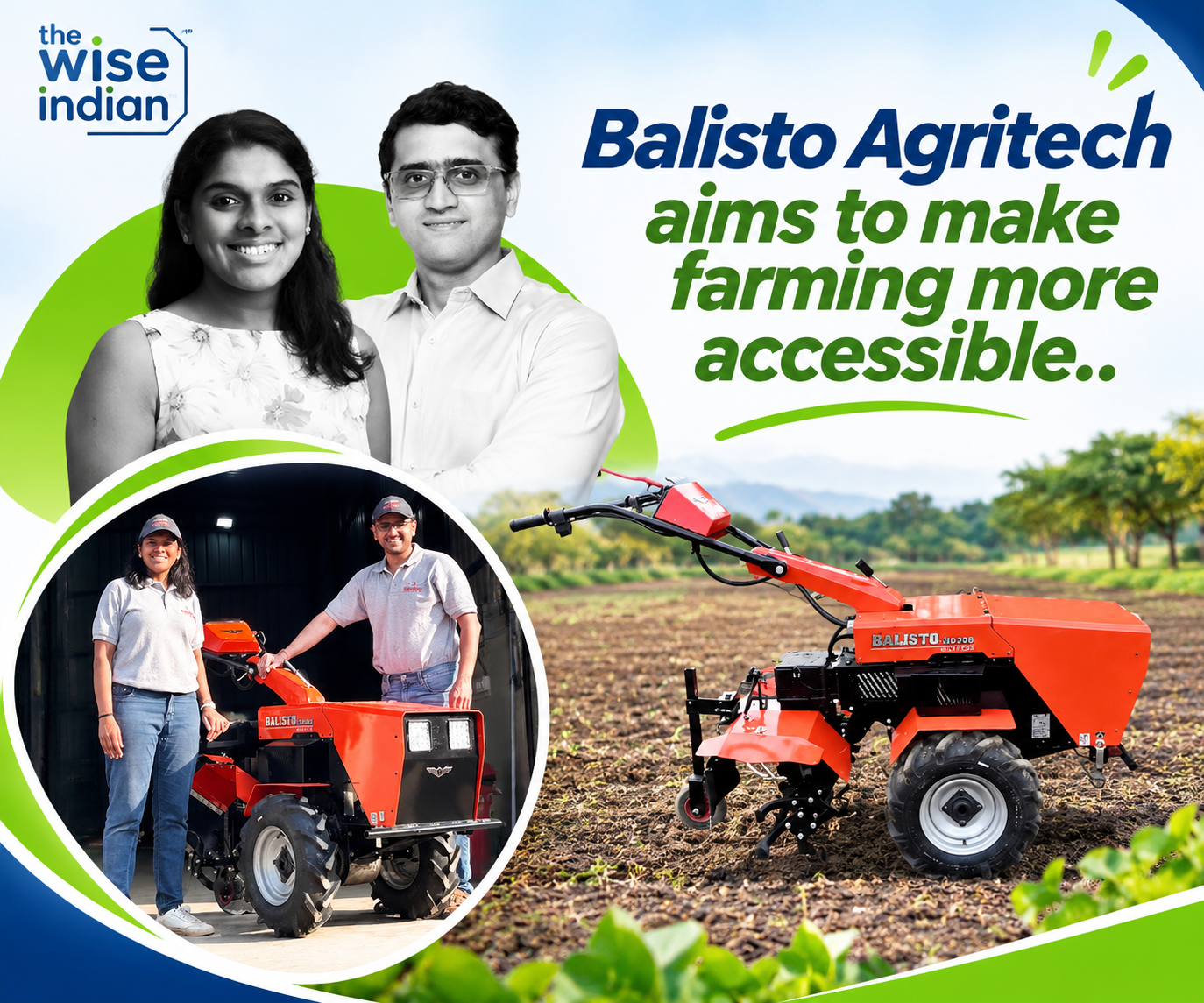
Indian agriculture faces several challenges, including labour shortages, rising fuel costs and expensive machinery. Small farmers often struggle to purchase separate equipment for different farming operations. This can increase their dependence on manual labour and traditional methods. Balisto Agritech, a Mumbai-based agricultural technology startup, aims to address these challenges through electric farm machinery.
Its multipurpose power tiller combines several agricultural functions in one machine. The startup wants to make mechanisation more accessible to farmers who cannot afford multiple expensive machines. By combining electric technology with practical farming requirements, the company hopes to offer an alternative to conventional agricultural equipment. Its approach also highlights how young entrepreneurs can use innovation to address problems in India’s agricultural sector.
From Corporate Careers to an Agricultural Challenge
Balisto Agritech began its journey in 2024 with two IIT Bombay graduates, Aishwarya Ramakrishnan and Kedar Gokhale. Both founders brought different professional experiences to the venture. Ramakrishnan pursued an MBA at Harvard Business School and worked with the Mahindra Group. Her experience included its farm equipment business and agritech venture, Krish-e. Gokhale explored entrepreneurship and later held senior operations positions at Swiggy. Their professional journeys helped them understand business operations and technology.
However, they also recognised several difficulties within Indian agriculture. Small farmers often struggle with expensive machinery, limited access to labour and increasing operating costs. Conventional equipment can also require significant investment. These challenges encouraged the founders to explore affordable and practical agricultural solutions. They established the company to develop machinery that addresses farmers’ everyday requirements. Their approach focuses on combining technology with the realities of agricultural work.
One Electric Machine for Multiple Farming Operations
The company’s flagship product, the Balisto 130 Pro, is a 13-horsepower electric multipurpose power tiller. It supports several agricultural activities through different attachments. Farmers can use it for land preparation, weeding, inter-cultivation, puddling and rotavating. It also supports earthing up and trolley operations. These functions make the machine useful across different stages of farming. The company targets crops such as paddy, sugarcane, cotton, turmeric and ginger.
Instead of purchasing separate machines for every activity, farmers can use one power unit with suitable attachments. This approach could reduce equipment investment for farmers managing smaller agricultural plots. However, actual performance depends on soil conditions, crop requirements and field size. Farmers must also consider the availability of suitable attachments. The company aims to provide a versatile alternative to conventional farm equipment. Its success will depend on how effectively the machine performs across different agricultural conditions.
Battery Technology, Remote Controls and Smart Features
The Balisto 130 Pro uses detachable lithium iron phosphate batteries to power its electric drive system. Its electronic control unit manages three motors. Two motors support wheel movement, while another powers the rear rotary implement. Farmers can operate the machine through onboard controls or a remote controller. This remote operation gives users another way to manage agricultural activities. The company has also integrated Internet of Things technology into its equipment. This system sends operational information to the company’s servers.
Its technical team can monitor machine performance and identify certain problems remotely. Electric power eliminates the need for diesel during machine operation. However, farmers must consider battery charging, maintenance and replacement costs. The startup is also developing an autonomous version of its machine. Its proposed system will use technologies such as GPS and sensors. These features could support automated movement across agricultural fields. However, the autonomous model remains under development. The current product offers electric and remote-control capabilities rather than fully autonomous farming.
Pricing, Sales and Reaching Farmers Across Markets
Balisto Agritech offers two battery configurations for its electric power tiller. The single-battery version costs approximately ₹2.5 lakh. The double-battery configuration costs around ₹3 lakh. The company also reports a three-year battery warranty. This pricing places the machine within a significant investment range for small farmers. However, its multipurpose functions could reduce the need for separate equipment. The company initially sold machines directly to customers. It later expanded through agricultural machinery dealers who help farmers purchase equipment and access after-sales support.
Balisto Agritech also works with rural entrepreneurs who purchase machines and rent them to other farmers. This model offers another way for farmers to access mechanisation without purchasing their own equipment. The startup has reported encouraging early sales. YourStory reported more than 30 machines sold and cumulative sales exceeding ₹60 lakh in October 2026. Startup Pedia later reported approximately 50 machines and around ₹70 lakh in revenue by the end of October 2026. These figures show early commercial interest in its products. However, the company still needs to expand its customer base and establish stronger market reach.
Manufacturing, Expansion and Future Plans
Although the startup operates from Mumbai, it manufactures its machines at a facility in Moshi, near Pune, Maharashtra. The facility initially supports production of approximately 60 machines each month. The company aims to increase this capacity to 150 machines monthly. Its manufacturing plans reflect an effort to prepare for growing demand. Balisto has also received early-stage investment from several venture capital firms and angel investors. These include DeVC, KPB Ventures, iSeed VC, Bharat Founders’ Fund, Spectrum Impact, Indian Silicon Valley and Amplify Fund.
The company intends to use its resources for product development, manufacturing and market expansion. It also plans to improve its existing machinery and introduce additional agricultural attachments. Developing autonomous farming technology remains another important goal. The startup has set a target of selling more than 200 machines by March 2027. This remains a future target rather than an achieved milestone. Its selection for YourStory’s Tech30 cohort in 2026 also brought recognition to its work. As the company expands, customer feedback and reliable service will remain essential.
The Wise Take
India needs agricultural innovations that address farmers’ actual difficulties. Balisto Agritech offers one approach through electric machinery that combines several farming operations. Its multipurpose design, remote controls and battery-powered system present an alternative to conventional equipment. However, affordability alone cannot determine its success. Farmers also need dependable performance, accessible servicing and practical charging facilities. The company’s ability to meet these requirements will influence its long-term growth. If it continues improving its technology and expanding its reach, it could contribute to a more accessible future for Indian farm mechanisation.
Also read our other article on Vaimanika Aerospace: How a Patna Startup Is Using 210 Agricultural Drones to Transform Farming Across India
Follow The Wise Indian for more technology-related information, insights, and daily updates on India’s tech landscape