

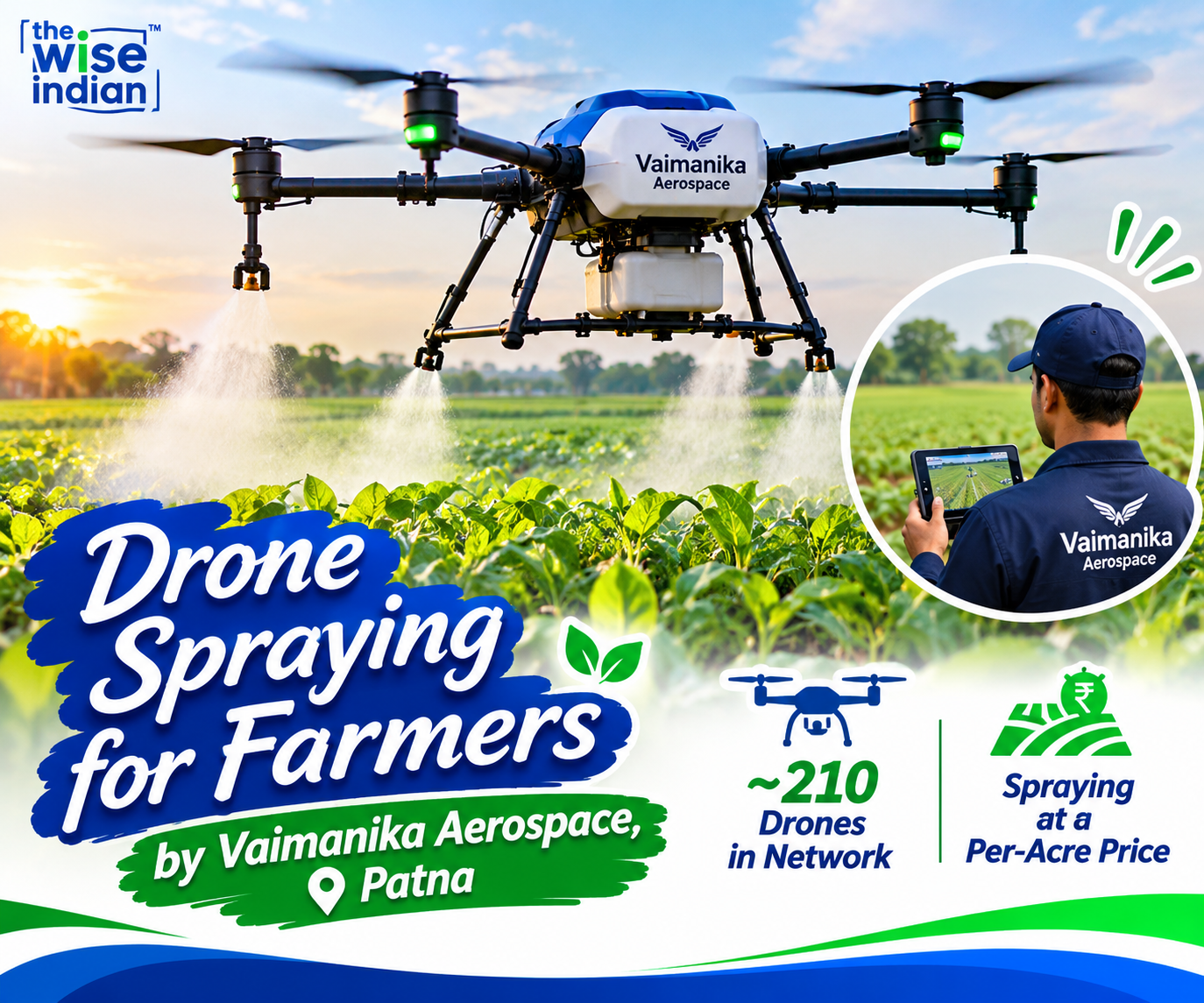
Technology is steadily changing how Indian farmers cultivate crops, manage resources and protect agricultural productivity. From automated irrigation to artificial intelligence, innovative solutions are creating new opportunities across the agricultural sector. Among the emerging businesses contributing to this transformation is Vaimanika Aerospace, a Patna-based drone technology startup. By offering agricultural spraying services at per-acre prices, the company is helping farmers access advanced equipment without purchasing expensive drones. With approximately 210 drones in its agricultural network, the startup is demonstrating how indigenous technology can support rural entrepreneurship and modern farming.
From Bihar to India’s Emerging Drone Industry
Founded in July 2022, Vaimanika Aerospace emerged from the vision of Manish Dixit, an entrepreneur with experience in robotics and unmanned aerial vehicle technology. The company was established to develop practical drone solutions for industries facing operational challenges, particularly agriculture. Its headquarters are located in Patna, Bihar, where it has been developing and expanding its drone manufacturing and service operations. The startup recognised that conventional agricultural practices often involve considerable labour, time and resource consumption. Manual pesticide spraying, for instance, requires workers to carry equipment across agricultural fields.
This can expose them to chemicals while making large-scale operations physically demanding. Therefore, the founders identified drone technology as a potential solution to improve efficiency and reduce direct human exposure. Vaimanika Aerospace subsequently developed its business around indigenous drone manufacturing and technology-based services. Its operations include agricultural spraying, drone sales, pilot training, maintenance and franchise partnerships. The company has also developed solutions for surveillance, logistics and defence applications.
Its growth attracted attention through Bihar’s startup ecosystem and institutional support. IIT Patna has featured the company in its innovation ecosystem, while the startup has also participated in industry events and government-supported initiatives. Its journey reflects the increasing potential of technology businesses emerging beyond India’s traditional metropolitan startup centres.
Making Agricultural Spraying Faster and More Accessible
Precision spraying is one of the company’s important agricultural applications. Traditional pesticide spraying can require substantial time and labour, particularly when farmers manage extensive agricultural land. Agricultural drones offer an alternative by distributing pesticides and fertilisers through controlled aerial operations. This allows operators to cover farmland without walking through every section carrying spraying equipment. According to the company’s published information, its agricultural spraying technology can cover approximately one acre in seven minutes. Its Kisan Drone V10 model features a 10-litre spraying tank and a hexacopter design. The system uses satellite-based navigation to support accurate flight operations and controlled spraying.
The technology also aims to reduce water consumption during agricultural applications. YourStory reported that the company’s spraying solution could reduce water usage significantly compared with conventional methods. However, actual savings depend on the crop, chemical concentration, field conditions and spraying requirements. Another important advantage concerns worker safety. By operating drones remotely, farmers can reduce their direct exposure to agricultural chemicals during spraying. Nevertheless, trained operators must follow safety instructions, maintain appropriate distances and use approved agricultural chemicals.
The company’s approach demonstrates how relatively simple technological interventions can address practical problems faced by farming communities. Instead of completely replacing traditional agricultural practices, these drones provide an additional option for farmers seeking faster and more controlled field operations.
A Pay-Per-Acre Model That Reduces Farmers’ Costs
One of the most interesting aspects of Vaimanika Aerospace is its Drone-as-a-Service business model. Purchasing agricultural drones requires an initial investment, which can be difficult for individual farmers with limited financial resources. Moreover, equipment ownership involves maintenance, battery replacement, training and operational expenses. To address these barriers, the company offers drone spraying services on a per-acre payment basis. Farmers can hire trained operators and access the technology whenever spraying is required. This removes the immediate need to purchase and maintain expensive equipment.
According to a June 2025 YourStory profile, the company’s agricultural spraying service was offered at approximately ₹450 per acre. Its franchise-related information also mentions service charges ranging from ₹500 to ₹1,000 per acre, depending on the service arrangement. This flexible approach creates opportunities for farmers, agricultural entrepreneurs and local service providers. Farmers pay for the actual service, while franchise partners can establish businesses around drone operations.
Furthermore, the model creates employment opportunities for trained drone pilots and rural entrepreneurs. Individuals can participate in agricultural technology services without necessarily developing their own manufacturing facilities. The company also offers training, dealership assistance and maintenance support to its partners. These services help create an ecosystem around agricultural automation rather than limiting its business to equipment sales.
Expanding Its Network to Approximately 210 Drones
Beyond individual spraying operations, Vaimanika Aerospace is building a wider agricultural service network. Its reported network of approximately 210 drones represents an important step towards expanding access to drone-based farming solutions. An August 2026 report from the company profile and recent industry coverage highlighted its agricultural operations and growing commercial activities. More recently, an Inc42 report published in October 2026 described the company’s approximately 210-drone agricultural network and nearly ₹35 crore in spraying revenue.
This development is significant because manufacturing drones alone cannot transform agricultural practices. Farmers also need access to trained operators, equipment maintenance, technical support and reliable local service providers. A distributed network can help address these requirements. The company has also pursued partnerships with agricultural organisations and businesses. Its earlier profile in YourStory reported an agreement with IFFCO covering 15 lakh acres. It also identified UPL among its important business relationships. These institutional connections could help the company reach agricultural customers beyond its immediate operating region.
In addition, the franchise model allows local entrepreneurs to participate in the growing agricultural drone industry. They can provide spraying services, maintain equipment and develop relationships with farming communities. Consequently, the business model connects technology manufacturing with rural service delivery. For farmers, the availability of nearby operators can make drone services more convenient. For entrepreneurs, it creates opportunities to establish businesses within an expanding agricultural technology market.
DGCA Certification and Opportunities Beyond Farming
Regulatory approval is essential for commercial drone operations in India. Manufacturers must meet applicable technical and safety requirements before their certified drone models can be used commercially. An important milestone came in February 2025, when Vaimanika Aerospace received a Directorate General of Civil Aviation (DGCA) type certificate for its Kisan Drone V10. The company’s published certification details identify it as a medium-class remotely piloted aircraft system designed for agricultural spraying.
The certification strengthened its position in the agricultural drone manufacturing sector. It also supported the company’s ability to undertake commercial activities under applicable aviation regulations. This development marked an important step in its journey from developing drone technology to expanding commercial operations. However, agriculture is not the company’s only area of interest. Vaimanika Aerospace also identifies surveillance, delivery, defence, mapping and infrastructure among its technology applications. Its wider portfolio reflects an ambition to develop solutions for different industries using unmanned aerial systems.
The company has also explored advanced engineering opportunities, including hydrogen-powered drone technology. Such developments indicate its interest in improving flight capabilities and exploring alternative energy systems. Nevertheless, each application involves different technical, regulatory and operational requirements. Agricultural spraying, for example, requires different equipment and approvals from surveillance or defence operations. Therefore, the company’s future growth will depend on its ability to develop reliable products for each market. Its expansion also reflects the broader development of India’s domestic drone industry. Government initiatives supporting indigenous manufacturing, agricultural mechanisation and drone entrepreneurship are creating opportunities for technology companies across the country.
The Wise Take
Vaimanika Aerospace illustrates how technology startups can address practical challenges in Indian agriculture while creating new economic opportunities. Its per-acre service model makes agricultural drones more accessible to farmers who cannot afford expensive equipment. Meanwhile, its expanding network creates opportunities for rural entrepreneurs and trained drone operators.
The reported deployment of approximately 210 drones highlights the growing demand for technology-enabled agricultural services. Although affordability, farmer awareness, regulatory compliance and operational reliability remain important challenges, the company’s journey represents an encouraging development in India’s domestic drone industry. By connecting engineering innovation with farming requirements, it is contributing to the future of precision agriculture.
Also read our other article on Three Young Engineers in Sangli Build an AI Chatbot for Autism Support and Win National Recognition at GRASP 2026
Follow The Wise Indian for more technology-related information, insights, and daily updates on India’s tech landscape