
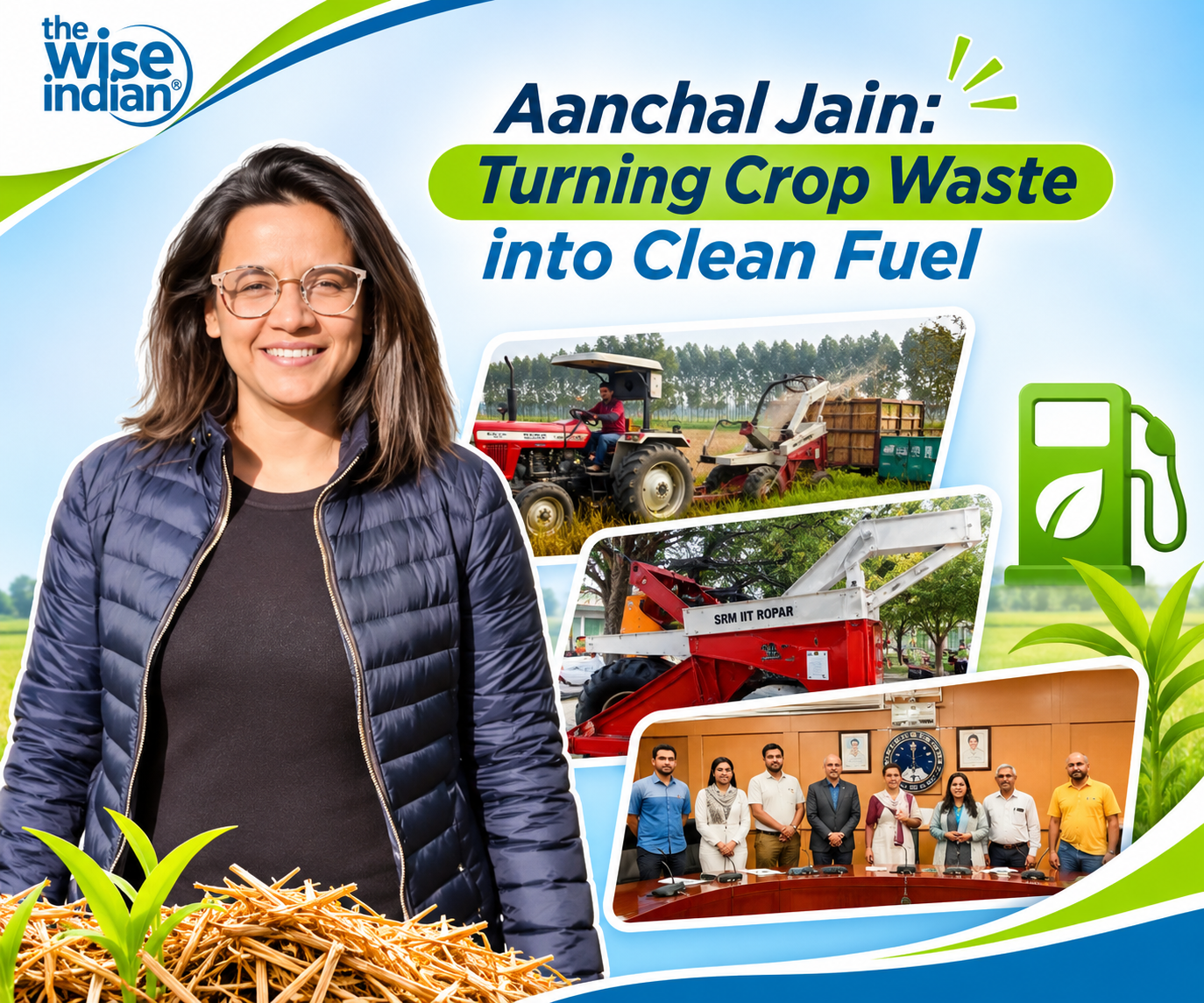
India’s stubble-burning problem often appears as a blanket of smoke over northern cities. However, the challenge begins much earlier, in farmers’ fields. After harvesting paddy, farmers must clear leftover straw before the next sowing season. When affordable collection services remain unavailable, burning can seem like the quickest option. The smoke worsens seasonal air pollution, while valuable crop residue goes unused. Delhi-based entrepreneur Aanchal Jain sees another possibility. Through Regenerix, she wants to turn agricultural waste into useful biomass fuel. Her approach connects farm management with industrial energy demand.
Seeing Value in Agricultural Waste
Regenerix works to change how farmers and industries view leftover crop residue. Instead of treating paddy straw as waste, the company sees it as a resource. Its official website says the venture converts agricultural waste into biofuel. It also describes stubble removal as a service offered without charge to farmers. This matters because farmers often work within a narrow window between harvesting and sowing. Therefore, they need practical options that do not add another expense.
Regenerix aims to collect residue and process it into fuel near the fields. As a result, farmers can clear land while the company develops a supply of raw material. The model also gives industries another potential source of energy. In this way, Aanchal Jain is linking an environmental challenge with a commercial opportunity. The business still needs reliable operations and buyers, but its central idea is straightforward.
Taking IIT Ropar Technology to Farms
A key part of the venture is its technology partnership with IIT Ropar. The institute’s iHub-AWaDH facilitated the transfer and licensing of a patented stubble-removal machine to Regenerix. Researchers Dr Prabir Sarkar and Professor Harpreet Singh developed the technology. The machine combines stubble cutting, conveying and collection in one tractor-mounted system. It cuts residue close to the ground and transfers the material into an attached trolley. Consequently, farmers can remove and gather straw through a coordinated operation.
This can reduce manual work and help prepare fields during a demanding seasonal window. The technology can also support uses beyond fuel production. IIT Ropar identifies biomass energy, biofuel, paper and pulp processing, animal bedding and composting as possible applications. For Aanchal Jain, the transfer offers a route to move academic research into field-level use. However, successful adoption will depend on dependable machinery, trained operators and timely service.
From Loose Straw to Biomass Pellets
Once workers collect the residue, Regenerix aims to process it into compact biomass pellets. The company describes a mobile pelletisation model that can operate close to villages. This approach reduces the need to transport bulky, loose straw over long distances. Instead, the collected material can move directly into a nearby processing unit. The resulting pellets are easier to store, handle and transport. Regenerix says industries can use these pellets as an alternative to coal. In particular, biomass can serve suitable industrial heating applications.
This creates a connection between seasonal crop waste and continuing energy demand. Moreover, the company’s model could create work for rural entrepreneurs who operate local pellet units. Industries may gain another fuel option, while farmers receive help with field clearance. Nevertheless, the model needs consistent residue supplies, dependable pellet quality and regular buyers. Its environmental benefits will also depend on efficient processing and transport. A viable market must support the entire chain.
A Personal Reason to Address Pollution
Aanchal Jain has also spoken about a personal reason behind her interest in air pollution. In a featured interview, she explained that pollution aggravated her son’s eczema during the affected season. That experience made the issue immediate for her family. She then explored practical ways to reduce crop-residue burning. Her search led her to IIT Ropar and its stubble-removal technology. She pursued a technology-transfer arrangement so the machine could reach farms. The story shows how a personal concern can lead someone towards a wider public problem. However, the solution must work for farmers, not simply attract attention.
Farmers need equipment and collection services at the right time. They also need confidence that the service will reach their fields reliably. Regenerix says its removal service does not charge farmers. If the model works at scale, it could make residue collection easier while supplying raw material for fuel. The company’s challenge is to turn that promise into dependable local operations. The company must also prove that local processing remains affordable during peak harvest periods. That test will shape whether farmers and buyers continue using the service.
The Wise Take
Regenerix is trying to connect farmers, rural operators, processors and industrial fuel users. Each group has a different need, so coordination matters. Farmers need quick field clearance, while pellet units need steady supplies of residue. Likewise, industries need consistent fuel quality and dependable delivery. The venture has also been associated with the incubation ecosystem at IIT Kanpur. Inc42 has reported revenue of about ₹2.3 crore for the company.
That figure should remain attributed to the publication, rather than described as independently audited turnover. The next stage will require stronger local networks, repeat industrial demand and careful cost management. Moreover, the company must show that its approach can work across different farming regions. For that reason, progress should be measured through farmer participation, repeat customers and the amount of residue collected without burning. These indicators matter more than publicity alone.
Aanchal Jain’s venture highlights an important principle in climate entrepreneurship. Environmental solutions become more practical when they also address everyday economic needs. By turning crop residue into a potential fuel source, Regenerix is testing a model that could benefit farms and industries. Its long-term impact will depend on execution, affordability and sustained demand.
Also read our other article on The Helmet Man of India: How Raghavendra Kumar Turned Personal Loss Into a Nationwide Mission to Protect Lives
Follow The Wise Indian for exclusive stories celebrating everyday heroes who are quietly shaping the culture, sustainability, and future of a better India.