
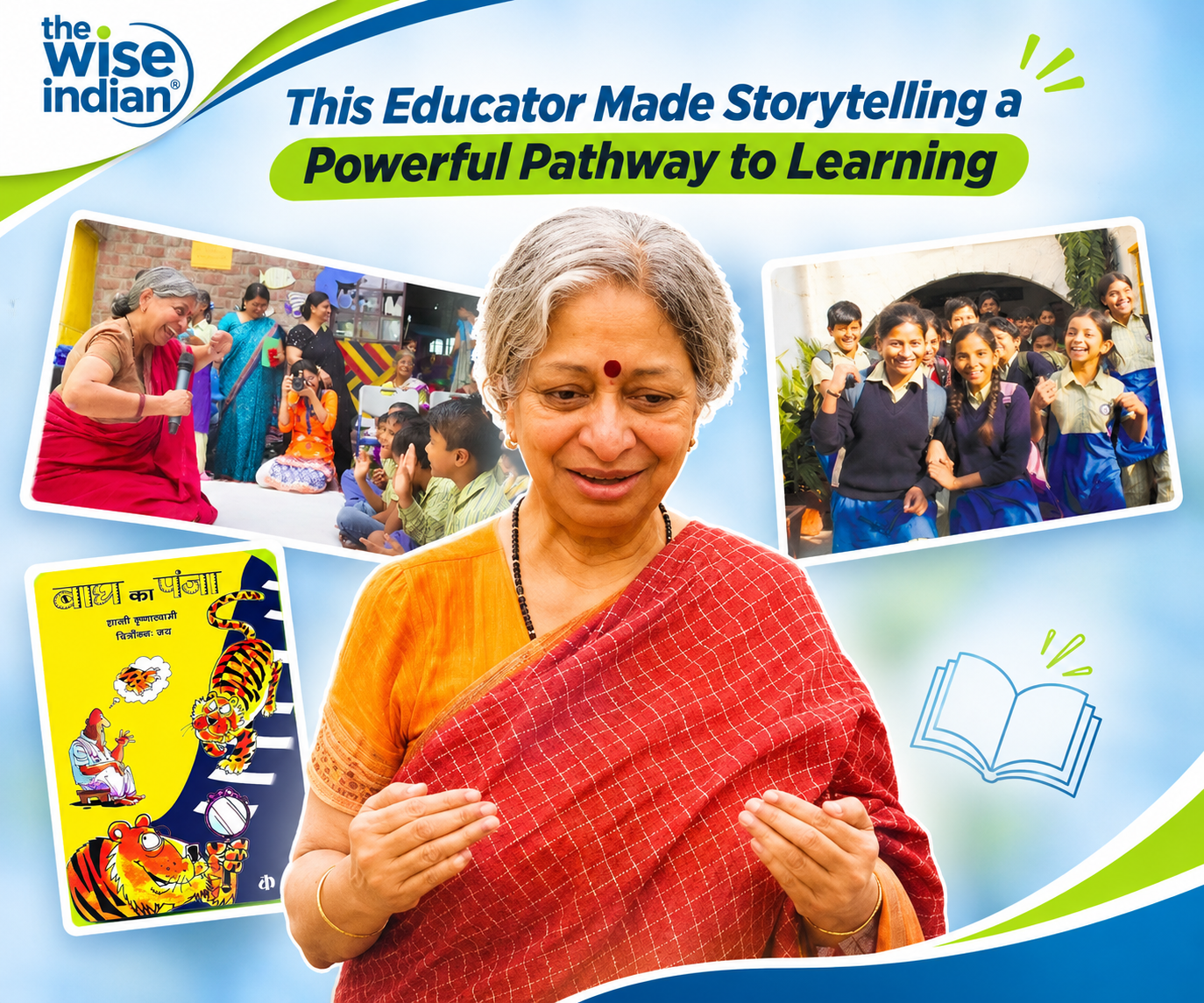
Geeta Dharmarajan is an Indian writer, editor, educationist, and social entrepreneur who has made children’s literature a practical instrument for educational change. As the founder of Katha, she developed a distinctive approach that places stories at the centre of learning.
Her work brings together reading, classroom teaching, teacher development, publishing, and community participation. Rather than treating books as an extra activity, she sees meaningful reading as a foundation for confidence, curiosity, and lifelong learning. Her journey shows how literature rooted in local cultures can help children connect classroom knowledge with the world around them.
From Writing and Publishing to a Larger Purpose
Before founding Katha, Geeta Dharmarajan built a career across writing, editing, education, and cultural work. Katha’s official biography records her professional experience with the India Today Group, the University of Pennsylvania, and the Indian National Trust for Art and Cultural Heritage (INTACH). For Geeta Dharmarajan, these roles brought her into contact with publishing, communication, and educational initiatives. After returning to India, her interactions with children and teachers deepened her understanding of the barriers facing young learners.
In parts of Delhi, she saw children growing up in communities where poverty, limited access to books, and weak educational support could restrict their choices from an early age. As a writer, she believed stories could offer an inviting starting point. This conviction gradually shaped a practical mission: make reading accessible, enjoyable. It relevant to children whose experiences were rarely reflected in conventional learning materials. Her professional background therefore became a resource for social action, connecting literary skill with a clear educational purpose.
Founding Katha and Taking Reading Into Communities
In 1988, she founded Katha, beginning with the children’s magazine Tamasha!, which used engaging content to encourage reading. She also introduce subjects such as health and the environment. The magazine was not intended to be literature separated from everyday life. It aimed to make useful information understandable and enjoyable for young readers. The initiative soon revealed a larger challenge. Children needed more than appealing publications: they needed regular opportunities, patient guidance, and learning spaces that would help them become confident readers. Katha established its first learning initiative, the Khazana Experiment, in Govindpuri, Delhi, in 1990.
The programme focused on children from economically disadvantaged communities and later developed into the Katha Lab School. Its approach also recognised that education is influenced by family circumstances. Katha connected learning with community participation and livelihood initiatives, including opportunities for women, so that families could better support children’s education. The organisation formally registered as a nonprofit in 1989, and its work grew from publishing into literacy programmes, schools, teacher training, and wider community development.
StoryPedagogy: Learning Through Stories
A defining contribution of Geeta Dharmarajan is StoryPedagogy, Katha’s story-centred teaching approach. Developed under her leadership and used in Katha learning centres since 1992, the method places narrative at the heart of classroom learning. Instead of relying only on memorisation or disconnected textbook exercises, teachers use stories to introduce ideas, invite questions, and connect academic subjects with familiar situations. A story can provide a context for exploring language, mathematics, science, social relationships, and practical problems. Children are encouraged to discuss what they read, interpret events, imagine alternatives, and apply ideas to their surroundings.
Katha explains that the method draws on traditional Indian storytelling practices and ideas associated with Bharata’s Natya Shastra. Its purpose is not simply to entertain learners. It is to make education child-centred and meaningful while developing reading ability, curiosity, empathy, communication, and critical thinking. Through this model, a child can move from listening to a story to asking questions about the community and considering possible solutions. StoryPedagogy also informs Katha’s teacher-training and publishing work, helping create continuity between books, classrooms, and community learning.
Literature, Translation, and Community Impact
Katha’s work extends beyond its learning centres. The organisation connects grassroots education with children’s publishing, literary translation, teacher development, and community programmes. Translation has been especially important to its mission. India’s literary traditions span many languages, yet children may have limited access to stories written in languages beyond their own. By publishing and translating writing from different parts of the country, Katha helps young readers encounter varied voices, places, and experiences. The effort also supports writers, translators, editors, and illustrators, strengthening the wider ecosystem of children’s literature.
At the community level, Katha’s educational model encourages children to see learning as something they can use beyond examinations. Its programmes have linked reading and inquiry with everyday concerns such as sanitation, safe drinking water, health, hygiene, and education. This connection matters because children are not separated from the circumstances around them; they can become participants in improving those circumstances. Katha’s current organisational profile says its work has reached more than 12.4 million children and young people. That figure reflects the organisation’s reach, while its central idea remains simple: joyful reading can open doors to wider learning and participation.
The Wise Take
Geeta Dharmarajan’s contribution lies in treating storytelling not as a decorative addition to education but as a serious way to help children understand, question, and engage with the world. Her work through Katha brings together literature, teaching, and community development, showing that educational opportunity depends on more than access to a classroom. In 2012, the Government of India awarded her the Padma Shri for her contributions to literature and education. She has also been recognised as an Ashoka Fellow and served as honorary Chairperson of National Bal Bhavan.
These honours acknowledge a career that has combined creative work with sustained social purpose. Her legacy is visible in the learning model she helped shape and in the belief that children from every background deserve books that speak to them. When stories reflect a child’s language, culture, and everyday life, reading can become a source of confidence as well as knowledge. That is the enduring lesson behind Katha: every child should have the chance to read, imagine, and lead.