
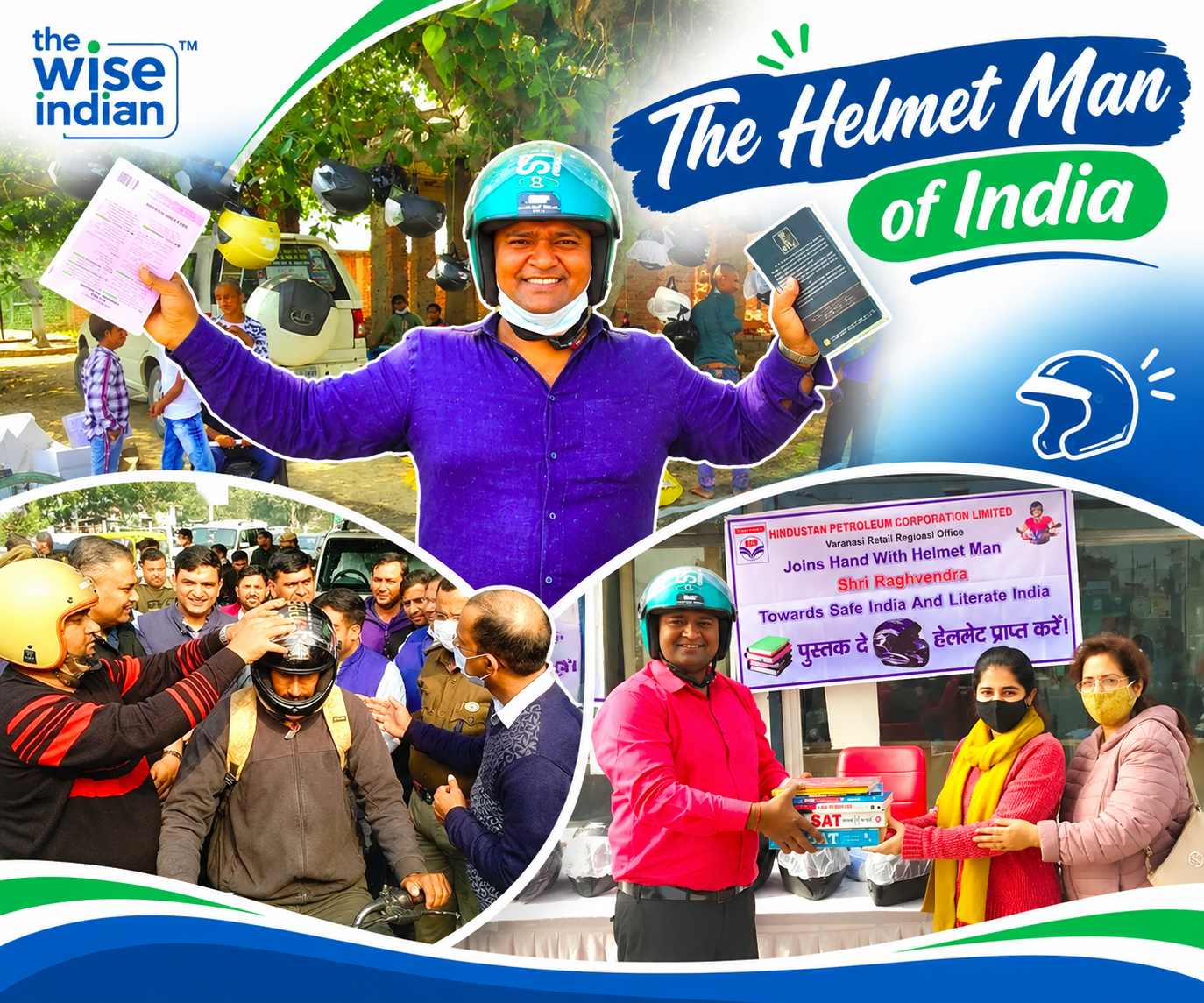
Sometimes, a single incident can change the direction of an entire life. For Raghavendra Kumar, the loss of a close friend became the beginning of an extraordinary mission. A law graduate from Bihar, he witnessed how the absence of a simple safety measure could cost someone their life. Instead of allowing grief to define his future, he decided to prevent other families from experiencing similar pain. Today, he is popularly known as the ‘Helmet Man of India’, with more than 60,000 helmets distributed across 22 states. His journey is not simply about giving away protective equipment. It is about turning personal heartbreak into a movement that encourages thousands of people to value their lives.
A Friend’s Death That Changed Raghavendra Kumar’s Life
Raghavendra Kumar comes from Kaimur district in Bihar and pursued his law degree at Lloyd Law College in Greater Noida, Uttar Pradesh. During his college years, he shared a hostel room with Krishna Kumar Thakur, an engineering student from Madhubani, Bihar. The two became close friends and shared ambitions of building meaningful careers while contributing something valuable to society. However, their dreams took a devastating turn in March 2014, when Krishna met with a road accident while travelling towards Greater Noida. He was riding a motorcycle without a helmet and suffered severe head injuries.
Despite receiving medical treatment, he died after spending several days in hospital. His death deeply affected Raghavendra, particularly because Krishna was the only child of his parents. He also witnessed the suffering of Krishna’s family, who had invested their hopes in their son’s future. That experience made him question why something as simple as wearing a helmet could be neglected. He realised that many riders underestimated the dangers of travelling without proper head protection. Rather than treating the incident as an unfortunate memory, he decided to act. By October 2014, he had begun distributing free helmets to riders who travelled without them. His friend’s death had given him a purpose that would eventually reach communities far beyond his hometown.
From a Personal Promise to a Nationwide Road Safety Mission
Initially, the initiative started on a small scale, without an established organisation or financial backing. Raghavendra used his personal savings to purchase helmets and distributed them whenever he encountered riders without protective headgear. He approached people directly, explained the risks and encouraged them to wear helmets. He did not want his campaign to become another awareness programme that people would quickly forget. Instead, he wanted every interaction to encourage a lasting change in behaviour. For nearly two years, he continued this work alongside his professional responsibilities. However, his growing commitment eventually demanded more time and resources.
In 2016, he left his job as a lawyer to concentrate entirely on road safety awareness. He also adopted an unusual approach to attract attention, wearing a helmet even while driving his car. His message was simple: safety should never become optional. As his work expanded, he travelled across different states, distributing helmets to people who needed them. According to reports published by The New Indian Express, he had distributed nearly 50,000 helmets across 22 states by 2021. By 2025, The Logical Indian reported that his distribution figure had crossed 60,000. This achievement established his reputation as the Helmet Man of India and brought his campaign national attention.
The Personal Sacrifices Behind Raghavendra Kumar’s Mission
Behind every helmet distributed was a financial commitment that became increasingly difficult to maintain. Purchasing thousands of helmets required substantial resources, and Raghavendra initially depended on his savings. However, his personal funds could not support an expanding nationwide campaign indefinitely. He eventually made sacrifices that extended far beyond giving up a comfortable professional career. In 2018, he sold his Greater Noida apartment to finance additional helmet purchases. Reports also revealed that he used money from investments and other personal assets to sustain the initiative. His wife, Dhanlaxmi Singh, supported the campaign by contributing her jewellery towards its expenses.
He also sold ancestral agricultural land in Bihar when the financial pressure increased. According to his interviews with the media, he had spent approximately ₹2 crore on purchasing helmets over the years. These decisions affected his family’s financial stability, but he continued working towards his original purpose. In March 2023, he spoke openly about his financial difficulties and considered returning to his ancestral village. Nevertheless, he made it clear that financial struggles would not end his road safety campaign. His story also highlights the importance of support systems for individuals pursuing long-term social initiatives.
Beyond Helmets: Connecting Road Safety With Education
Over time, the initiative developed into something larger than helmet distribution. Raghavendra recognised that road safety awareness and education could work together to create lasting social change. An incident involving his late friend’s old textbooks inspired another important part of his mission. During a visit to Krishna’s family, he noticed books that were no longer being used. With the family’s permission, he collected them and donated them to an underprivileged student. Later, the student’s family contacted him with encouraging news about the child’s academic achievement. That experience motivated him to collect unused books from people and distribute them among students who needed educational resources.
He subsequently introduced a book-for-helmet exchange programme, connecting educational support with road safety awareness. Under this initiative, people could exchange books for helmets, encouraging participation in both causes. His organisation also worked towards establishing libraries for underprivileged children. The Logical Indian reported in May 2025 that his efforts had helped establish approximately 1,400 libraries across 22 states. He also promoted helmet banks, where riders could borrow protective headgear instead of travelling without it. These initiatives demonstrate how one person’s response to tragedy gradually expanded into multiple community-focused activities.
The Wise Take
Raghavendra Kumar’s journey reminds us that meaningful change does not always begin with enormous resources or established institutions. Sometimes, it begins with an individual who refuses to ignore a problem after experiencing its consequences personally. He could not bring his friend back, but he transformed that painful experience into an opportunity to protect other families. His sacrifices, educational initiatives and nationwide helmet distribution campaign demonstrate the power of sustained commitment. More importantly, his story carries a message that every motorcycle rider should remember. A helmet is not merely a traffic requirement or an accessory; it is essential protection. While his journey continues, the impact of his work offers an inspiring reminder that one person’s determination can influence thousands of lives.
Also read our other article on Shilpi Soni and Elina Mishra: The ISRO and BARC Scientists Who Took Over PM Modi’s Social Media on Women’s Day
Follow The Wise Indian for more inspiring stories.