

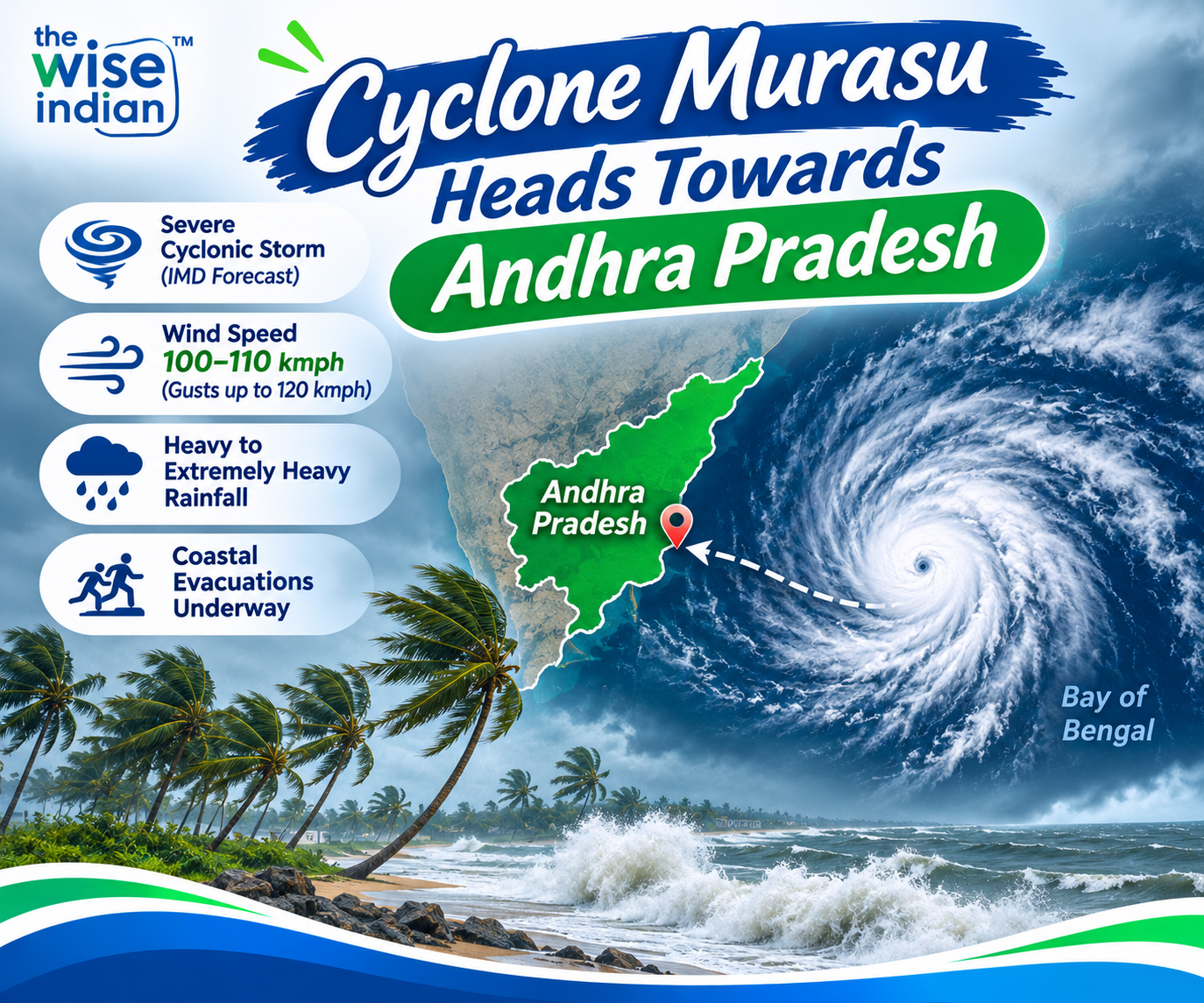
A cyclonic system over the Bay of Bengal has intensified into Cyclone Murasu, raising concerns along India’s eastern coastline. The India Meteorological Department (IMD) has forecast further intensification as the storm moves towards Andhra Pradesh. The system is expected to cross the south Andhra Pradesh coast between November 2 and 3. Coastal districts are preparing for strong winds, heavy rainfall and potentially hazardous sea conditions. Odisha is also monitoring the developing weather system as southern districts face forecasts of intense rainfall.
Cyclone Murasu Intensifies Over the Bay of Bengal
The deep depression over the southwest and adjoining southeast Bay of Bengal intensified into Cyclone Murasu on November 1, according to the IMD. The system was moving west-northwestwards when it developed into a cyclonic storm. At 11.30 a.m. IST, it was centred near latitude 12.1°N and longitude 85.3°E. It was approximately 560 kilometres east-southeast of Chennai and 630 kilometres east-southeast of Nellore.
The weather system subsequently continued moving towards the northwest. By the evening, the IMD’s coastal bulletin placed its centre near latitude 12.4°N and longitude 84.6°E. Its position was approximately 480 kilometres east-southeast of Chennai. The department reported sustained winds and gusts consistent with its cyclonic classification.
The cyclone received the name Murasu, contributed by India under the regional naming system. The name means a traditional drum, commonly associated with announcements and public gatherings. The naming process follows the list maintained by the World Meteorological Organization’s regional cyclone naming arrangement. The designation helps meteorological agencies and coastal communities identify the storm in warnings and public communications.
Cyclone Murasu Forecast to Cross Andhra Pradesh Coast
The IMD expects the system to intensify into a severe cyclonic storm over the west-central Bay of Bengal around November 2. It is then likely to move northwestwards towards the south Andhra Pradesh coastline. The latest national bulletin identifies the stretch between Nellore and Narsapur as the projected landfall region. The department expects the storm to cross the coastline between approximately 11.30 p.m. on November 2 and 4 a.m. on November 3. At landfall, sustained wind speeds could reach 100 to 110 kilometres per hour. Gusts may reach 120 kilometres per hour, according to the forecast. These conditions could affect coastal infrastructure, electricity networks, transport services and agricultural areas.
The IMD has also warned about a possible storm surge along the south Andhra Pradesh coast. Water levels could rise approximately one metre above the astronomical tide during landfall. Low-lying coastal areas of Bapatla, Krishna and Prakasam districts face particular exposure. The department has identified these districts as locations where the peak surge could occur. The forecast remains subject to updates as the cyclone approaches land. Changes in its movement or intensity could affect the timing and location of landfall. Authorities and residents have therefore been advised to monitor subsequent meteorological bulletins.
Heavy Rainfall Forecast for Andhra Pradesh and Odisha
Coastal Andhra Pradesh is expected to experience widespread rainfall as the cyclone approaches. The IMD forecasts heavy to very heavy rainfall at a few places on November 2 and 3. Extremely heavy rainfall is also possible at isolated locations during this period. Heavy rainfall may continue at isolated places on November 4. Rayalaseema is also expected to receive rainfall under the system’s influence. The department has forecast heavy to very heavy rainfall at isolated locations on November 2 and 3. These conditions could increase the risk of waterlogging and flooding in vulnerable areas. Local authorities will need to monitor low-lying settlements and drainage systems.
Southern Odisha is also expected to receive rainfall, although the storm’s projected landfall remains along Andhra Pradesh. The IMD forecasts heavy rainfall at isolated places on November 2. Rainfall intensity is expected to increase on November 3 and 4. Heavy to very heavy rainfall is possible at isolated locations across the southern region. The rainfall forecast places districts in southern Odisha under close observation. Ganjam, Gajapati, Rayagada, Koraput and Malkangiri are among the areas highlighted in local weather reports. The Odisha administration is monitoring vulnerable settlements and areas affected by earlier weather events. The actual rainfall distribution will depend on the cyclone’s movement and associated weather conditions.
Coastal Warnings and Disaster Preparedness Measures
The developing storm has prompted maritime warnings along the eastern coastline. The IMD has advised fishermen not to venture into the southeast Bay of Bengal on November 1 and 2. Restrictions also apply to the southwest and west-central Bay of Bengal during the approaching storm period. Fishing operations along the Andhra Pradesh coast are advised to remain suspended from November 2 until November 4 afternoon. Sea conditions are expected to deteriorate as the cyclone strengthens.
The IMD forecasts high to very high sea conditions along the Andhra Pradesh coast between November 2 and November 3. Rough to very rough conditions are also expected along the south Odisha coast. Port authorities have been instructed to maintain the prescribed warning signals. Authorities in Andhra Pradesh have started reviewing emergency arrangements ahead of the projected landfall. Chief Minister N. Chandrababu Naidu directed officials to remain prepared for rescue and relief operations.
The administration is coordinating arrangements involving disaster response personnel, equipment and essential supplies. Vulnerable coastal communities may be shifted to safer locations depending on local assessments and official instructions. Odisha has also strengthened preparations in its southern districts. State Disaster Management Minister Suresh Pujari reviewed the arrangements, according to The New Indian Express. District administrations have been instructed to prepare for possible flooding and waterlogging. Disaster response teams are also being kept ready in vulnerable locations.
The fresh warning comes shortly after Cyclone Arnab affected parts of the eastern coastline. Several communities are still dealing with the consequences of that earlier weather event. The possibility of another period of heavy rainfall has increased the importance of emergency coordination. Authorities are monitoring developments to reduce risks to residents, infrastructure and agricultural areas.
The Wise Take
Cyclone Murasu has intensified over the Bay of Bengal and is forecast to approach the south Andhra Pradesh coast as a severe cyclonic storm. The projected landfall between Nellore and Narsapur could bring strong winds, heavy rainfall and a possible storm surge. Southern Odisha is also preparing for intense rainfall, despite the absence of a projected direct landfall there. As the system develops, timely warnings, coordinated disaster response and public adherence to official safety instructions will remain essential.
Also read our other article on Kotpad Weaving of Koraput: How Mirgan Weavers Dye Adivasi Pata With Aal Roots While Only 18 Households Survive
Follow The Wise Indian for exclusive stories celebrating everyday heroes who are quietly shaping the culture, sustainability, and future of a better India.