
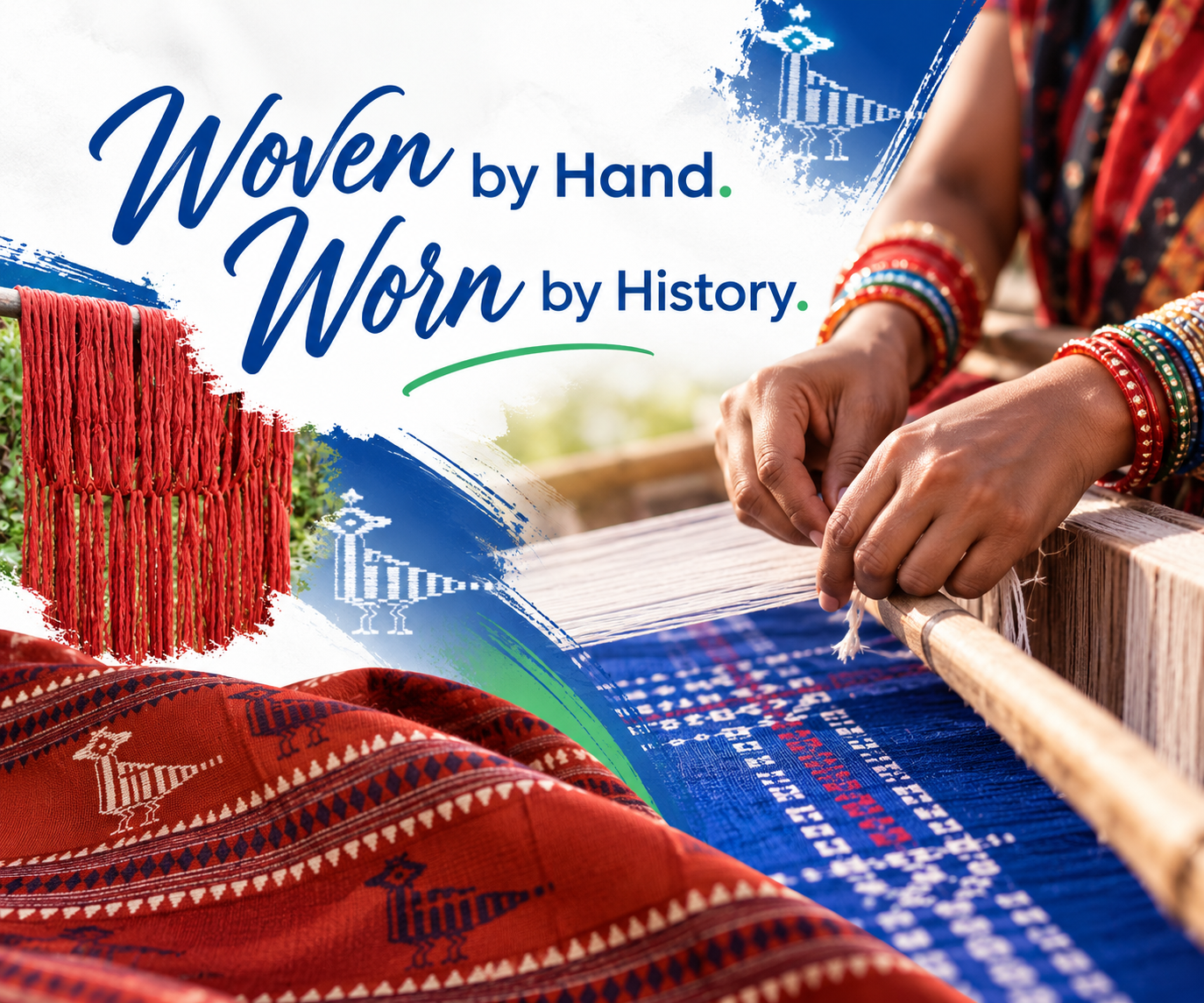
A deep red cloth, dyed with tree roots, still comes from a small Odisha town. Kotpad weaving is that rare craft. Mirgan weavers in Koraput make it by hand. Yet only about 18 households now keep the looms running.
What Is Kotpad Weaving and Who Makes It?
Kotpad weaving is a tribal textile tradition from Kotpad village in Koraput district, southern Odisha. The village lies about 70 km from Koraput town. The Mirgan community weaves it, and locals call the cloth Adivasi Pata. The name means textile of the original inhabitants. Moreover, it is Odisha’s first Geographical Indication tagged product. The tag arrived in 2005. The craft began with tribal people weaving their own clothes. Later, Mirgan weavers made cloth for the Koraput Raja.
Subsequently, they wove it for tribes such as the Gond, Bhatra, Dharua and Paroja. Each group received its own motifs. These designs marked weddings, births and the hunting season. Thus, the cloth works as a cultural code. The fabric looks simple, yet it is rich in detail. Heavy undyed cotton carries reds, maroons and browns. Some pieces also use tussar silk. Weavers use pit looms with a multi-shuttle interlocking technique to create the motifs. Animal and bird motifs add a storytelling touch.
How Aal Roots Turn Yarn Red
The process starts with cotton yarn, which is often handspun. Weavers treat it with cow dung, ash and castor oil. Then comes the dye, made from the dried roots of the Aal tree. The tree is a species of Indian mulberry (Morinda citrifolia). Workers crush the roots into powder and mix it with castor oil and water. The yarn is then soaked and boiled in this solution. The dyeing is slow and laborious. In fact, it takes 15 to 30 days to dye the yarn. The best season runs from November to March, when rain stays away. Dye strength and root age decide the final shade. As a result, colours range from red to maroon to brown.
Women usually prepare the dye. Men weave the cloth on pit looms made of wood and bamboo. A saree can take about a month to finish. Besides, the main colour comes from natural roots, not synthetic dyes. The yarn is dyed and dried at least twice. Dyers also add ground iron sulphate to get darker browns and black. Hence, each batch carries its own earthy tone.
A Craft Down to a Handful of Homes
Kotpad weaving was once a thriving community occupation. Today, the picture looks very different. Local estimates suggest only 15 to 20 households weave actively. In contrast, over 100 households wove cloth two to three decades ago. The dyers have shrunk in number as well. The Kotpad Weavers Cooperative Society, founded in 1956, puts the dyers at just 30 to 40 women. These numbers show how fast a living tradition can shrink.
Few young people are learning the skill. Padma Shri awardee Gobardhan Panika has warned that his generation could be the last. He and his wife Jemamani have won national awards for their work. Meanwhile, cooperative leaders say the women’s labour remains undervalued. Leaders also warn that, without training for young women, the art may vanish. Demand does exist. Kotpad sarees, shawls and stoles have found buyers in India and abroad. Designers, NGOs and traders have helped create new products for niche markets. However, this work is irregular and mostly reaches reputed master weavers.
Why Forests and Factories Threaten the Craft
Two forces hurt the craft the most. First, power looms and cheap factory clothes cost Kotpad weaving its traditional market. Factory cloth is easy to find and costs much less than handloom. Meanwhile, a single handloom piece takes weeks to make.
Second, deforestation has sharply cut the number of Aal trees. Earlier, the trees grew abundantly in local forests. Adivasi communities such as the Muria, Koya and Bhatra harvest the roots in deep forests. Now, forest department limits make root collection hard for tribal women. In addition, roots reportedly come from areas 80 to 100 kilometres away. Climate change and environmental damage also threaten the Aal tree. Prices reflect the squeeze. A NIFT Bhubaneswar professor notes that dried roots now cost about three times more. Earlier, a 14 kg bundle sold for roughly Rs 500 to Rs 700. Now it fetches Rs 1,800 to Rs 2,200.
The state responded in 2019. It planted Aal trees across about two acres in Thenguda village. However, this remains only a temporary fix. Weavers also claim that harvesting root ends does not harm the tree. Yet research to confirm the forest department’s claims is minimal. Money troubles deepen the crisis. Orders often pass through master weavers and moneylenders, who keep much of the profit. The cooperative system, meant to help, mainly benefits master weavers. Many weavers also lack access to government schemes. Consequently, ordinary weavers see little of the support meant for them.
The Wise Take
Kotpad cloth is more than a saree or a stole. It carries tribal memory, forest knowledge and women’s skill. Saving it needs action on three fronts. First, protect Aal trees through science-backed plantation and fair harvest rules. Research must verify whether root harvesting harms the tree. Second, pay weavers and dyers fairly, with fewer middlemen. Designers and brands can help by paying fair rates and honouring original motifs.
Third, buy genuine handloom so that demand keeps the looms busy. Invest India’s team also suggests organic certification to open niche markets abroad. Small choices by buyers can add up to a real lifeline. Kotpad weaving can survive, but buyers and policymakers must act soon. Otherwise, a century-old red thread may snap for good.
Also read our other article on Sharan Handloom Village in Kullu: How Himachal Women Turned Household Pattu Weaving Into a Steady Income and Pride
Follow The Wise Indian for exclusive stories celebrating everyday heroes who are quietly shaping the culture, sustainability, and future of a better India.