
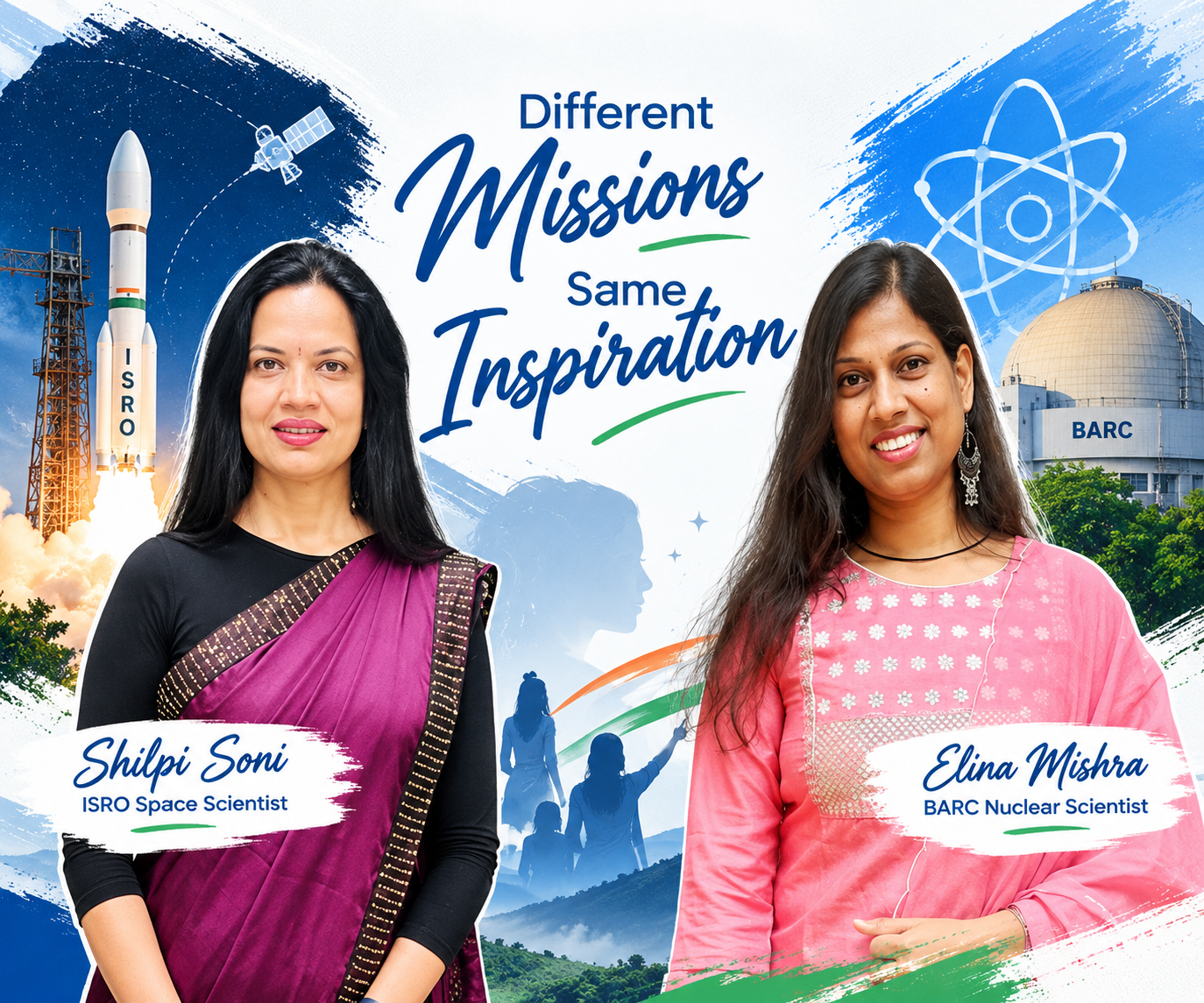
Two scientists, one huge platform and a day to remember. On 8 March 2025, Shilpi Soni and Elina Mishra stepped into a space usually held by the Prime Minister. One works on satellite communication technology at ISRO, while the other develops accelerator magnets at BARC. Together, they showed India what women in science really look like.
Shilpi Soni and Elina Mishra Took the PM’s Handle
Shilpi Soni and Elina Mishra were two of six women who took over the Prime Minister’s social media. The plan began two weeks earlier, when Narendra Modi announced it during his Mann Ki Baat radio programme. Then, on Women’s Day, he kept his promise. He posted that women making a mark in diverse fields would run his accounts for the day. The PM India website lists their joint post alongside messages from other women achievers. Their message was simple. India is a vibrant place for science, so more women should step into it.
Chess grandmaster R Vaishali opened the day with a warm Tamil greeting. Next came Elina and Shilpi, who introduced themselves as a nuclear scientist and a space scientist. Their opening line tied space technology, nuclear technology and women empowerment together. While four women shared individual stories, Shilpi and Elina chose to speak as a pair. The group also included chess grandmaster R Vaishali and rural entrepreneur Ajaita Shah. Moreover, this was not the first such handover. In 2020, seven women achievers ran the same accounts on Women’s Day. Still, this pair brought something rare to the feed: science from the lab floor.
A Daughter of Sagar Who Cycled Eight Kilometres Daily
Shilpi’s story begins in Sagar, Madhya Pradesh, in a family with modest means. She calls her background humble, yet her family always loved learning, innovation and culture. Her father, Omprakash Rusia, wanted her to study electronics and communication engineering. However, money was tight, so he borrowed at interest to pay for her education. The CSR Journal reported that Shilpi cycled eight kilometres every day to reach coaching classes. Her effort paid off, and she topped her studies.
Her mother, Sudha, studied only up to class eight. Marriage ended her schooling, so she promised that her daughters’ learning would never stop. That promise held, because the family has four daughters, and all of them built careers. Of her three sisters, two now work in Canada and one in Malaysia. Shilpi has served ISRO for 24 years, working on more than 35 communication and navigation missions. She specialises in RF and microwave subsystems, which sit at the heart of satellite communication. She also felt proud of a national milestone.
ISRO has indigenised space travelling wave tube technology, which only a handful of nations hold. For her, it marked a leap towards self-reliance in space. As a result, Shilpi has become a source of pride for all of Sagar and Madhya Pradesh.
From Bhubaneswar to BARC: Elina Mishra’s Science Journey
Elina hails from Bhubaneswar, Odisha, and her curiosity about science began with her father. She calls him her inspiration. Later, she earned a place at the Bhabha Atomic Research Centre in Mumbai. That selection turned a childhood dream into a career. Odisha Bytes noted that she and Shilpi recounted their success stories in a series of posts. Her team’s work travelled well beyond Mumbai. Under the Indian Institutions and Fermilab Collaboration, her team designed and developed several magnets in India. These included focusing quadrupole magnets and beam steering dipole corrector magnets for Fermilab’s 800 MeV PIP-II project. In simple terms, quadrupole magnets focus a particle beam, while dipole correctors steer it.
Fermilab says India’s Department of Atomic Energy is making a 140 million dollar in-kind contribution to PIP-II. BARC also tested its first magnets thoroughly before delivery, and Fermilab tested them again. So, a daughter of Bhubaneswar now helps push science forward on another continent. The same PTI report says she has contributed to projects in electromagnetism, accelerator physics and nuclear technology. In other words, her work sits where physics meets real-world engineering.
What the Two Scientists Told India’s Young Women
Shilpi Soni and Elina Mishra also spoke about the doors now open to women. They admitted that few people once imagined nuclear technology offering women so many opportunities. Similarly, more women and private firms are entering the space sector, which makes India an exciting place to innovate. Therefore, they urged young women to consider careers in science and technology. A PTI report on Dinamalar says they also stressed the role of government support. Later, the Prime Minister praised all six women for sharing their journeys. He said their journeys show how much women can achieve for a Viksit Bharat. Their closing words carried the most weight. “Indian women surely have the talent and India surely has the right platform,” they said.
The Wise Take
A social media takeover lasts one day, but the stories behind it last far longer. Shilpi Soni and Elina Mishra remind us that big careers often begin with small, stubborn steps. For Shilpi, it was eight kilometres on a bicycle. For Elina, it was a father who nurtured her curiosity. Both also found institutions that gave their talent room to grow. Their journeys prove that a starting point does not decide a destination. So, if you are a young woman dreaming of a lab or a launchpad, take heart. Aim high, keep learning and let your work do the talking. Somewhere, a student who read their posts may become India’s next great scientist.
Also read our other article on How Arun Yellamaty Turned 20 Cream Buns and Pocket Money Into a Movement of 70,000 Weekend Volunteers in India
Follow The Wise Indian for more inspiring stories.