
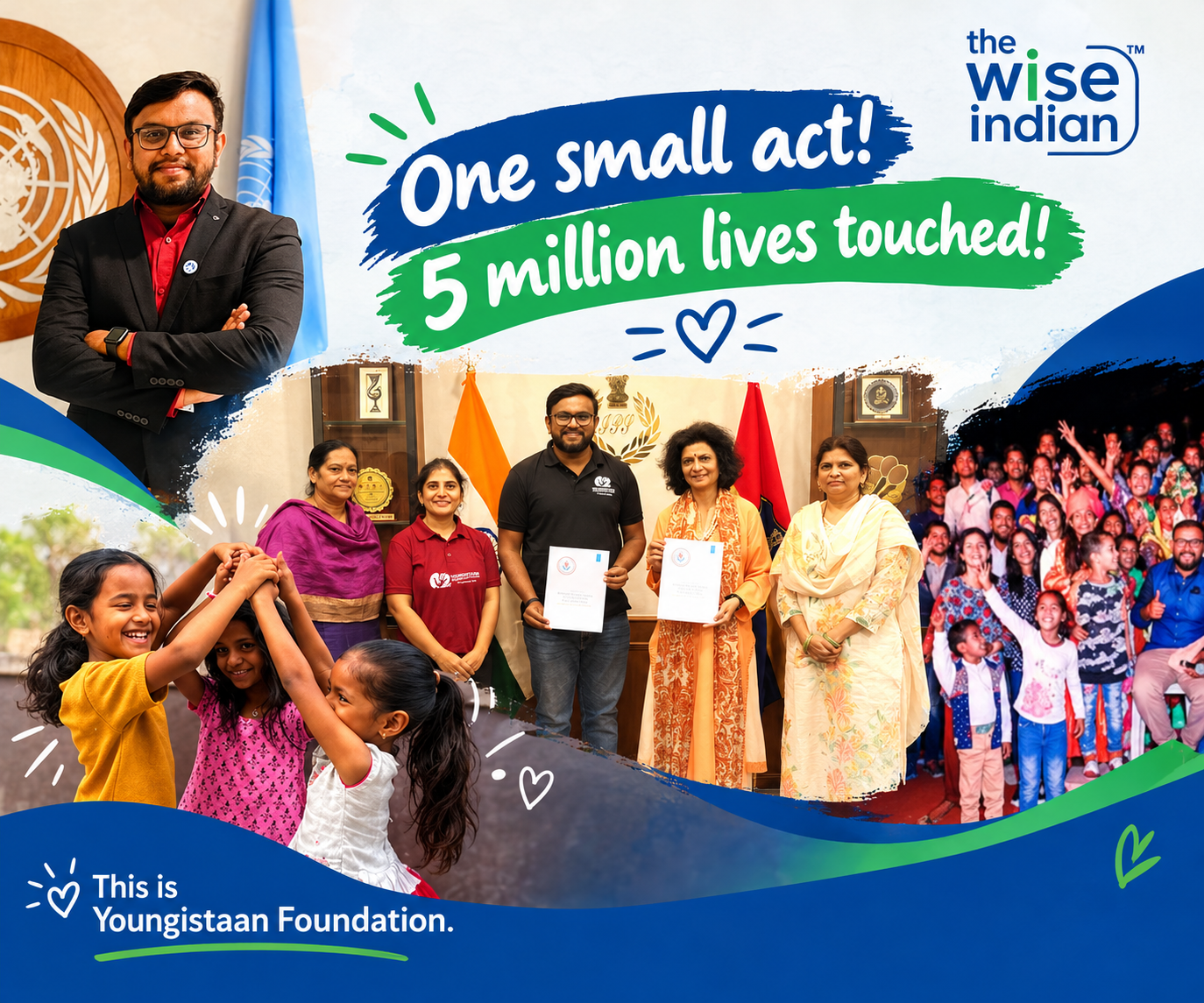
Twenty cream buns. A few friends. Some pocket money. That was all it took to start the Youngistaan Foundation in Hyderabad. Today, more than 70,000 volunteers give three hours every weekend to its work. This is the story of Arun Yellamaty, and how one small act of kindness grew into a movement.
How Twenty Cream Buns Started the Youngistaan Foundation
The Youngistaan Foundation did not begin with a grand plan or a big donation. It began with a bag of twenty cream buns from a local bakery. Arun and his friends pooled their pocket money to buy them. Then they walked to the spots where Hyderabad’s homeless people slept. They did not hand out the buns and leave. They sat down and talked with every person they met. Arun was a young man then, working night shifts at a call centre so he could attend college by day.
The Logical Indian traced this humble start in a June 2026 profile of his journey. Nobody planned it as an organisation. Arun himself says, “It was never my intention of starting an NGO.” He only wanted to give back, the way he had learnt at home, in church and in college. But that simple habit of showing up slowly turned into something far bigger.
A Hard Childhood That Taught Arun What Caring Means
Arun’s own life gave him a deep sense of what need feels like. His single mother raised him, and his upbringing was tough. At 18, he started working as a pizza delivery boy to pay his own college fees. Those hard years became one of the reasons he wanted to help others. After college, he briefly dreamed of making films, but the costs were out of reach. Journalism found him next, and he loved the work.
Music also played a part in his story. Arun played in a band, and he often screened short videos at concerts to inspire people to help the needy. After one show, a young listener told him that he wanted to help but knew no platform. Arun never met that person again, but he kept thinking about those words. He told YourStory in 2017 that he and some friends began the group in 2010. They wanted to offer young people that platform.
The first team was tiny. Just five volunteers fed about ten homeless people. The group formally registered only in January 2014. Meanwhile, many people doubted the idea, and some told Arun to focus on his career instead. “No one believed in us,” he recalls. A few early members even dropped out. Still, those hard days taught the team to keep working.
From Feeding the Homeless to Changing Whole Communities
Then a volunteer filmed one food drive and posted it online. The video went viral. Soon, young people in six more cities wanted to join the Youngistaan Foundation. Those cities were Bengaluru, Chennai, Bhopal, Delhi, Mumbai and Durgapur. The growth was fast, and the work deepened. By 2017, the group had fed more than five lakh homeless people. Volunteers called Hunger Heroes cooked fresh meals and shared them across the city every Sunday.
Another team, the Transformers, gave haircuts, clean clothes and basic first aid. Arun wanted people to feel valued, not just fed. Need by need, new programmes followed. Education classes reached orphanages, government schools and urban slums. Later, the team took on women’s safety, menstrual health, disaster relief and cyber safety. Volunteers even helped some homeless people return to their home towns.
One urban slum shows how deep this work runs. The team has worked there for six years. They first arrived with a small gift of school bags, and the start felt uncertain. But they kept returning and sat with parents, leaders and children. Today, the community hosts a resource centre in a space it provided itself. A trained local runs English classes, computer training and life skills sessions there. First-generation degree holders have emerged from that slum. Girls who might have left school early now continue their studies.
Why Seventy Thousand Volunteers Give Three Hours Every Weekend
Big numbers mean little if people quit. Arun knows this, so he built a clear system. Every new volunteer goes through orientation and several rounds of training. Then each one joins a programme, such as education, food distribution or health work. Each volunteer commits three hours every weekend. Those who cannot give that much time can still join one-off drives. The method works. Some volunteers have stayed for eight or nine years, and several now work for the foundation full-time. Arun says a few of them even urge him to move faster. He also reminds everyone that change takes time.
The reach now looks huge. A Meridian profile of Arun says the foundation has supported over five million lives across 60 cities since 2014. It also credits over 150 partners. New fronts are opening too. The Youngistaan Foundation now teaches responsible AI use in schools and colleges. Its teams also work on substance use among young boys and counsel youth inside juvenile homes. In Telangana, it is working with the police on a Safe Village Initiative across 126 villages. It is also setting up menstrual hygiene incinerators and building girls’ toilets in schools.
The Wise Take
Arun Yellamaty never set out to build an organisation. He only wanted to help the people he met on the street. Because he kept showing up, others joined him, and the circle kept growing. The Youngistaan Foundation proves that small, steady kindness can change millions of lives. So the next time your effort feels too small, remember the twenty cream buns.
Also read our other article on 230 FIRs and 1,100 Raids: Inside Maharashtra’s Crackdown on Adulterated Milk
Follow The Wise Indian for exclusive stories celebrating everyday heroes who are quietly shaping the culture, sustainability, and future of a better India.