
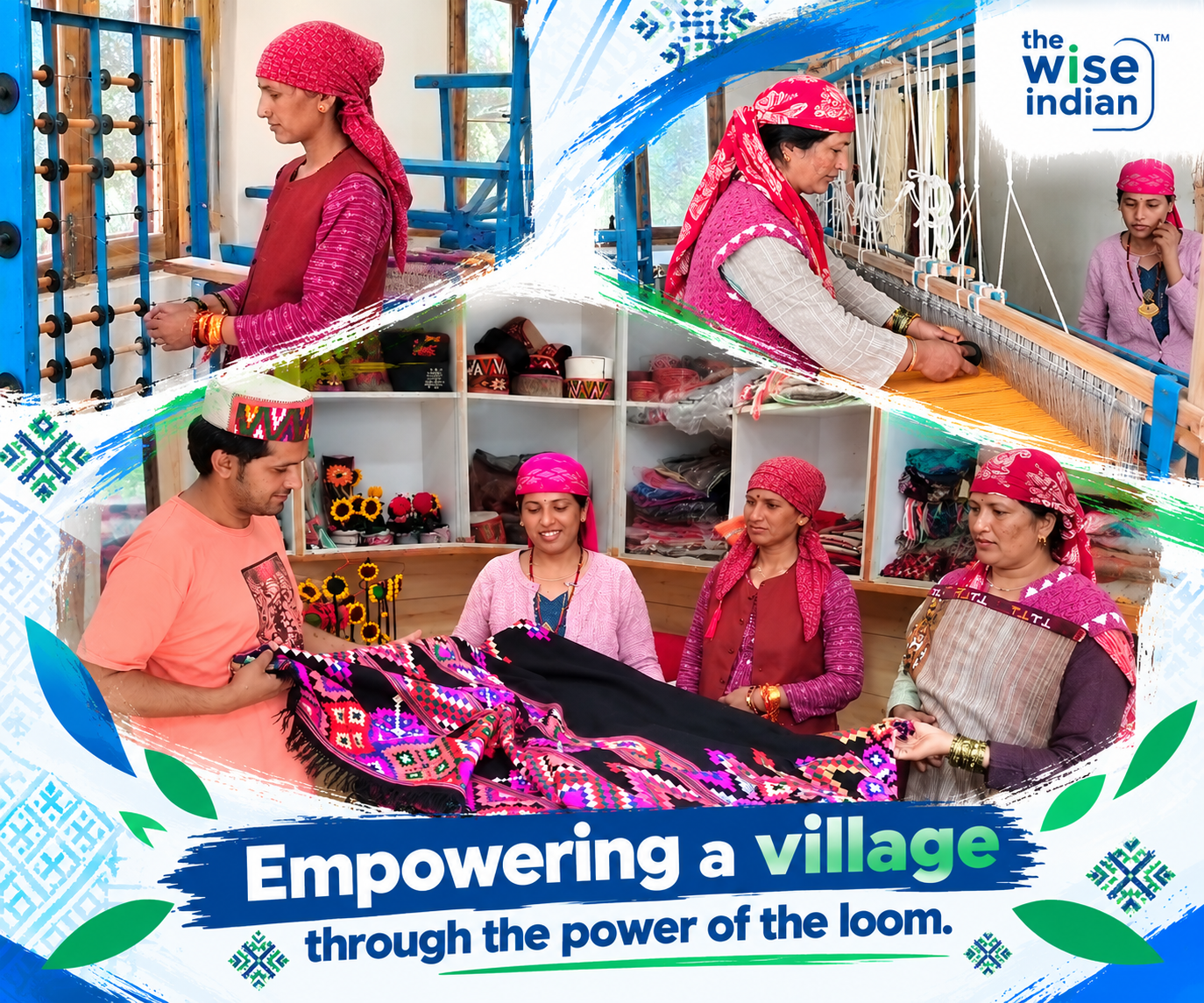
Snow has long cut off Kullu’s villages every winter. Families used those quiet months to weave warm pattu cloth from natural wool. Today, the Sharan handloom village near Naggar turns that old habit into steady income. Its women now weave for markets, tourists and brighter futures.
A Quiet Himalayan Village Near Naggar Finds Its Thread
The Sharan handloom village sits under the Rumsu Panchayat, close to Naggar in Kullu district. Naggar itself is a heritage village. Houses of stone and timber cling to its slopes in the old Kath-Kuni style. In fact, a Union Ministry of Textiles survey found nearly 95 per cent of homes follow that style. Besides, a large number of residents were already weaving at home. Weaving runs deep in this valley. Across the valley, many homes keep a pit loom, and both men and women weave.
In 1942, film star Devika Rani asked weaver Sheru Ram of Banontar village for an urban-size shawl. He wove it on his pit loom. Many credit that moment with sowing the seeds of today’s Kullu shawl. Around 1944, the Bhutti weaver cooperative society came up and trained thousands of Kullu women to weave shawls. The state federation HIMBUNKAR has long promoted Kullu shawls and caps. Kullu shawls also trace their origin to Kinnauri shawls, as a Fibre2Fashion article explains.
Picture a Kullu veranda in the cold months. Women take turns to spin, sort yarn and weave there. Meanwhile, the family grows basic food on a small patch of land. Dastkari Haat Samiti describes this rhythm of village life in its documentation. As a result, work and aspirations stay shared between men and women.
Sharan Handloom Village Earned a National Title in 2020
In 2020, the Union government picked the Sharan handloom village as one of ten across India. Those findings fulfilled the criteria for the Handloom Village title. The title did not stop at a signboard. A government handloom building came up in the village. Then a self-help shop followed. Together, they gave weavers a place to work and a place to sell. Because of this support, weaving gained both a workplace and a sales counter. As a result, a skill once used only at home began to earn money. Meanwhile, PTI has noted that women are the biggest stakeholders in Kullu’s weaving hubs.
From Pattus for Home to Shawls for Tourists
Earlier, the women wove pattus only for their own families. A pattu is a woollen cloth that women drape like a sarong. Everyday pattus are usually plain or chequered with simple borders. Then a handloom building and a shop arrived in Sharan. Suddenly, the same skill had buyers. Now, the cloth that kept a family warm also earns money. Today, the weavers make shawls, stoles, caps and mufflers for sale. They also craft a range of crochet items. Moreover, they watch what visiting tourists like. One artisan said they weave products to match those tastes. IANS shared their voices on National Handloom Day this August.
That day, observed every 7 August, recalls the 1905 Swadeshi Movement and honours weavers. For these women, handloom has become a real source of income. Design matters too. A Kullu piece usually has a plain body with bold, geometric borders. For example, wider and finer borders raise the value of a shawl. Weavers also tweak sizes and colours to suit what city customers want. Kullu women even wear what they weave.
Craft keeps evolving across the district. In 2021, a Ministry of Textiles project in Shamshi village trained around 30 women. A young designer also helped local weavers add woollen sarees to their range. Hindustan Times covered that effort. Clearly, Sharan’s weavers are part of a wider revival.
Training, a Shop and Skills Passed Down Through Generations
Weaving has stayed in these families for generations. Artisans here usually start learning the craft at around 14 or 15. Later, training programmes sharpened those skills. Another artisan said the self-help shop gave their business a big boost. Employment for local women also rose after the training. The village gained a bigger stage in December 2024. Mandi MP Kangana Ranaut inaugurated the craft handloom village at Sharan. She handed certificates and tools to women entrepreneurs, News Arena reported. A craft village lets artisans live, work and sell in one place. It also promotes tourism as a destination. IANS added that the initiative encourages financial independence while preserving one of Himachal’s oldest traditions.
Meanwhile, Kullu shawls have held a GI tag since 2004. PTI noted that this tag helps weavers protect the craft’s authenticity. In early January 2026, Himachal’s shawl industry also entered the Guinness Book for the largest display of handwoven pieces. Such recognition shows that handloom now earns respect, not just nostalgia.
The Wise Take
The story of the Sharan handloom village is not about charity. It shows what happens when skill meets training and a shop. The women already knew the craft. They simply needed a place to work and sell. Financial independence matters because it gives women choices. However, challenges remain. The same Hindustan Times report noted stiff competition from cheap imitation shawls. Some sellers even branded them as Kullu shawls. Therefore, buyers should look for genuine handloom and GI-tagged Kullu work. Every real shawl then supports a woman’s income and a village’s pride.
Three lessons stand out. First, existing skills deserve investment. Second, a nearby shop turns skill into income. Third, recognition brings pride along with attention. If you visit Naggar, ask where your shawl was woven. Sharan proves that India’s oldest crafts can still build tomorrow’s livelihoods.
Also read our other article on The Hand That Came Home: Riya’s Gift, Anamta’s Second Chance
Follow The Wise Indian for exclusive stories celebrating everyday heroes who are quietly shaping the culture, sustainability, and future of a better India.