
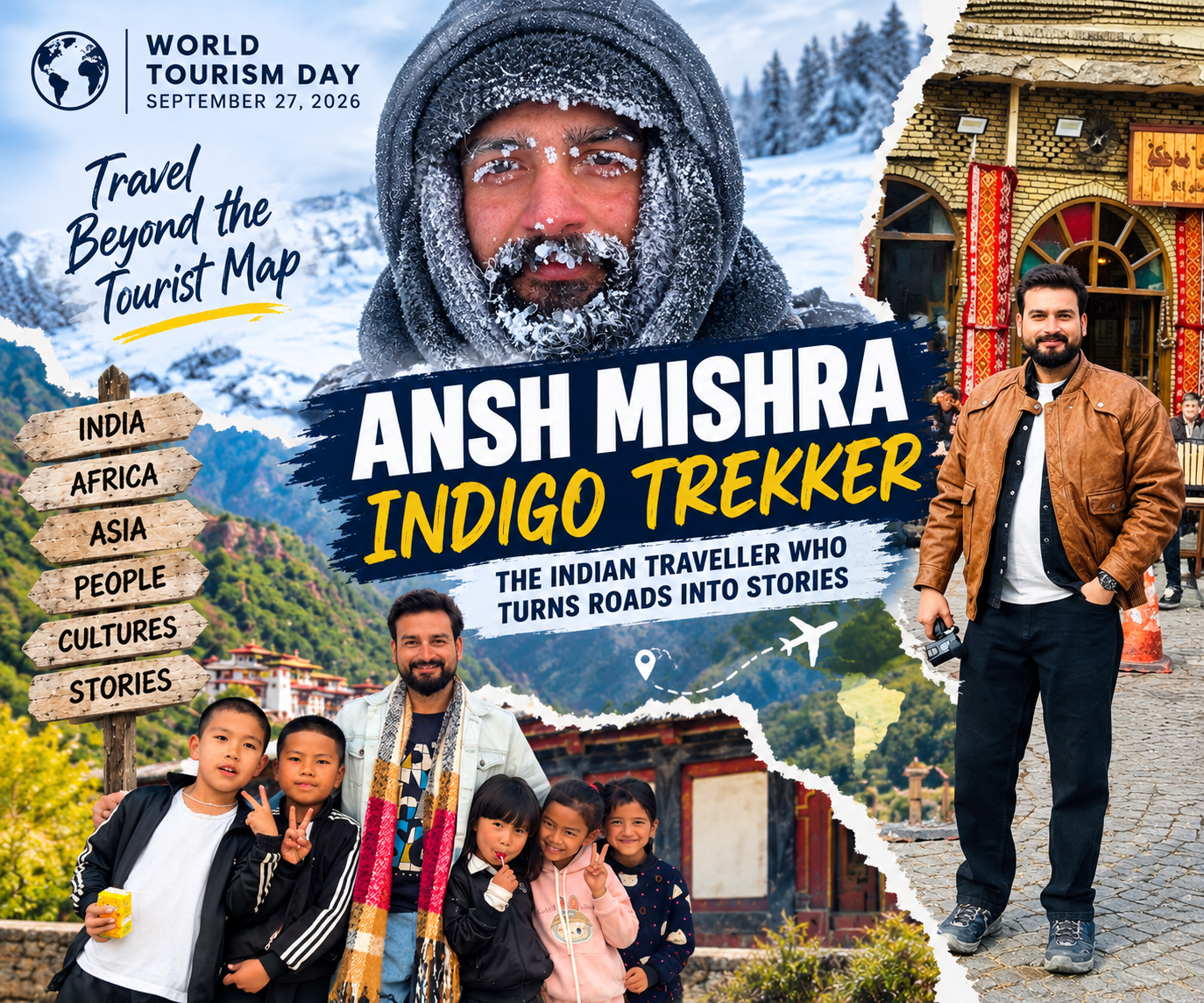
On World Tourism Day 2026, the story of Ansh Mishra, popularly known as Indigo Trekker, offers a different way of looking at travel – one built around people, cultures, human connections and places beyond the conventional tourist map.
Tourism is often associated with famous landmarks, carefully planned itineraries and destinations that dominate social media. But for some travellers, the real experience begins when the conventional itinerary ends. Ansh Mishra, better known as Indigo Trekker, has spent years exploring that side of travel, documenting people, communities, cultures and places that may not always appear on the typical tourist map.
His journey began with an unusual experiment in India: travelling across the country through hitchhiking and human connections rather than allowing money to determine where he could go. Over time, that experiment evolved into an international journey spanning India, Africa and several other parts of the world. His 2026 media portfolio describes him as a world traveller, hitchhiker, explorer, travel filmmaker, human storyteller and TEDx speaker, with 55+ countries travelled.
The journey also makes his story particularly relevant to World Tourism Day 2026, whose United Nations theme is “Digital Agenda and Artificial Intelligence to Redesign Tourism.”
From Engineering to an Unconventional Journey Across India
Before becoming a travel storyteller, Ansh Mishra had an engineering background and was following a conventional professional path. In 2017, he began what he describes as “The India Experiment”, starting from Delhi and travelling across India’s states and Union Territories while relying extensively on hitchhiking and the kindness of strangers. Contemporary reports documented the unusual nature of the journey, including the challenges of travelling without conventional financial resources. For Mishra, however, the experience was not simply about finding an inexpensive way to travel. It became an exploration of trust, generosity and the relationships created along the road.
Strangers became hosts, fellow travellers and storytellers. Roads became meeting points, while unfamiliar destinations became opportunities to understand everyday life from a local perspective. That experience would eventually transform the way Mishra approached travel itself.
“Hitchhiking for Humanity” Took His Story Beyond Travel
Mishra’s India journey eventually became a story that reached audiences beyond travel videos. In 2019, he delivered a TEDx talk titled “Hitchhiking for Humanity” at TEDxNUV, bringing the philosophy behind his journey to a wider audience.
The title reflected an important element of his travel philosophy: the belief that journeys can be shaped as much by human connections as by destinations. His media portfolio records the next major chapter of his journey as an Africa Expedition beginning in 2021, when he extended his road-first approach to different countries and began documenting communities, cultures and everyday life on a much larger international scale.
From India to Africa, Exploring Beyond Conventional Tourism
Africa became an important part of Mishra’s international travels. Rather than relying solely on conventional tourist circuits, he continued exploring through road travel, hitchhiking and direct interaction with local communities. His travels have taken him through countries across different parts of Africa, including Kenya, Uganda, Tanzania, Rwanda, Zambia, Malawi, Mozambique, Zimbabwe, Botswana, Namibia, Angola, Ghana, Senegal and Morocco. His media kit also records journeys through parts of Central Asia and Asia, including Kazakhstan, Uzbekistan, Tajikistan, Iran, China, Bhutan, Thailand, Myanmar, Malaysia and Brunei.
These journeys have produced stories that go beyond destination guides. They bring together people, food, traditions, landscapes, local experiences and the realities of everyday life. For Indigo Trekker, travel is therefore not simply about reaching another country. It is about understanding what exists beyond the postcard image.
Indigo Trekker and Human-Centred Travel Storytelling
Today, Indigo Trekker has developed into a travel storytelling identity focused on hidden places, remote communities, unusual cultures, extreme environments and under-reported realities.
Its philosophy is summed up in a simple idea: “Travel beyond the tourist map.”
That message has particular relevance in an age when smartphones, algorithms and artificial intelligence can tell travellers where to go before they even leave home. Digital platforms can make distant destinations accessible within seconds, but they can also reduce places to photographs, rankings and short videos.
Mishra’s storytelling takes a different approach by placing the journey and the people encountered along the way at the centre of the experience. His growing digital audience has helped take those experiences to viewers far beyond the places he visits, turning individual journeys into stories that can be experienced globally.
Why Ansh Mishra’s Journey Matters on World Tourism Day 2026
World Tourism Day is about more than encouraging people to travel. Tourism connects people with cultures, communities and heritage while creating livelihoods around the world. The 2026 theme focuses on how artificial intelligence and digital technology are reshaping tourism. Yet Mishra’s journey highlights something that technology cannot replace: human interaction.
A traveller can discover a destination through an algorithm, watch a video before arriving and use AI to create an itinerary. But understanding a place often begins only after meeting the people who live there. That is where the Indigo Trekker story becomes meaningful. From hitchhiking across India to exploring Africa and documenting communities around the world, Mishra’s journey has consistently moved beyond conventional tourism.
The Wise Take
The Wise Indian believes that the best travel stories are not always about how many countries someone has visited, but about what they discover once they arrive.
Ansh Mishra’s journey offers a reminder that travel can be about curiosity, conversations and cultural understanding as much as destinations. In a world where technology increasingly determines what travellers see, stories like his encourage us to look beyond the obvious and seek the people and experiences behind every destination.
This World Tourism Day, perhaps the most meaningful journey is still the one that takes us beyond the tourist map.