

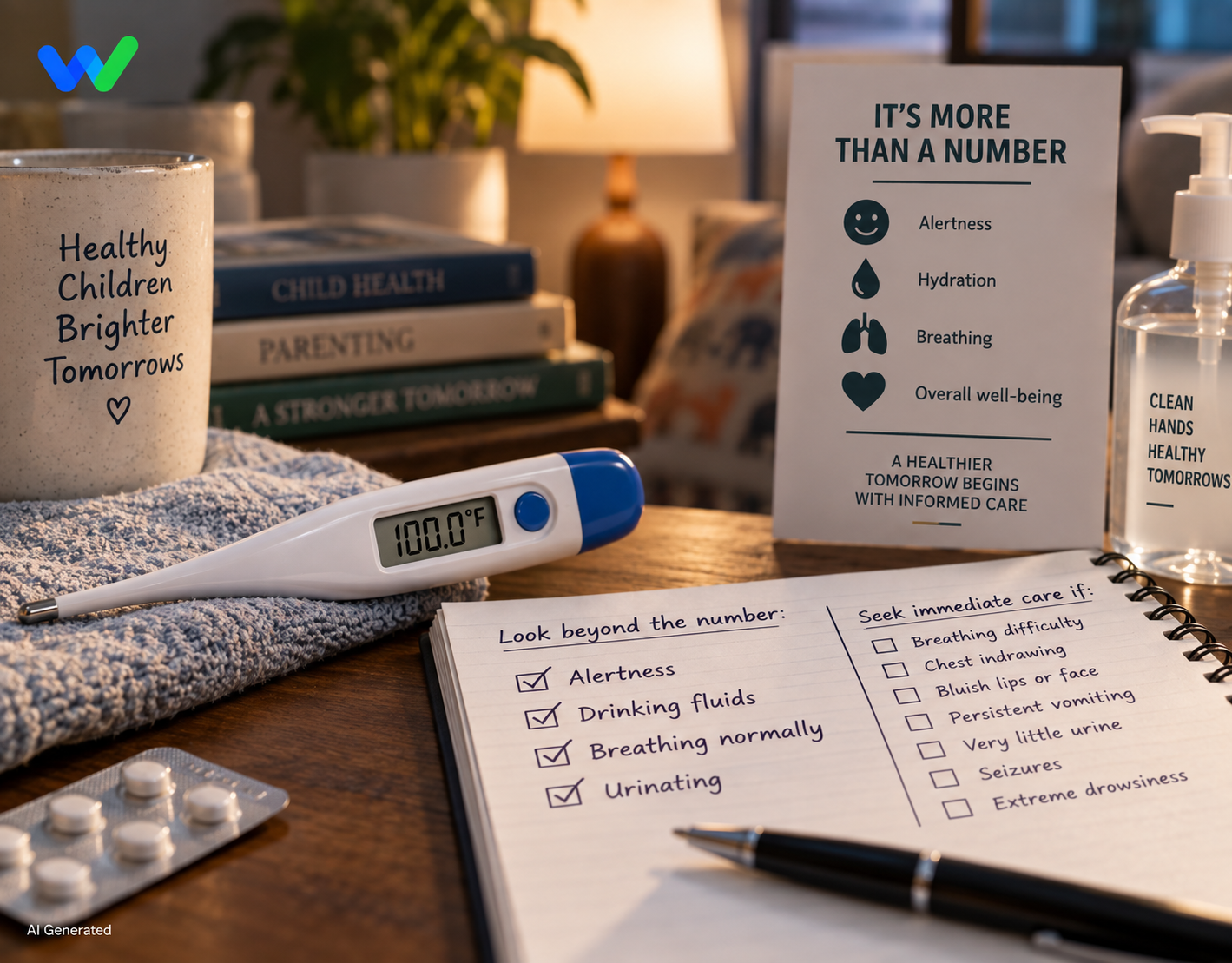
Delhi-NCR has logged 1,349 H1N1 cases. The thermometer is the least useful thing in the room.
Every Indian household has a thermometer and almost nobody has been told how little it tells you. Dr Shravan Krishna Reddy, a paediatrician, neonatologist and paediatric nutritionist at The Family Tree Hospital in Tirupati, puts the whole thing in one line: “Your child is more important than the number.” He is not being reassuring. He is being precise. Fever in children is judged by how the child looks and behaves, and the reading on the thermometer is close to the last thing a doctor weighs.
The Sentence Every Parent Should Read Twice
Here is how he explains the inversion.
“A child with 102°F who is talking, drinking water and playing once the fever comes down may worry me much less than a child with 100°F who is dull, breathing fast and refusing even water.”
That is the whole principle. The number does not track the seriousness of the illness. Fever is the body’s response to an infection, not a measure of it, and how high it climbs depends on the child, their age and the bug.
So the useful routine is this. Bring the fever down. Then wait. Then look at your child. A child who perks up is usually reassuring. A child who stays flat once the temperature has dropped is the one to act on.
What a Doctor Watches Instead of Fever in Children
Three things carry most of the weight in fever in children: alertness, hydration and breathing.
Alertness means responding normally, knowing you, wanting to watch something or play. Hydration means drinking, and passing urine. Breathing means an easy rhythm with no visible effort.
Failing on any one of those needs review, whatever the thermometer says.
Dr Reddy also warns against treating children as interchangeable. “A six-month-old, a healthy eight-year-old and an eight-year-old with significant asthma cannot be treated as the same patient.” Age and background matter more than the reading does.
The Signs That Mean Go Now
These are the ones he lists as needing immediate attention rather than a phone call.
Difficulty breathing or fast breathing. Chest indrawing, where the skin sucks in between or below the ribs with each breath. Bluish lips or face. Extreme drowsiness, or trouble waking the child. Very little urine. Repeated vomiting. Seizures. Severe weakness.
Chest indrawing is the one parents miss, because it is something you see rather than something you hear. Lift the shirt and watch the chest for a few breaths. That is all it takes.
And on hesitating, he is blunt. “If your child looks seriously sick to you, don’t wait for one more symptom to prove it.”
The Delhi Outbreak, and What Not to Reach For
Delhi-NCR has recorded 1,349 H1N1 cases. H1N1 is a strain of influenza and, as Dr Reddy puts it, “H1N1 doesn’t come with a label.” In the first day or two it is indistinguishable from any other viral fever, which is precisely why the warning signs matter more than the name of the virus.
Three things to avoid without medical advice.
Antibiotics do nothing to a virus. They help only if a bacterial infection develops on top, and that is a doctor’s call.
Stacking cough syrups is common and avoidable. Different bottles frequently contain the same ingredients.
Oseltamivir, sold as Tamiflu, is a real antiviral for influenza in some cases. It needs clinical assessment first, not a chemist and a hunch.
On when to call, he has no patience for waiting it out: “If your child is getting worse on Day 1, why would we wait for Day 3?”
The Wise Take
None of this replaces seeing a doctor, and it is not meant to. It is meant to change what you notice while you decide.
Because misreading fever in children costs you in both directions. It sends families to a hospital at three in the morning over a high reading in a child who is essentially fine. It also keeps families at home with a listless child at 100°F who needs to be seen tonight. Both mistakes come from the same place.
What would fix it is not more information. It is different information, delivered where parents already are. A single laminated card in every paediatric waiting room in the country, alertness and hydration and breathing on one side, the emergency signs on the other, would do more good than another season of fever advice.
The health workers who already carry counselling material into homes have the distribution network for exactly this. Until somebody builds it, every Indian parent works this out alone at two in the morning, holding a thermometer that was never going to tell them the thing they most need to know.