

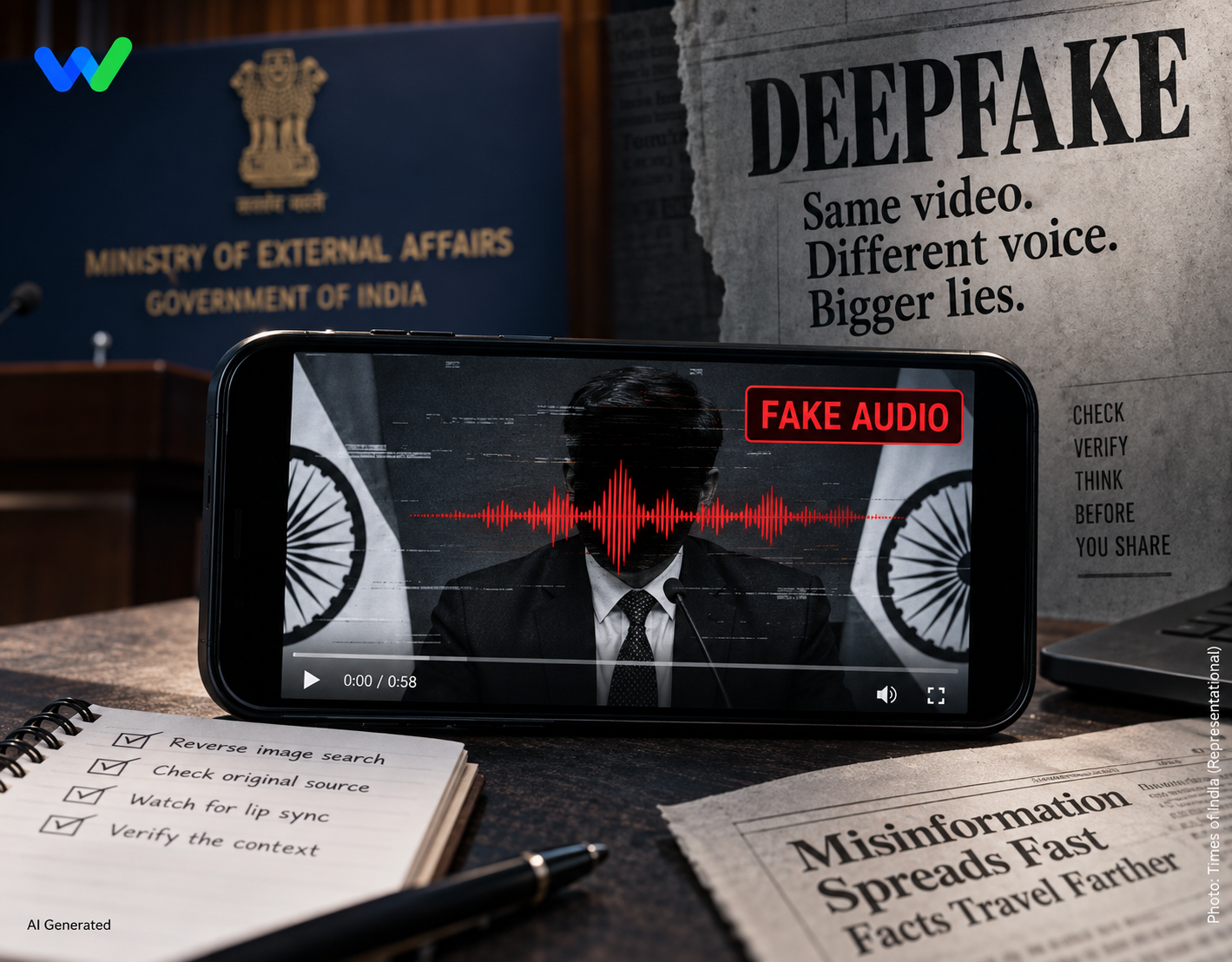
The Operation Sindoor deepfake wave worked by putting synthetic audio over genuine footage. Once you know that, you can catch it on a phone in about a minute.
Somebody took a real clip of Foreign Secretary Vikram Misri at a real briefing. They stripped his voice off it and put a fabricated one in its place. In the version that spread, he appears to admit the government named the soldiers killed in Operation Sindoor because their families had pushed it to. He never said any such thing. The pictures were real. The room was real. The man was real. Only the words were made up, which is why an Operation Sindoor deepfake of this kind is so hard to wave away.
Where the Footage Actually Came From
The government released casualty information on 27 June 2026. The fake surfaced straight after, riding the news.
Fact-checkers traced the underlying video to an ANI clip from 29 June 2026. In the real clip Misri is talking about a Track 2 India-Pakistan meeting in Colombo. He is explaining that such meetings do not carry the government’s views.
A routine briefing about back-channel talks, redubbed into a confession about dead soldiers. Nothing was generated except a voice.
How the Operation Sindoor Deepfake Was Caught
BOOM used three methods and none of them requires a subscription or a lab.
The first was a reverse image search on frames from the clip. That alone found the original ANI video and showed what Misri was really discussing. This tool is about fifteen years old.
The second was audio detection, using HIVE Moderation’s tool and Hiya’s voice detector.
The third was watching his mouth. The sound does not land cleanly on the lips. That mismatch is the usual giveaway, because the forger is fitting new words to footage that was never going to fit them.
It Was Not One Video
The Operation Sindoor deepfake wave produced a cluster.
CyberPeace caught a fake clip of Lieutenant General Devendra Sharma talking about missing aviators. The Quint’s WebQoof caught one of former army chief General Upendra Dwivedi seeming to attack the government over casualties. BOOM handled fakes of the Prime Minister, the Home Minister and the External Affairs Minister appearing to say sorry to Pakistan.
Look at the target list and the logic is obvious. Every Operation Sindoor deepfake picked someone with hours of real footage online and words that carry weight. The footage is the raw material. Being important is the weak point.
Why This Category Is the Dangerous One
A fake of a film star is a reputational nuisance. A fake of a serving Foreign Secretary during a military operation is a different animal.
These clips arrive in the exact window when official information is thin. Governments say less during operations, not more. The gap between what people want to know and what anyone has confirmed is where a fake moves fastest.
And they feed a real argument. People fought hard over casualty figures during the operation. A video that seems to prove what one side already believed gets forwarded long before anyone opens a browser.
What You Can Do in Sixty Seconds
Watch the mouth first. Play it twice and look at nothing else. A lag between sound and lips is the single most reliable tell in political deepfakes right now.
Then find the original. Screenshot one frame, reverse image search it. If the same footage exists elsewhere carrying different audio, you are finished in under a minute.
Then check the manner against the claim. Here is a man at a routine briefing, calm, dressed for a fixed appointment. Nobody makes a dramatic confession standing like that. When the words and the body seem to come from two different days, they usually do.
The Wise Take
The most instructive thing here is how ordinary the method was. No new technology, no custom model. Real video, synthetic audio, published at the right hour.
Which is awkward for the way India talks about this. The debate keeps drifting towards detection tools, and those tools do help. But the one that caught this was reverse image search. It has been sitting in your browser since before most deepfake firms existed.
The real gap is speed, and nobody is fixing it. A fact-check published three days after a clip peaks reaches a fraction of the people the clip reached. A fabricated Nehru video has now survived five separate fact-checks and is still doing the rounds, and it does not even have a living subject who can deny it.
Here is what would genuinely help, and what no platform will give you. How many people saw the fake. How many saw the correction. Until somebody publishes those two numbers side by side, every fact-checker in India is working in the dark and calling it a win when the article goes live.