

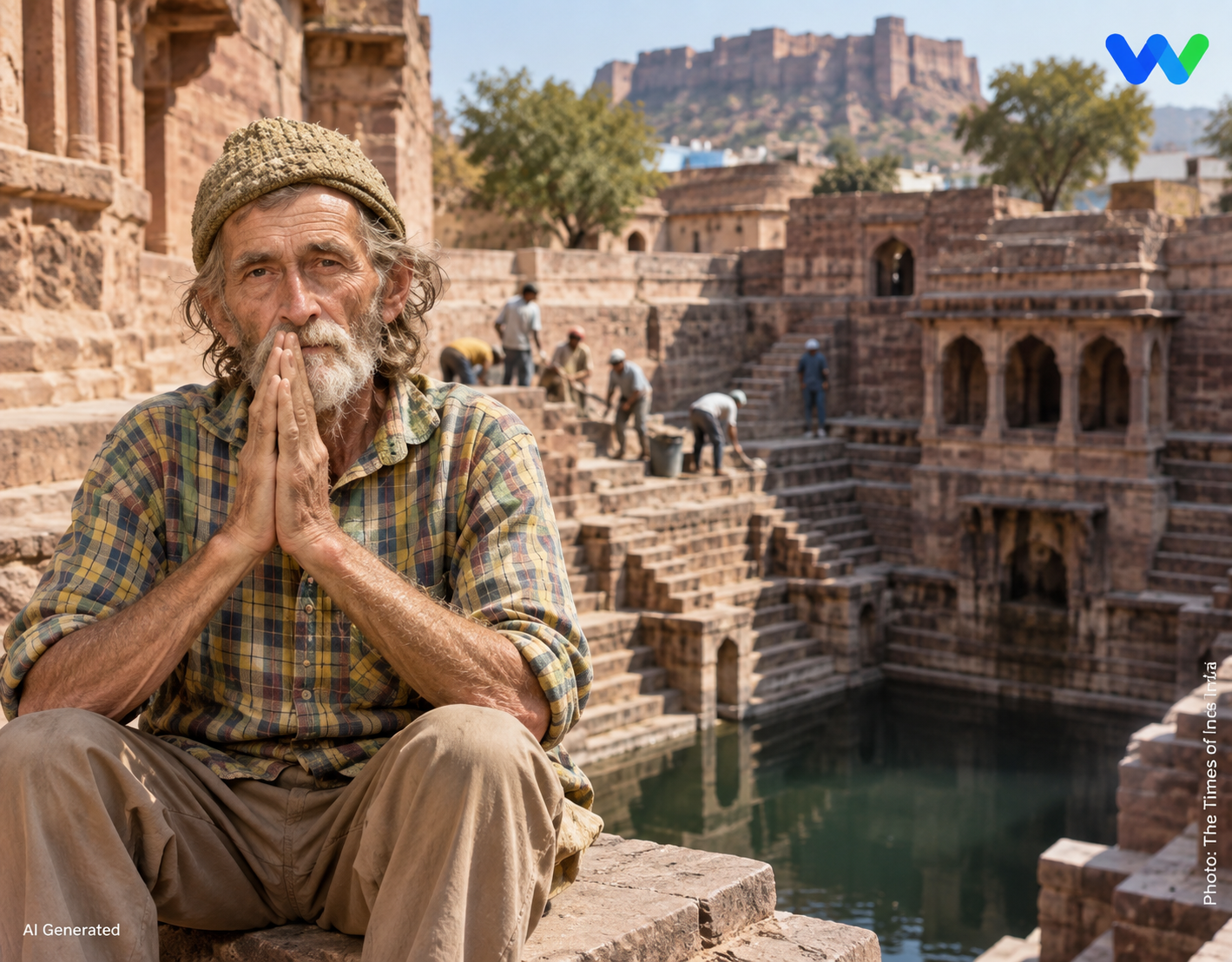
He came to trace his mother’s childhood and never left. “I think people are inspired by me because I’m not from India,” he says, which is the uncomfortable part.
Caron Rawnsley is Irish, eighty years old, and has spent years hauling rubbish out of the Jodhpur stepwells nobody else wanted. For a long time the neighbours called him Paagal Saab, the crazy sahib, because clearing a disused well struck everybody as a pointless way to spend a life. Now they call him Jodhpur’s Aquaman. He has helped revive ten historic waterbodies across the city, among them Mayla Bagh ka Jhalra, Ram Bawari, Govinda Bawari, Mahamandir Bawari and Gulab Sagar. He came to India, in his own words, “looking for my mother’s past.”
The Mother He Came Looking For
His mother was called Elaine, later Caroline. She grew up in Kashmir and spent part of her childhood in Jodhpur.
Rawnsley arrived to retrace that. What he found instead was a city whose old water system was full of garbage, and a long second act.
He is not coy about where he has ended up. “My country is India. Now I’m a part of India,” he told Deputy Chief Minister Diya Kumari. And, more bluntly: “I hope to leave this planet in India.”
What the Jodhpur Stepwells Were Built to Do
A stepwell is a well you walk down into. Rajasthan calls them baoris or bawris, Gujarat calls them vavs.
Instead of hauling water up on a rope you descend a staircase to meet it. As the water table drops through the dry months, you simply walk further down.
The design solves a desert problem elegantly. Open water evaporates. Water sitting at the bottom of a deep stepped shaft stays in shade most of the day and survives the summer.
They were social spaces as much as utilities. Cool, shaded, public, and in many towns the place women gathered.
Piped Water Killed Them, Fast
Once a municipal supply reached a neighbourhood, nobody was going to walk down eighty steps with a pot.
The stepwell stopped being infrastructure and became a hole in the ground belonging to nobody in particular. What followed was predictable. People dumped rubbish. Silt filled some. Builders covered others. Municipalities sealed a few for safety, and not unreasonably, because an open shaft in a crowded lane will eventually kill somebody.
By the time anyone thought of the Jodhpur stepwells as heritage, you could not tell many of them from waste ground.
Clearing One Is Not Glamorous
The rubbish comes out first, and that can mean decades of household waste, building debris and silt.
Then somebody assesses the stonework, because steps and retaining walls that held earth for three centuries can fail the moment the load on them changes.
Then the water itself. A cleared stepwell that fills with contaminated groundwater is not a restored stepwell. It is a pond with architecture.
And then the part that decides whether any of it lasts. Somebody has to keep it clean. Clear one and walk away and it reverts inside a few years, which is why a restoration count is a weaker number than a maintenance arrangement. The question is never how many got cleared. It is how many still hold water five monsoons later, and whose job that is.
The Wise Take
The lazy version of this story writes itself. Foreigner cares more than locals do. It is both unfair and wrong, and Rawnsley has said the smarter thing himself.
“I think people are inspired by me because I’m not from India.”
Sit with that. He is describing the novelty that gets him attention, and gently pointing at why the same work by a resident of Jodhpur would not have made the BBC. The nickname Paagal Saab was never about Jodhpur not valuing its heritage. It was about a man with no deadline, no employer and no rent to earn doing something everybody else lacked the free hours for. That describes a retired foreigner. It also describes almost no working resident of a crowded Indian city.
There is a harder question sitting under the heritage story. Rajasthan’s groundwater is falling and its cities run on tankers in bad summers. Stepwells were built to hold water through exactly that.
So are these ten Jodhpur stepwells coming back as monuments or as infrastructure? A stepwell that recharges groundwater is a working asset. One that is fenced, lit and photographed is an ornament. Bengaluru found its buried drains on 1923 British maps, and the valuable discovery there was not the history. It was that the old system still worked. Somebody should go and test whether these ten do.