
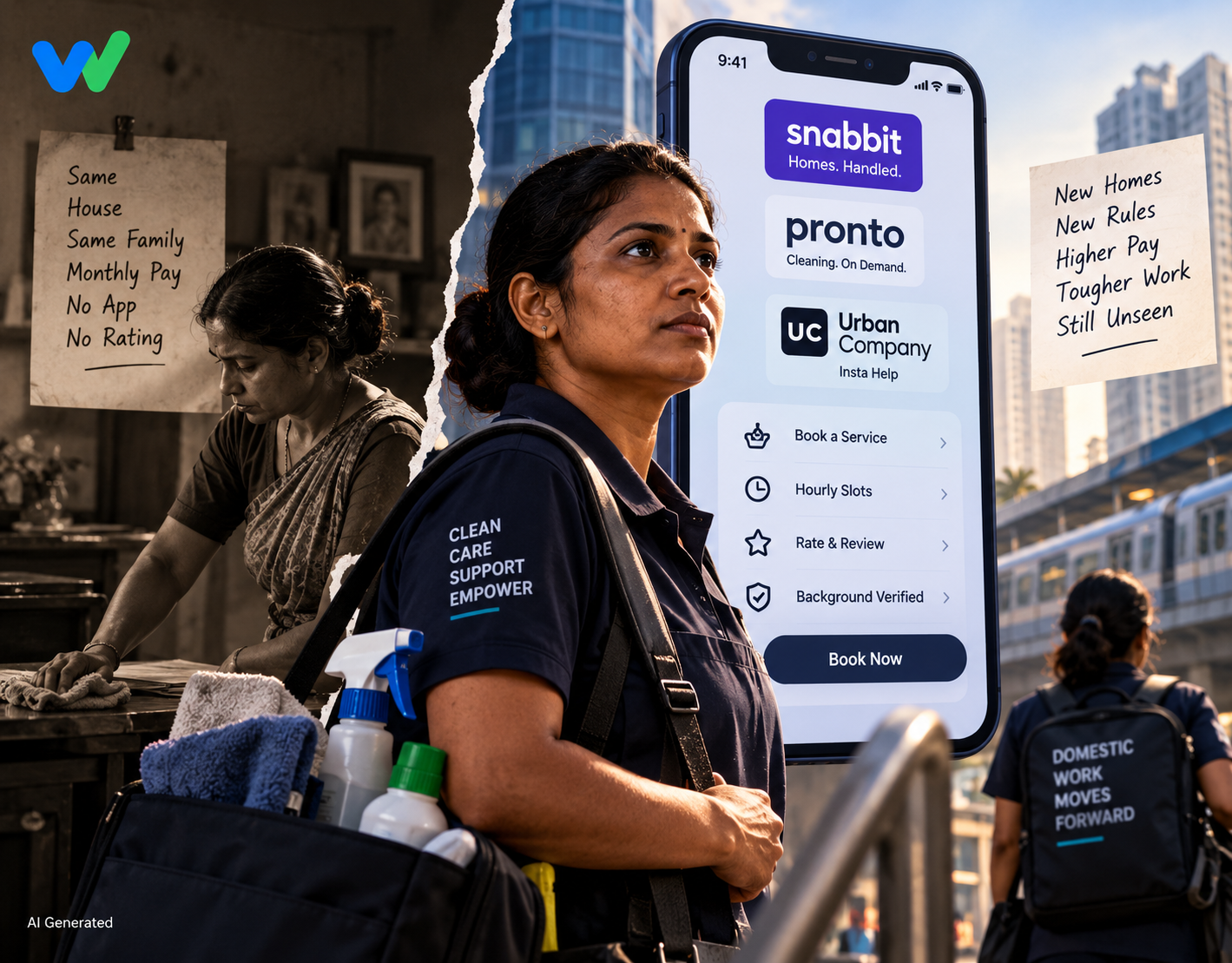
Snabbit, Pronto and Urban Company’s Insta Help have moved household work onto an app. Three specific mechanisms change what the work is.
Domestic work platforms India arrived in the big metros around late 2024. Snabbit was founded that year. It was valued at about $180 million in October 2025 and was in talks at roughly $400 million by April 2026. Pronto sells cleaning by the hourly slot. Urban Company launched Insta Maid in March 2025 at an introductory Rs 49 an hour, then renamed it Insta Help after the reaction. Workers on these apps often earn more per hour than they did before. They also describe work that has become harder to do.
The Clock Replaced the Relationship
A booking is a fixed block of time against a set list of tasks. The worker travels to the address. She clocks in on a phone at the door. The slot then measures her.
A worker in Bengaluru told ThePrint she leaves home at 4.30 am, because logging in late at 6 am can cost her the day’s pay. Training covers how to tie your hair and how to greet a customer.
That is some distance from an arrangement negotiated with one household over years.
Exit Stopped Being Free
A domestic worker in a difficult house has always had one real power. She can stop going.
On a platform that power costs her something. A rating below four out of five triggers a review call, by one company’s own account. Ratings shape how much work arrives.
A ThePrint ground report in March 2026 recorded women on these platforms describing stalking and assault inside customers’ homes. When walking out of a house carries a scoring penalty, the oldest protection in the job is worth less than it was.
One City, One Price on Domestic Work Platforms India
Domestic wages in India have always been set street by street. The commute, local demand and what a particular neighbourhood pays all shaped the rate.
A single city-wide rate replaces all of that. Unions in Bengaluru, including the Domestic Workers Rights Union and Stree Jagruti Samiti, argue that this pushes earnings down. It does so hardest in exactly the areas where workers had bargained highest.
The Wise Take
Domestic work platforms India have done one thing the older arrangement never did. Domestic work sat almost entirely outside Indian labour law. There was no employer on paper and no register to appear on.
The Code on Social Security recognises platform and gig workers as a category. So a woman moving from a household to an app picks up a legal identity she did not have before.
That is not a defence of the conditions. It is the reason the conditions can now be argued in a forum that exists, which is more than the sector had in 2019. Cab and bike taxi drivers have already tested what that forum can deliver. Whether anything is actually paid out remains a separate question.