

An ICMR study recorded large falls in Aedes breeding after residents organised the work, though the figure now being quoted describes one ward.
Mosquito control usually arrives from outside, as a fogging machine or a health worker with a checklist. In two wards of Alappuzha in Kerala, researchers tried the opposite. They asked residents to run Alappuzha mosquito control themselves, then measured what happened.
What the Residents Actually Did
The Kerala unit of the ICMR-National Institute of Virology ran the study with TD Medical College, Alappuzha, between November 2016 and October 2018. It covered two of the town’s 52 wards, Pazhaveedu and Vadackal, which hold 1,623 households.
Residents formed three tiers of committees in each ward. Twelve group committees covered 35 to 60 households each, six cluster committees supervised them, and a steering committee ran the ward.
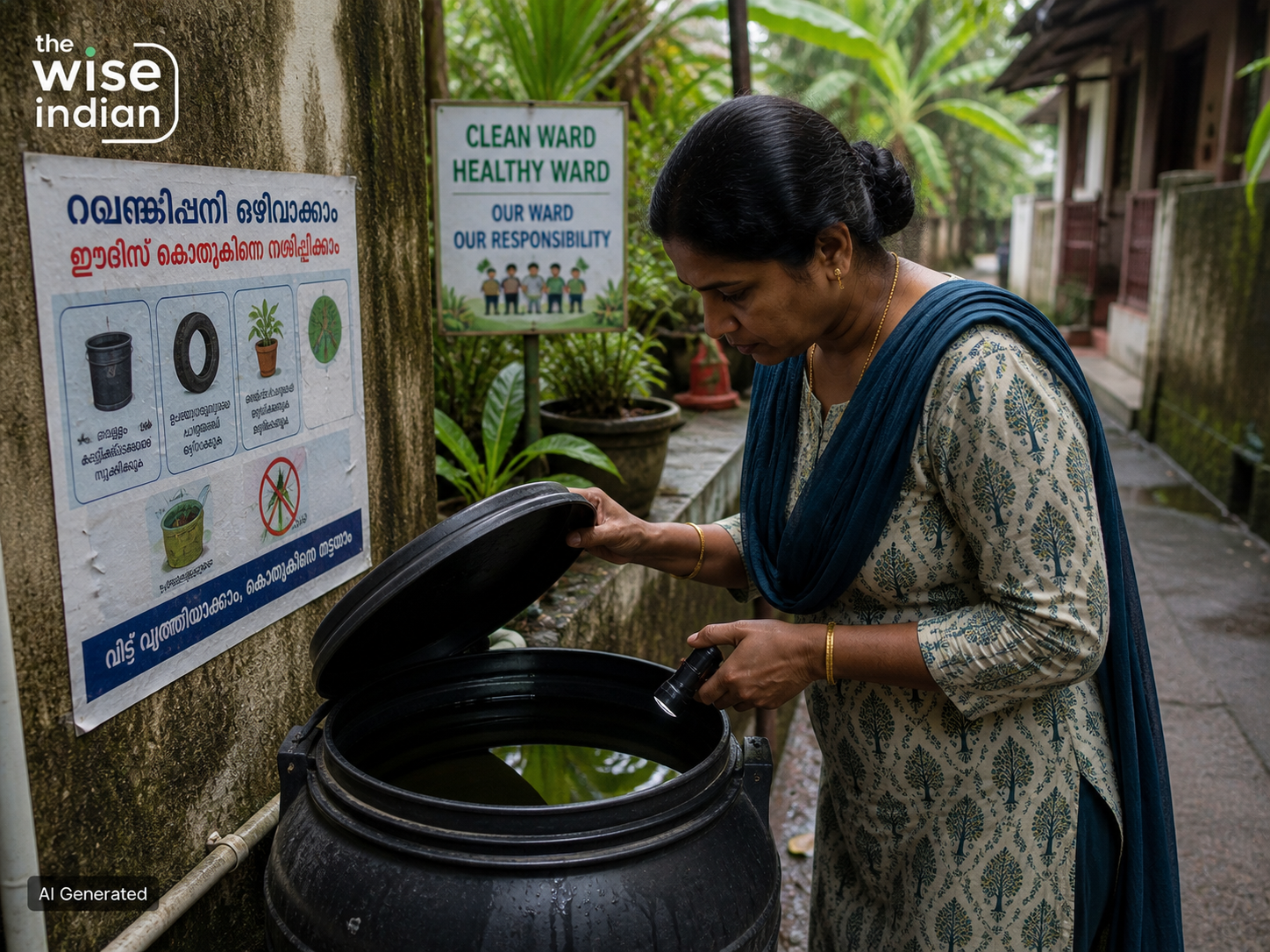
The work itself was ordinary. Poster campaigns, door-to-door visits, WhatsApp groups and cleaning drives. One cluster began collecting plastic waste from every household weekly, then sending it to the municipal compost unit. Rs 15 a household each month paid for it. Another built larval traps, containers of water left out to attract egg-laying mosquitoes, then sieved clear every week.
What the Alappuzha Mosquito Control Indices Measure
Three numbers track Aedes breeding. The house index is the share of houses found with larvae or pupae. Next comes the container index, the share of water-holding containers found with them. The Breteau index counts positive containers per 100 houses inspected.
All three fell in both wards after a year. In Pazhaveedu the house index went from 16.7 to 6.0, while in Vadackal it went from 64.2 to 8.6.
Where the 87 Percent Figure Comes From
The fall in Vadackal’s house index works out to roughly 87 percent. That is the number now attached to the study in the coverage. It is accurate, though it describes a single ward.
The equivalent fall in Pazhaveedu was closer to 64 percent. Neither figure describes Alappuzha as a whole, because the study ran in two wards out of 52.
What Slowed the Work Down
The researchers were direct about the difficulties. Coordination among residents fell short of their hopes. Members were not always free at the same time, so activities shifted around religious functions, political engagements and local festivals.
The Wise Take
Two wards over two years is a small study, so the honest way to read it is as a demonstration rather than proof. What it demonstrates is still worth noting. The largest fall came in the ward that began in the worst condition, where nearly two-thirds of houses had larvae at the start. That suggests the method works hardest where conditions are poorest. The researchers’ own conclusion was about policy rather than mosquitoes. They argued that community engagement belongs at the centre of public health planning, not at its edges. Whether Alappuzha mosquito control holds up without a research team in the room is the open question.