
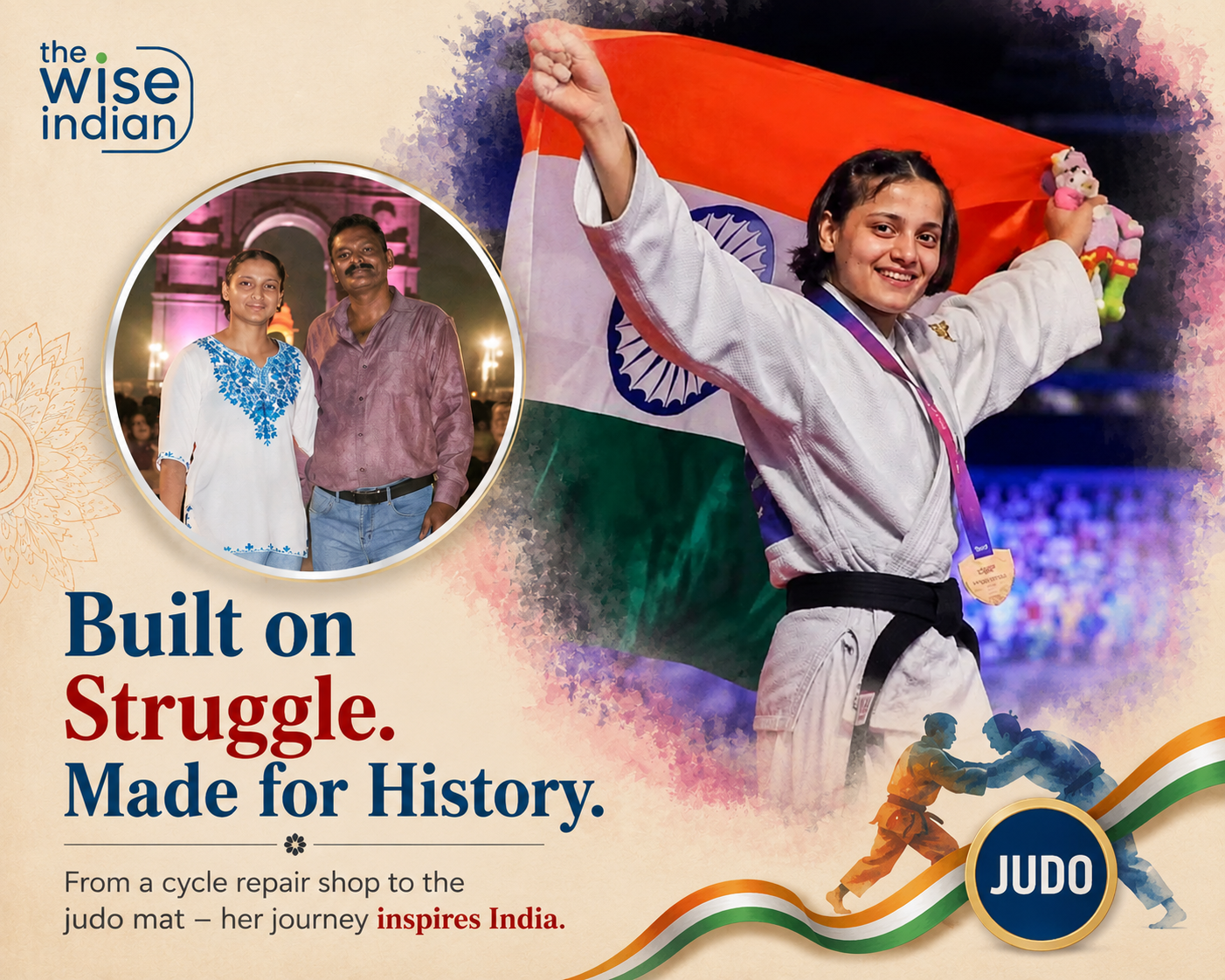
Asmita Dey grew up in a mud house in Tripura. Seven months after losing the father who supported her sporting dream, she became India’s first Commonwealth Games judo gold medallist.
From a Small Home in Tripura to a Historic Podium
Asmita Dey’s journey to the Commonwealth Games podium began far away from the spotlight. She grew up in Belonia, Tripura, in a family with limited financial means. Her father, Arjun Dey, repaired bicycles and reportedly earned around ₹300 a day to support the family.
Years later, his daughter stood on the biggest podium of her career.
Dey won the women’s 48kg judo gold at the 2026 Commonwealth Games in Glasgow, becoming the first Indian judoka to win a Commonwealth Games gold medal. She defeated Canada’s Heidi Quach in a final that went into Golden Score.
But the person who had supported her journey from the beginning was not there to see it.
Her Father’s Belief in Her Dream
Dey did not begin her sporting career with judo. She had competed in athletics before a coach recognised her potential and encouraged her to take up the combat sport.
Her progress eventually took her from Tripura to national-level training. In 2018, she joined the Sports Authority of India’s regional centre in Bhopal, where she continued developing as a judoka.
The journey was not easy. Training, travel, competition and medical treatment all came with costs that were difficult for her family to manage.
When Dey suffered a serious knee injury, her father reportedly took her to Delhi for treatment and helped arrange the money needed for her recovery. For a family dependent on a modest daily income, supporting an aspiring athlete was a major sacrifice.
Then Came the Loss That Almost Ended Everything
In December 2025, Dey lost her father after he suffered a brain stroke.
His death came just months before the Commonwealth Games. For Dey, it was not only the loss of a parent but also the loss of one of the people who had believed most strongly in her sporting ambitions.
She struggled to imagine continuing.
Her mother, however, encouraged her to return to training. She reminded Asmita of how much her father had invested in her dream and encouraged her to keep going. Dey eventually returned to the mat and resumed her preparations for Glasgow.
The Fight That Made History
At the Commonwealth Games, Dey competed in the women’s 48kg category.
Her final against Heidi Quach was closely contested. Neither athlete could settle the bout during regulation time, sending the contest into Golden Score.
Dey eventually secured the decisive score and won the final 2–1. The victory made her the first Indian judoka to win Commonwealth Games gold, giving Indian judo a landmark moment on the international stage.
For Dey, however, the victory came with a painful absence.
Her father, who had supported her through financial difficulties, injury and the early stages of her career, was no longer there to watch her make history.
A Medal, and a Dream for Her Family
Dey’s Commonwealth victory is not her first major achievement. She had already built an international record, including a bronze at the Asian Cadet and Junior Championships in 2022, a gold at the Junior Asia Cup in 2023 and a senior international title at the Casablanca African Open in 2025.
Her story is therefore not simply about an unexpected sporting victory. It is about years of training, family sacrifice and the determination to continue after losing someone central to her journey.
Dey has also spoken about wanting to build a house for her family. For someone who grew up in a mud house, that ambition carries a meaning that goes well beyond material success.
Her gold medal may have changed the way India sees its judokas, but her journey says something even more universal.
Great sporting stories do not always begin with expensive facilities, famous coaches or established sporting families. Sometimes they begin with a parent working long hours, a child with a dream and a family willing to make sacrifices to keep that dream alive.
Asmita Dey’s Commonwealth gold is now part of Indian sporting history.
But behind that medal is a father who repaired bicycles for ₹300 a day, a mother who encouraged her daughter to continue, and a young athlete who returned to the mat when giving up would have been easier.
THE WISE TAKE
Asmita Dey’s gold medal is more than a sporting milestone. It is a reminder that talent can emerge from places far removed from India’s traditional sporting centres — and that opportunity, support and persistence can determine how far that talent travels.
Her father’s sacrifice and her mother’s encouragement were part of the journey, but the medal ultimately belongs to Asmita. She returned to training after a devastating personal loss and went on to create a first for Indian judo.
The wise lesson? We should not only celebrate athletes when they reach the podium. We should build the systems that help more young Indians reach it.