
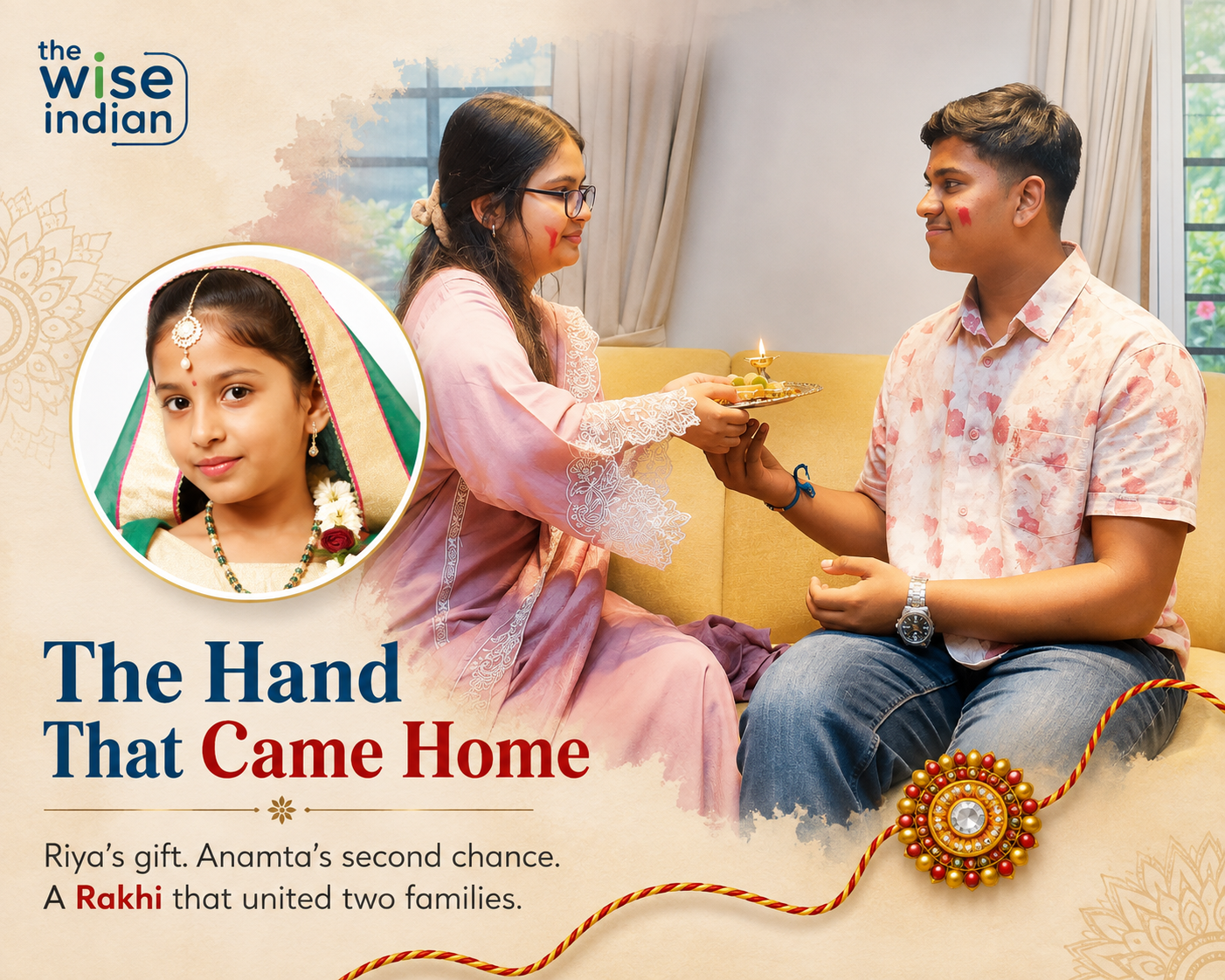
Riya was nine when her family chose organ donation. Today, Anamta carries her donated hand and returns to Valsad every Raksha Bandhan to tie a rakhi to Riya’s brother.
When Anamta Ahmad travelled from Mumbai to Valsad for Raksha Bandhan, she was returning to a family that she never expected to become part of her life. Seventeen-year-old Anamta used her transplanted right hand to tie a rakhi to Shivam Mistry, the brother of Riya Mistry, the nine-year-old girl whose hand Anamta now carries.
It is an extraordinary story of organ donation, resilience and a bond that grew far beyond the operating room.
The girl from Valsad
Riya Bobby Mistry was a nine-year-old Class 4 student from Valsad, Gujarat. In September 2024, she suffered a brain haemorrhage and was admitted to Kiran Hospital in Surat. Her parents, Bobby and Trushna Mistry, were later faced with an unimaginable decision, but chose to donate their daughter’s organs so that others could have another chance at life.
Riya’s kidneys, liver, lungs and corneas were donated to recipients across India. Her right hand was also prepared for transplantation. It was transported from Gujarat to Mumbai through a green corridor, where surgeons at Global Hospital transplanted it onto Anamta. Reports described the procedure as a medical milestone, with Anamta becoming the world’s youngest recipient of a shoulder-level upper-limb transplant at the time.
Anamta’s journey
Anamta had already fought her own difficult battle. In 2022, when she was 13, she came into contact with an 11,000-volt high-tension cable while playing on a terrace at a relative’s home in Aligarh, Uttar Pradesh. Her right arm had to be amputated at shoulder level.
She refused to let the setback decide her future. Anamta learnt to write with her left hand, continued her education and scored 92% in her Class 10 examinations. When she received Riya’s donated hand two years later, it gave her the opportunity to regain abilities she had lost. Today, she is studying B.Com at Mithibai College in Mumbai.
A rakhi brings two families together
The transplant created a connection between two families, but Raksha Bandhan gave that connection a new meaning. In 2025, Anamta travelled to Valsad to meet Riya’s parents and her brother Shivam. She tied a rakhi to him using Riya’s hand.
Anamta had grown up without a brother, while Shivam had lost his sister. They decided to become siblings themselves. What began as a medical connection slowly became a family bond.
This year, Anamta returned to Valsad again. People who had known Riya gathered to meet her, and some touched the transplanted hand that had once belonged to the little girl they remembered. For Riya’s parents, seeing Anamta return with their daughter’s hand is a reminder of the life their child helped another young person build.
Riya’s gift lives on
Anamta does not simply remember Riya. She carries a part of her every day. The hand that helps her write, study and reach for things is also a lasting connection to the family that chose to donate.
The story is remarkable not only because of the hand transplant, but because of what followed. A girl from Gujarat became part of another girl’s future. A brother found a sister. Two families from different communities found a bond that neither could have imagined.
The Wise Take
Organ donation is often discussed through numbers, but behind every donation is a deeply human decision. Riya’s parents chose to give, and Anamta chose to keep moving forward.
Today, Riya’s gift is still being lived. Every Raksha Bandhan, when Anamta returns to Valsad and ties a rakhi to Shivam, that gift becomes more than a medical achievement. It becomes a reminder that generosity can travel beyond families, cities and circumstances.
Sometimes, a legacy is not simply something we remember. It is something we help another person live.