

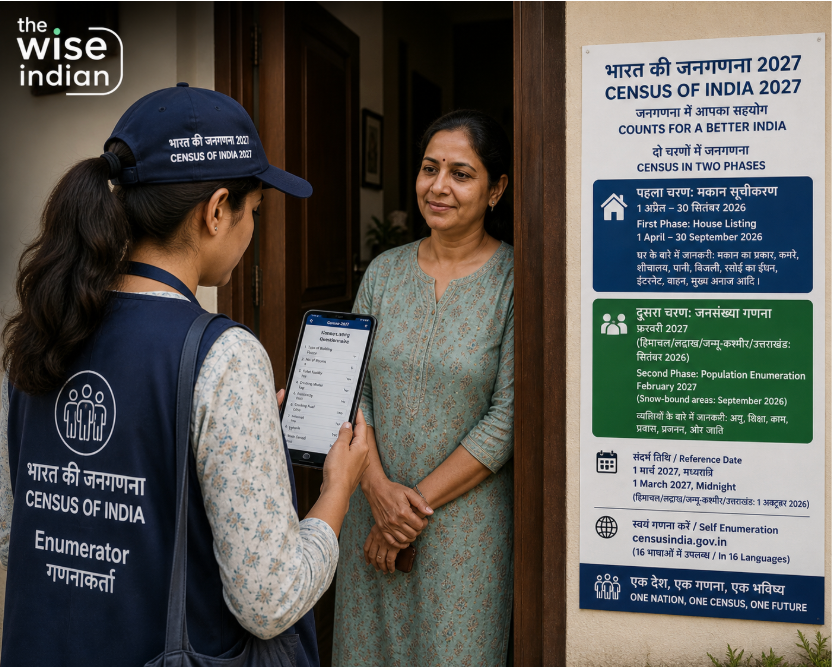
India’s first digital census began on 1 April 2026. The first visit is about your house. The second, in 2027, is about the people living in it.
India has not counted itself since 2011. The count due in 2021 did not happen. It is happening now, and it comes in two visits, about ten months apart.
The First Visit Is About the Building
The first phase is called House Listing. It runs from 1 April to 30 September 2026, and each state gets a 30-day window inside that period.
The enumerator asks about the house, not the people. What it is built of. How many rooms it has. Whether there is a toilet, drinking water and electricity. What fuel is used for cooking. Whether the household has internet and a vehicle. Even the main cereal the household eats.
The Second Visit Is About the People
The second phase, Population Enumeration, is scheduled for February 2027. Snow-bound areas in Ladakh, Jammu and Kashmir, Himachal Pradesh and Uttarakhand are covered earlier, in September 2026.
This round asks about age, education, work, migration and fertility. It will also record caste, which the census has not done since 1931.
Everyone Is Counted at One Fixed Moment
A census needs a single instant so that nobody is counted twice or missed. Here that instant is 1 March 2027 at midnight. For the snow-bound areas it is 1 October 2026.
About 31 lakh enumerators and supervisors are involved. The approved budget is Rs 11,718.24 crore.
You Can Fill It In Yourself
For the first time you can enter your own details online, in any of 16 languages. The window opens about 15 days before the enumerator reaches your area. You get a Self-Enumeration ID, and the enumerator checks against it.
Why an Old Count Costs People Money
Ration coverage is the clearest example. The National Food Security Act covers up to 75 percent of the rural population and 50 percent of the urban population. That ceiling works out to 813.5 million people, and it is still calculated on the 2011 Census.
On 5 August 2026 the government told Parliament that states had identified 790.8 million beneficiaries, leaving 22.7 million places unfilled. The census results will also feed into Lok Sabha seat delimitation and the one-third reservation for women in legislatures.
The Wise Take
A census sounds like paperwork until you see what is attached to it. Ration limits, seat counts, scheme budgets and reservation formulas all take their numbers from the last count. India has been running on 2011 figures for fifteen years, through a period when people moved cities, families got smaller and new towns appeared. How accurate the next set of numbers is depends on ordinary households answering carefully rather than quickly. That includes listing everyone who lives in the house, including those who work away and come home.