
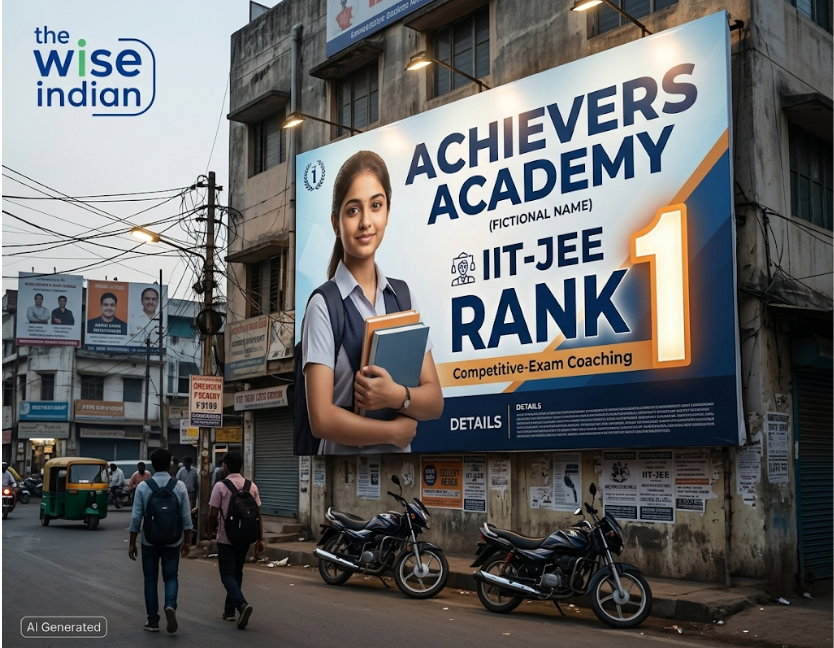
You have seen the hoarding: a student’s photograph, a rank, and the coaching centre’s name in the biggest letters on the board.
But what the hoarding may not tell you is how long that student actually studied there.
It could have been two years. Or it could have been a two-week test series.
That difference matters.
What the Rule Actually Says
In November 2024, the Central Consumer Protection Authority (CCPA) introduced rules for advertisements by coaching centres.
If a coaching centre features a rank holder or successful student in its advertisement, it must disclose three important details:
- Which course the student took
- How long the student took the course
- Whether the student paid for the course or received it free
The disclaimer must also be displayed prominently rather than being hidden in tiny print.
The coaching centre must obtain the student’s consent for using their result in advertising after the result, rather than taking such consent at the time of admission.
Why the Topper’s Course Matters
A topper’s photograph can make an advertisement look convincing.
But a student featured in the advertisement may not necessarily have completed the coaching centre’s flagship programme.
They could have:
- Taken a two-year classroom course
- Joined only a test series
- Used a free online course
- Joined the institute after appearing for the examination
So, when you see a topper advertisement, the rank alone does not tell the whole story.
The course, duration and payment status matter too.
What the CCPA Found
In May 2026, the CCPA fined Motion Education Pvt Ltd ₹10 lakh.
The institute had advertised a 51.02% success rate in JEE Advanced 2025 and a 91.2% success rate in NEET 2025.
The CCPA found that most of the students shown in those advertisements were enrolled in a free online course. Some had also joined only after writing their examination.
Career Line Coaching in Sikar was fined another ₹5 lakh in the same order.
Its advertisement claimed that more than 1,650 students had entered MBBS, IIT and other courses. The CCPA found that the institute had given different explanations about the period covered by that number.
Several students named in the advertisement had also signed up only for a test series.
How Widespread Is It?
By May 2026, the CCPA had issued more than 60 notices to coaching centres and fined 31 institutes a total of more than ₹1.39 crore.
That makes one thing clear: parents should not assume that every number or topper claim in a coaching advertisement tells the complete story.
Three Questions to Ask Before You Pay
Before paying a coaching centre, ask three simple questions.
1. Which course did the student in the advertisement take?
Make sure it is the same type of course you are being offered.
2. How long did the student study there?
A two-year programme and a two-week test series should not create the same impression.
3. Did the student actually pay for the course?
Ask whether the student paid the regular fee, received a scholarship or studied through a free programme.You should also ask how the institute calculated its success percentage.
After all, 51% of 40 students is not the same as 51% of 4,000 students.
If the coaching centre will not give you clear answers in writing, consider that a warning sign.
The Wise Take
Most parents have never heard of the rules governing coaching advertisements. That is exactly why these rules are easy to overlook.
The CCPA’s enforcement actions show that coaching advertisements can face scrutiny when their claims are misleading or incomplete.
So, the next time you see a topper’s photograph outside a coaching centre, don’t just look at the rank.
Ask: Which course did that student take, how long did they study there, and did they pay for it? Before you pay for a promise, check the story behind the topper.