
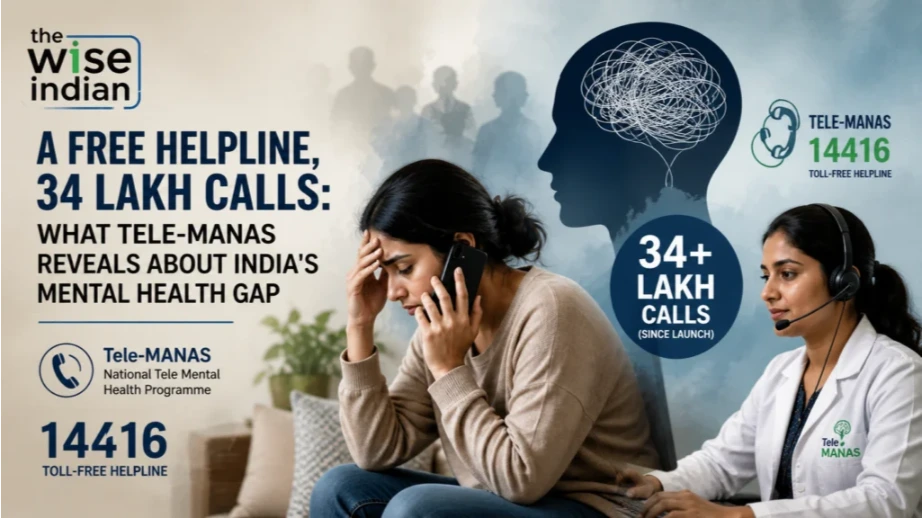
India’s national tele mental health service has become one of the world’s largest public programmes of its kind. Its call volume is both a success story and a diagnosis.
A helpline’s usefulness is usually measured by how many people it helps. It can also be read the other way, as a measure of how many people had nowhere else to go.
Tele-MANAS, India’s national tele mental health programme, was launched on 10 October 2022. By March 2026, a review published in a peer-reviewed psychiatry journal reported the service had handled close to 34.3 lakh calls.
How the Service Works
Tele-MANAS operates a toll-free helpline on 14416, also reachable as 1-800-891-4416, available around the clock at no cost. Services are offered in around twenty languages depending on the state.
Callers are connected to a trained counsellor and can be referred onward to a mental health professional. With consent, a video consultation can be arranged, and psychiatrists within the network can issue e-prescriptions where medication is indicated. The helpline model was chosen deliberately, because a phone call requires no appointment, no travel and no explanation to anyone at home, which removes three of the most common reasons people delay seeking help.
Follow-Up Rather Than a Single Call
One design feature separates Tele-MANAS from a conventional helpline. Counsellors are expected to follow up with callers, particularly those identified as higher risk, rather than treating each call as a closed interaction.
That continuity-of-care approach is harder to run at scale and matters more than call volume, because a single conversation rarely resolves what prompted it.
Who Is Actually Calling
Roughly seventy per cent of callers have been in the eighteen to forty-five age bracket, which covers working-age adults and students. Published analysis has also found a majority of callers to be male, with one study reporting fifty-six per cent.
Researchers have noted that this skew may reflect differences in phone access and help-seeking behaviour rather than differences in need, which means the pattern is a question rather than a finding. Understanding who is not calling is arguably more useful than celebrating who is, because a service that reaches one demographic well may simply be invisible to another.
The Gap the Numbers Point To
Structural barriers continue to limit access to mental healthcare in India, including distance, cost, low mental health literacy and stigma, with rural and underserved populations affected most.
Analysts have observed that many people wait months before seeking psychiatric help. Against that backdrop, a service reaching millions of callers is significant, and it is also operating alongside a shortage of trained professionals that a helpline alone cannot resolve. India’s mental health workforce remains thin relative to population, and expanding the number of trained counsellors and psychiatrists is the constraint that determines what happens after a first phone call.
The Wise Take
It is worth sitting with what 34 lakh calls actually represents. Each one was a person who decided, often after a long stretch of not deciding, that they needed to speak to someone. That the number is large is partly a story about a service working and partly a story about how few alternatives existed before it. Both readings are true. What the data suggests most clearly is that willingness to seek help was never the missing ingredient in India. Access was. Building the professional workforce that a scaled-up helpline eventually refers people to is the slower and less visible half of this work, and it is the half that decides outcomes.
This is a sensitive subject. If you or someone you know is struggling, Tele-MANAS can be reached free of charge on 14416, and speaking to a doctor or a trusted person is always a reasonable first step.