
A new national initiative asks gram panchayats to plan water the way they plan money. It draws on a decade of evidence that community-led groundwater management works.
Most Indian villages know precisely how much money they have. Far fewer know how much water they have, where it comes from, and how long it will last if the rain arrives late.
That gap is what the Water Sufficient Gram Panchayat initiative sets out to close. Launched by the Ministry of Panchayati Raj with the organisation PRADAN as knowledge partner, it asks village councils to prepare water budgets and fold water security planning into their development plans.
How the Initiative Is Structured
Water Sufficient Gram Panchayat has been identified as a theme under the Localisation of Sustainable Development Goals framework, which gives it a place in existing village planning rather than creating a parallel process.
The Ministry has said implementation will be phased. The first phase is reported to cover ten states, one hundred districts, one hundred blocks and one thousand gram panchayats, with a cadre of resource persons built from national to grassroots level.
Water Budgeting Explained Simply
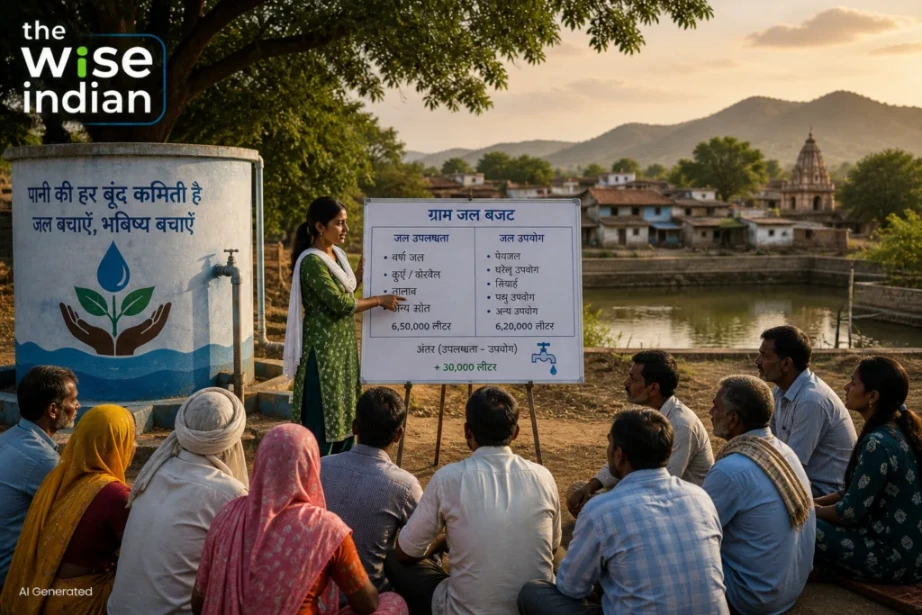
A water budget works much like a household one. A village estimates what is available from rainfall, surface storage and groundwater, sets that against what is being drawn for drinking, livestock and irrigation, and identifies the shortfall before it becomes a crisis.
The point is not the document. It is that decisions about cropping and extraction get made with the arithmetic visible to everyone in the village. Water budgeting also creates a record that carries forward. A panchayat that has tracked extraction for three consecutive years can see a trend, which is something no individual borewell owner can observe alone.
The Evidence Base It Builds On
The approach draws on Atal Bhujal Yojana, launched in 2019, which promotes decentralised water governance through annual water budgeting and operates across 229 groundwater-stressed blocks in seven states, covering 8,203 gram panchayats.
The government has said assessments conducted during 2023-24 and 2024-25 showed measurable groundwater improvement in 180 of the 229 participating blocks. As of March 2026, nearly 81,700 water conservation and recharge structures were reported created or restored under the programme.
Old Structures, New Tools
The programme also supports the revival of traditional water systems adapted to local conditions, including johads, bawdis, tankas, kalyanis and diggis, rather than treating conservation as a purely modern engineering problem.
Digital tools are being layered on top. A web application developed under an Indo-German water security project generates block-level water budgets by combining rainfall, land use, cropping pattern and population data. The mission’s Nari Shakti se Jal Shakti component has additionally promoted women-led institutions, including self-help groups and water users’ associations, within community water conservation efforts.
The Wise Take
Water schemes in India have rarely failed for want of construction. Structures get built; what often goes missing is the habit of collective accounting that keeps them useful five years later. Budgeting changes that quietly, because it turns an invisible shared resource into a number a gram sabha can argue about. That argument is the mechanism. A village that debates whether it can afford a second water-intensive crop is already managing its aquifer, whether or not anyone calls it governance. Phased rollouts are slow and the first thousand panchayats are a small share of the country. But this is the kind of slow that tends to hold.